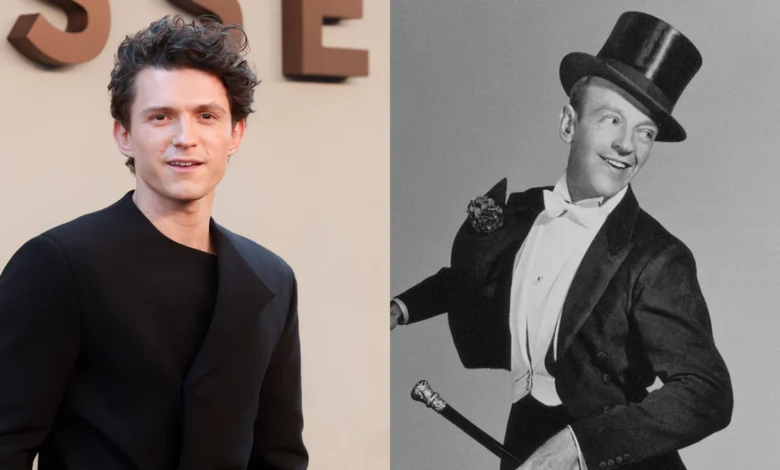
Tom Holland, the acclaimed 30-year-old actor currently commanding the summer box office with his dual roles in Christopher Nolan’s epic "The Odyssey" and the highly anticipated "Spider-Man: Brand New Day," is charting a course toward his most challenging artistic endeavor yet: embodying the iconic dance and film titan, Fred Astaire. This ambitious undertaking, announced five years ago by Sony Pictures, is set to explore the life and legacy of the golden age Hollywood luminary. Holland has confirmed that he has already commenced dance rehearsals for the untitled Fred Astaire drama, helmed by director Paul King, and intends to immerse himself further in rigorous training once his current promotional obligations for his summer releases conclude.
A New Chapter: Embracing the Challenge of Astaire
Holland articulated his perspective on this significant career shift during a recent appearance on "Good Morning America." He expressed a sentiment of evolving into a new phase of his acting career, one where the youthful roles he once inhabited are becoming less frequent. "I now feel like I’m starting this chapter where I can’t quite get away with being a teenager anymore, and for me, what I love about my job is the challenges," Holland stated. He emphasized his anticipation for the Astaire project, declaring, "We have Fred Astaire next, [which] is what we’re planning on doing. And as soon as I finish with these tours, I’m diving back into the dance studio."
The actor’s initial forays into preparation have been met with a potent mix of exhilaration and trepidation. "I did my first few rehearsals recently. And it both filled me with excitement and absolute dread because I’ve got so much work to do to try and do Fred proud," he confessed. This statement underscores Holland’s profound respect for Astaire and his commitment to delivering an authentic and reverent portrayal.
Honoring a Legacy: Holland’s Ambitious Vision
Holland’s dedication to honoring Astaire’s unparalleled artistry extends to his performance aspirations. He has voiced a strong desire to perform all the dance sequences himself, eschewing the use of doubles. Furthermore, his ambition is to replicate Astaire’s signature style of shooting dance numbers in single, unbroken takes, a testament to the precision and mastery Astaire was known for. "I have a desire to use no doubles. To do all of the dancing. To shoot those dances in one shot. How he would have done it," Holland explained, revealing a deep understanding and admiration for Astaire’s innovative approach to cinematic dance.
This commitment to authenticity is rooted in Holland’s own extensive background in dance. He gained significant recognition for his starring role as Billy Elliot in "Billy Elliot the Musical" on London’s West End, a demanding theatrical engagement that spanned from 2008 to 2010. His performance in the musical was critically acclaimed, showcasing his nascent talent and dedication to the craft of dance and acting simultaneously.
Reflecting on a Past Passion and Future Pursuit
In a separate conversation on "Live With Kelly and Mark," Holland reflected candidly on his decision to step away from dancing after his formative experience in "Billy Elliot." "One of my biggest regrets in my career is after I finished ‘Billy Elliot,’ I quit dancing," he admitted. This retrospective view highlights a lingering appreciation for the discipline and joy he found in dance, making the prospect of returning to it for the Astaire role particularly meaningful.
"To have an opportunity to get to re-explore that world that I loved so much, that I owe so much to," Holland elaborated, his voice conveying genuine enthusiasm. "I’m so excited for the challenge." This sentiment suggests that the Astaire biopic is not merely another acting role for Holland but a deeply personal and fulfilling artistic journey, allowing him to reconnect with a foundational element of his performing identity.
A Busy Summer and a Look Ahead
Holland’s current cinematic landscape is undeniably robust. "The Odyssey," in which he portrays Telemachus, the son of Odysseus and Penelope, has already premiered in theaters, drawing considerable attention for its ambitious scale and Nolan’s distinct directorial vision. Following this, his fourth solo installment as the web-slinging superhero, "Spider-Man: Brand New Day," is slated for release on July 31, promising another significant contribution to his already impressive filmography.
The juxtaposition of these high-octane, contemporary roles with the period biopic of Fred Astaire signals Holland’s burgeoning versatility and his willingness to tackle projects that demand a different spectrum of acting and physical prowess. The announcement of the Astaire film was initially made approximately five years ago, indicating a project that has been in development for a considerable time, allowing for meticulous planning and casting.
The Legacy of Fred Astaire: A Benchmark of Elegance and Innovation
Fred Astaire, born Frederick Austerlitz in 1899, remains one of the most influential figures in the history of dance and musical cinema. His partnership with Ginger Rogers in a series of RKO musicals in the 1930s defined an era, characterized by effortless grace, sophisticated choreography, and a seamless integration of song, dance, and narrative. Astaire’s innovative approach to dance on film revolutionized the medium, moving beyond staged routines to create sequences that felt organic to the story and character. He was known for his exceptional musicality, impeccable timing, and a unique ability to make complex movements appear utterly natural. His signature style, marked by tap, ballroom, and balletic influences, set a standard for elegance and technical brilliance that continues to inspire dancers and performers today.
Astaire’s career spanned over seven decades, earning him numerous accolades, including an Academy Honorary Award, a BAFTA Award, and two Golden Globe Awards. His impact transcended the screen; he influenced generations of performers and remains a cultural icon synonymous with class, charm, and unparalleled talent.
Director Paul King: A Proven Track Record in Character-Driven Narratives
The appointment of Paul King as director for the Astaire biopic is a significant factor in the project’s potential success. King is widely recognized for his masterful direction of the Paddington films, "Paddington" (2014) and "Paddington 2" (2017). These films were lauded for their warmth, wit, visual inventiveness, and their ability to craft deeply resonant, character-driven stories that appealed to both children and adults. His success in bringing a beloved literary character to life with such critical and commercial acclaim suggests he possesses the sensibility and skill to navigate the delicate task of portraying a historical icon like Astaire. King’s ability to blend humor with heartfelt emotion, coupled with a keen visual eye, bodes well for a biopic that aims to capture the essence of Astaire’s captivating persona and artistic contributions.
The Significance of Holland’s Dance Background
Tom Holland’s prior experience as a principal dancer in "Billy Elliot the Musical" is not merely a footnote; it is a crucial asset for this role. The rigorous physical demands of musical theater, particularly a role like Billy Elliot which requires extensive ballet and tap training, have instilled in Holland a strong foundation in dance technique. This background is invaluable when preparing to portray a legendary dancer like Astaire. While Astaire’s style was distinct and honed over decades, Holland’s existing discipline and understanding of movement provide a significant head start. His previous stage experience also equips him with the stamina and stage presence necessary for demanding performance sequences.
However, the transition from the contemporary choreography of "Billy Elliot" to the specific stylistic nuances of Fred Astaire presents a formidable challenge. Astaire’s routines were often characterized by a subtle fluidity and an almost conversational interaction with the music and his dance partners. Replicating this level of nuanced expression, especially with the intention of performing it live and in single takes, requires an extraordinary degree of dedication and technical mastery. The "excitement and absolute dread" Holland expressed are entirely warranted, reflecting the magnitude of the artistic undertaking.
The Broader Implications for Holland’s Career Trajectory
This role has the potential to mark a pivotal moment in Tom Holland’s career, signaling his maturation as an actor capable of taking on complex biographical subjects and demanding artistic challenges beyond his established superhero persona. By stepping into the shoes of Fred Astaire, Holland is not only aiming to pay homage to a cinematic legend but also to demonstrate his own artistic breadth and depth. Success in this role could solidify his reputation as a serious dramatic actor with exceptional physical talents, opening doors to a wider range of prestigious projects.
The choice to eschew doubles and perform all the dances himself is a bold statement of confidence and ambition. It aligns with a growing trend among some actors to embrace authenticity and push their physical and artistic boundaries. If Holland can successfully capture Astaire’s inimitable style and spirit, he will undoubtedly etch his own significant mark in the annals of cinematic biopics. The success of this film will likely be measured not only by its box office performance but by its ability to resonate with audiences as a compelling and respectful tribute to one of Hollywood’s most beloved and influential entertainers. The anticipation surrounding this project is palpable, as fans and critics alike will be watching closely to see how Holland navigates this demanding and iconic role.