The 250th anniversary of the United States, a milestone of profound historical significance, was marked by celebrations that were widely described as chaotic, disappointing, and overshadowed by a pervasive sense of political division. While previous national anniversaries, such as the 1976 Bicentennial, were characterized by grand parades, historical reenactments, and unifying national pride, the semiquincentennial under the current administration appeared to fall short of expectations, leaving many attendees and observers underwhelmed and frustrated. The contrast between past jubilant commemorations and the recent somber and disorganized events highlights a potential shift in how the nation engages with its foundational moments.
A Stark Contrast to Bicentennial Celebrations
The 1976 Bicentennial provides a compelling benchmark against which to assess the recent semiquincentennial. That year, the United States celebrated its 200th birthday with a series of elaborate events that spanned two years leading up to the official date. Queen Elizabeth II and Prince Phillip of the United Kingdom participated in tours, a symbolic gesture acknowledging the historical relationship and evolution of the nations. A spectacular naval parade stretched from New York City to Boston, symbolizing America’s maritime strength and history. Reenactments, such as a 50-wagon train retracing the Oregon Trail journey and a poignant recreation of George Washington’s crossing of the Delaware River, aimed to connect Americans with pivotal moments in their past. The iconic country singer Johnny Cash served as the Grand Marshal for the Fourth of July parade in Washington D.C., an event that also marked the inauguration of a new Smithsonian institution and the city’s first subway line, underscoring a spirit of progress and national unity. These celebrations were designed to be inclusive and educational, fostering a shared sense of identity and national pride.
Recent Celebrations Characterized by Disorganization and Division
In stark contrast, the recent Fourth of July festivities, intended to commemorate 250 years of American independence, were widely perceived as lacking substance and marred by logistical failures and political undertones. The National Mall, the traditional epicenter of national celebrations, hosted what was described as a lackluster "fair" with a commercial bent, featuring companies seemingly aligned with the "MAGA" political movement. This atmosphere was further complicated by the presence of white supremacist groups. On the morning of the Fourth of July, hundreds of members of the Patriot Front, a white supremacist organization, marched through Washington D.C. They were observed to be masked and carrying Confederate flags, and reports indicated they surrounded Black Americans on their public transit commutes.
Later in the day, following weather-related delays and a tense standoff between law enforcement and Trump supporters, the President delivered a late-night speech. This address, described by some as "bizarre," did not focus on the historical significance of the semiquincentennial but rather on a litany of grievances the President holds against the nation he leads. The planned fireworks display, which the President had touted as the largest in American history, was ultimately obscured by thick smoke minutes into the show, hindering visibility for the attendees who had endured the day’s challenges.
The President’s Role in Shaping the Anniversary
While the President could not control the extreme heatwave affecting the Eastern United States, the article’s author posits that the "hollow, depressing celebrations" were a direct result of his administration’s approach. The intent, according to the critique, was to create a curated "diorama of Americana" that instead devolved into a "walled-off petri dish of heat-struck fairgoers and lackluster performance." This perspective suggests that the true spirit of the nation’s achievements lies outside of the administration’s perceived manufactured realities.
Administration’s Focus on Personal Branding
Evidence suggests a deliberate shift in the planning and execution of the anniversary events, with a strong emphasis on personal branding by the President. The bipartisan "America 250" commission, established by Congress in 2016 to plan the semiquincentennial, was reportedly sidelined. Funds were allegedly diverted to "Freedom 250," a commission reportedly stocked with loyalists to the President. This redirection of resources and planning authority led to an anniversary that appeared to be primarily about the President himself. Reports indicate banners featuring the President’s face were displayed throughout Washington D.C., some with spotlights to ensure visibility. His image was also reportedly featured on passports, commemorative coins, and National Parks passes, suggesting a personalized appropriation of the national milestone.
The "Great American State Fair": A Corporate Spectacle
The "Great American State Fair," set up on the National Mall a week before the Fourth of July, was described as having the feel of a corporate expo rather than a traditional celebratory fair. The area between the Capitol and the Washington Monument was divided into pavilions for states, territories, government agencies, and corporate sponsors to showcase their offerings. While the concept might have aimed to evoke the spirit of expositions like the Chicago World’s Fair or a classic American carnival, attendees reported a distinct lack of traditional fair attractions such as funnel cake, balloon darts, or amusement rides.
For many, the primary activities involved waiting in lines, such as for the Ferris wheel, or experiencing "high sensory" exhibits like the Northrop Grumman sky tunnel. Collecting cheap trinkets and seeking refuge in air-conditioned spaces were also common pastimes. The article highlights the irony of a temporary structure, built from drywall and plaster, serving as one of the few sources of shade on the entire Mall. Amidst these conditions, emergency medical services were frequently called upon to attend to attendees succumbing to the heat.
Logistical Nightmares and Unpleasant Conditions
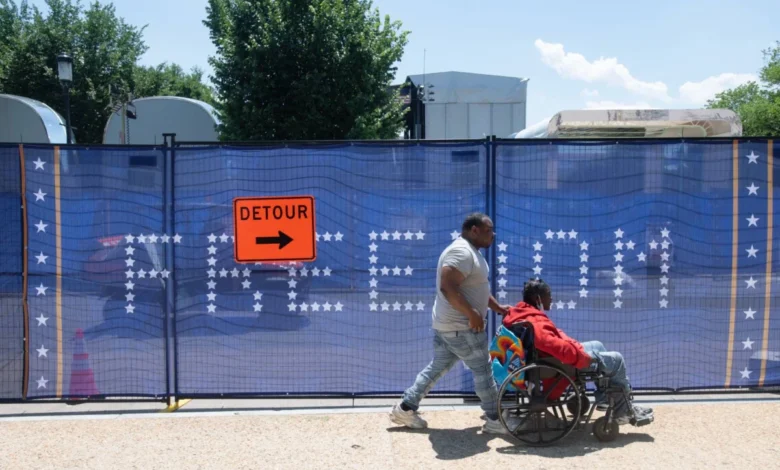
The extreme weather, including heat and storms, led to the postponement or cancellation of some events over the weekend. Compounding these issues were the logistical challenges on the National Mall itself. The vastness of the Mall, while aesthetically pleasing from above, proved difficult to navigate on foot. Security fences further complicated movement, forcing attendees to traverse lengthy perimeters to access different areas, even between adjacent museums. Visitors were observed clustered around sparsely located water fountains, seeking relief from the oppressive heat.
The security protocols at the fair also drew criticism. Backpacks, water bottles, and sunscreen were reportedly banned by event security, forcing attendees to discard essential items. Some states, like Ohio and Florida, offered popular giveaways such as free tote bags, sunscreen, and plush toys, drawing significant crowds. However, many state booths were described as generic, featuring patio furniture and simple backdrops, with some states declining to participate due to the perceived political takeover of the planning commission. Freedom 250 organizers reportedly provided these minimal setups, with some states, like Wyoming, offering only a sagging camping tent as their exhibit.
Administration’s Exhibits and Public Reception
The administration also had its own designated booths. One attendee, described as a father with his teenage sons, reportedly expressed his disappointment, stating, "this isn’t worth it," after a brief visit to the Department of "War" booth. They opted to skip collecting lanyards featuring cabinet agency logos. The overall sentiment was that many county fairs across the nation offered more entertaining and thoughtful productions.
The juxtaposition of the fair’s offerings with the world-class collections at the adjacent Smithsonian museums was particularly striking. Instead of a curated partnership that leveraged the nation’s historical wealth, attendees were presented with opportunities to register for a Truth Social account or enter a raffle for a "marriage retreat." When storms forced attendees to evacuate the fair, the Smithsonian museums, which the President has reportedly disparaged, opened their doors to the displaced crowds. The article suggests these visitors might have benefited from engaging with the actual historical exhibits.
A Monument to Narcissism and Missed Opportunity
Ultimately, the semiquincentennial celebrations were characterized as a "papier mache and printed vinyl monument to the greed and narcissism of one man." The surrounding Smithsonian museums housed artifacts representing the breadth and depth of American history and achievement: mammoth bones, bison skulls, lunar command modules, the Star-Spangled Banner, and works by Mary Cassatt. These were contrasted with the mundane offerings of the "Freedom 250" event, which included items like lunch counter stools from the Civil Rights movement and Abraham Lincoln’s top hat, all juxtaposed against what the article describes as a "heated purgatory" of the President’s creation. The author laments this as a glimpse of what the celebrations "could have been."
Artistic Reflection on the Nation’s Journey
Just a short distance from the fairgrounds, the National Gallery hosted an exhibition commemorating the anniversary, featuring Thomas Cole’s series The Voyage of Life. The painting Manhood was highlighted as particularly resonant. Cole’s accompanying text described this period as characterized by "trouble" and the lifting of "the golden veil of early life," leading to "deep and abiding sorrow." The painting itself depicts a man in a small boat surrounded by dark clouds and turbulent waters, a visual metaphor that the article suggests is fitting for the current state of the nation, with its "golden glow of our youth behind us."
The Path Forward: Confronting the Unacceptable
The article concludes by suggesting that while the President’s recent party was a failure, stepping outside its confines and engaging with the nation’s historical and cultural institutions reveals a different reality. The columns of Lincoln, the atrium of the Museum of Natural History, and the solemn exhibits of the Museum of African American History stand as testaments to the nation’s enduring spirit. The author posits that the only force that can truly bring the nation to its knees is its own "acceptance of the unacceptable," implying a call for vigilance and a refusal to normalize what is detrimental to the nation’s core values.