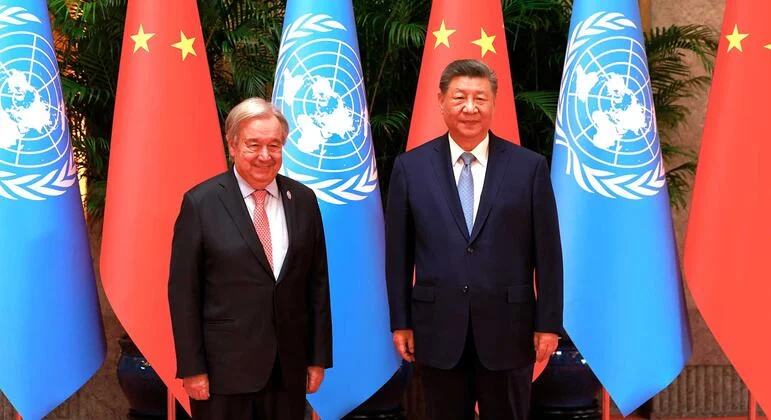
United Nations Secretary-General António Guterres issued a stark warning at the opening ceremony of the World Artificial Intelligence Conference (WAIC) in Shanghai, emphasizing that while artificial intelligence (AI) presents "humanity’s greatest opportunity in the 21st century," it also carries the potential to become "one of its greatest risks." The Secretary-General unequivocally stated that the technology poised to reshape the future of humanity must be shaped by all of humanity, not solely by a select group of powerful nations or corporations. He underscored the critical need for every nation to have a voice and a seat at the table in the ongoing discourse on AI governance, cautioning that without robust international cooperation, AI risks exacerbating global inequalities rather than fostering sustainable development.
The Shanghai Platform: A Global Stage for AI Dialogue
Mr. Guterres’s address at the World Artificial Intelligence Conference in Shanghai, a premier global event that convenes leading AI researchers, entrepreneurs, and policymakers, provided a significant platform for this crucial message. The WAIC, annually hosted in China, a nation at the forefront of AI research and application, serves as a nexus for discussing advancements, applications, and the ethical implications of AI. Its location in Shanghai, a burgeoning global innovation hub, symbolically highlights the geographical concentration of AI development and the importance of engaging major players like China in global governance efforts. Guterres’s presence underscored the UN’s commitment to ensuring that the benefits and risks of AI are addressed through a multilateral, inclusive lens, moving beyond the traditional technological and economic spheres to encompass global ethical and developmental concerns.
AI’s Dual Nature: Opportunity and Existential Risk
The Secretary-General elaborated on the inherent dichotomy of AI. On one hand, its potential to accelerate progress across numerous sectors is transformative. Medical breakthroughs, such as advanced diagnostics, personalized treatments, and drug discovery, stand to revolutionize healthcare. In education, AI can tailor learning experiences, provide universal access to knowledge, and bridge learning gaps. Agriculture can benefit from AI-driven precision farming, optimizing resource use and strengthening food systems against climate change. Furthermore, AI has the capacity to create entirely new industries and jobs, driving economic growth and contributing significantly to the achievement of the Sustainable Development Goals (SDGs) by 2030. These 17 goals, adopted by all UN Member States, address global challenges including poverty, hunger, health, education, climate change, and peace.
However, Guterres cautioned that this immense potential is shadowed by equally profound risks. The rapid, often unregulated, development of AI technologies raises serious concerns about ethical dilemmas, including bias in algorithms, privacy infringements, the spread of misinformation, and the potential for autonomous weapons systems. The concentration of computing power, technical expertise, and investment in a handful of countries and companies creates a dangerous imbalance, threatening to leave developing nations further behind and widen existing economic and social divides. This technological chasm could lead to "greater inequalities, greater divides in income, in opportunity, in security," fundamentally undermining the UN’s mission to foster a more equitable and peaceful world.
The Imperative for Inclusive Governance
Central to Guterres’s message was the insistence that AI governance cannot be left to a few powerful actors. He argued that the very nature of AI, as a technology with far-reaching societal and ethical implications, demands a governance framework built on broad international consensus and participation. This perspective counters the prevailing trend where a small number of technologically advanced nations and private sector giants largely dictate the direction and standards of AI development. The call for "every nation to have a seat at the table" is not merely rhetorical; it signifies a demand for genuine co-creation of norms, standards, and regulatory frameworks that reflect diverse values, priorities, and societal contexts from around the globe. Without such inclusivity, the risk of developing AI systems that perpetuate biases, infringe upon human rights, or exacerbate global power imbalances remains high.
UN’s Proactive Stance: A Timeline of Initiatives
Recognizing the urgency of the situation, the United Nations has significantly ramped up its efforts on AI governance over the past year. This proactive engagement reflects a growing international consensus that multilateral action is indispensable for navigating the complexities of AI.
A pivotal step in this chronology was the adoption of the Global Digital Compact. While not exclusively focused on AI, this initiative, endorsed by UN Member States, seeks to establish shared principles for an open, free, secure, and human-centred digital future. It provides a foundational framework for addressing digital governance challenges, including those posed by AI, emphasizing human rights, data protection, and digital inclusion.
Building on this, the UN General Assembly backed the establishment of the Independent International Scientific Panel on AI, marking the first global scientific panel dedicated to this revolutionary technology. Comprising leading experts from various disciplines and geographies, the panel’s mandate is to provide independent, evidence-based scientific and technical advice on AI’s opportunities, risks, and governance implications. Its formation signals a commitment to grounding AI policy in robust scientific understanding, ensuring that decisions are informed by the best available expertise.
Most recently, the first session of the Global Dialogue on AI Governance was convened in Geneva earlier this month. This forum brought together governments, civil society organizations, academia, and the private sector for open, transparent, and inclusive discussions on the myriad aspects of AI governance. These dialogues are crucial for fostering mutual understanding, identifying common ground, and exploring potential pathways for cooperative action. They serve as a vital mechanism for sharing expertise, promoting common standards, and, crucially, ensuring that developing nations, often underrepresented in global tech dialogues, have a stronger, more audible voice in shaping the technology’s future. Guterres stressed that the next critical phase must involve translating these commitments and dialogues into tangible, practical support, enabling all countries to harness AI’s rapid development for their own benefit.
Bridging the Digital Divide: A Global Challenge
The Secretary-General highlighted a fundamental obstacle to inclusive AI development: the persistent digital divide. He pointed out that "one-third of humanity is still offline," equating to billions of people lacking basic access to the internet, let alone the advanced digital infrastructure required to engage with AI. This stark reality means that a significant portion of the global population is already excluded from the foundational benefits of the digital age, further exacerbating their disadvantage in the era of AI.
Beyond mere connectivity, the concentration of essential resources for AI development—computing power, technical expertise, and investment capital—remains heavily skewed towards a small number of economically advanced countries and major technology companies. For instance, reports consistently show that the vast majority of private AI investment is concentrated in North America and Asia, particularly China, with European nations also making significant strides. African and Latin American countries, despite their potential, receive a fraction of this investment. This disparity means that many developing nations lack the fundamental infrastructure, skilled workforce, and financial resources to develop, adapt, or even effectively regulate AI systems, leaving them vulnerable to becoming mere consumers of technology designed elsewhere, potentially without regard for their specific needs or cultural contexts. Unless these profound disparities are actively addressed, AI risks deepening existing inequalities in income, opportunity, and security, creating a future where technological advancement benefits only a select few.
To help bridge these critical gaps, Mr. Guterres announced concrete initiatives. He noted that over 20 countries, including China, have already nominated centers to participate in a UN-supported Global Network for Exchange and Cooperation on AI Capacity Building. This network aims to facilitate knowledge transfer, skill development, and collaborative research, empowering developing nations to build their own AI capabilities. Furthermore, he revealed plans to soon present recommendations for a Global Fund for AI, a financial mechanism designed to provide resources for AI development and adoption in countries that lack the necessary investment. He urged governments worldwide to lend their full support to both these crucial initiatives, recognizing them as vital steps towards a more equitable AI future.
Guterres’s Three Pillars for Responsible AI
In his address, the Secretary-General outlined three overarching priorities for ensuring that AI serves the interests of all humanity: expanding capacity in developing countries, establishing robust international safety standards, and making AI more environmentally sustainable.
Firstly, expanding capacity in developing countries is paramount. This goes beyond mere access to technology; it encompasses empowering nations to build their own AI systems tailored to their specific data, languages, and cultural contexts. This localized approach is crucial to avoid a future where AI solutions are imposed from external entities, potentially overlooking unique challenges or perpetuating biases. Investment in education, infrastructure, and local talent development is essential for fostering self-sufficiency and genuine participation in the global AI landscape.
Secondly, the establishment of international safety standards is non-negotiable. Guterres called for governments to adopt common approaches to AI testing and risk management, firmly grounded in international law and human rights principles. This includes developing globally accepted benchmarks for AI system performance, transparency, accountability, and robustness. He stressed that "human rights must be protected," and critically, "humans must keep control over every life-and-death decision." This latter point directly addresses concerns about autonomous weapons systems and AI’s role in critical infrastructure. Furthermore, he emphasized a child-centric approach, stating that "no AI system should be put in a child’s hands before it has been proven safe." This highlights the particular vulnerability of children to unvetted AI technologies, from educational tools to social media algorithms, and calls for stringent safeguards.
Thirdly, Guterres addressed the often-overlooked but rapidly growing environmental footprint of AI. The training and operation of complex AI models, particularly large language models and advanced machine learning systems, consume vast amounts of energy. Data centers, which house the servers powering AI, are significant contributors to global energy demand and carbon emissions. The Secretary-General called on major AI companies to transparently disclose the environmental impact of their systems and to commit to powering their operations with renewable energy sources by 2030. He also urged governments to integrate clean energy strategies for AI into their national development plans, recognizing that sustainable AI is integral to achieving broader climate goals.
Broader Geopolitical and Socioeconomic Implications
The implications of Guterres’s call for inclusive AI governance extend far beyond mere technological development. Geopolitically, the concentration of AI power in a few states could solidify existing hierarchies or create new ones, potentially leading to a new form of digital colonialism where technological dependence becomes a tool of influence. Economically, unchecked AI could exacerbate wealth inequality, displace workers without adequate reskilling programs, and concentrate economic power in the hands of a few tech giants. Socially, issues of privacy, surveillance, algorithmic bias, and digital ethics pose profound challenges to democratic values and human autonomy.
The Secretary-General’s concluding remarks encapsulated the fundamental question facing humanity: "The defining question is whether that transformation will reduce inequalities or reinforce them. Whether it will concentrate power or expand opportunity." This succinctly frames the choice before the international community. Without collective, inclusive action, AI risks becoming a force that entrenches existing disparities and centralizes power, rather than democratizing access to progress and expanding opportunities for all.
Achieving global consensus on AI governance is undoubtedly a formidable challenge. Diverse national interests, varying regulatory philosophies, the rapid pace of technological change, and the inherent competitiveness of the tech industry all present significant hurdles. However, the UN’s sustained engagement, through initiatives like the Global Digital Compact and the Global Dialogue, demonstrates a recognition that the stakes are too high for inaction or fragmented approaches. The future of AI, and by extension, the future of humanity, hinges on the ability of nations to collaborate, share responsibility, and build a governance framework that ensures this powerful technology serves the common good.