The Ayanet pickup and the Gredos SUV revive Spain’s Galloper brand with a mix of Japanese components for the European market


The relentless expansion of new automotive brands originating from China has fundamentally altered the global landscape, inadvertently serving as a lifeline for defunct marques seeking a second chance in the modern marketplace. The latest beneficiary of this manufacturing paradigm shift is Galloper, a historically recognized Spanish nameplate once synonymous with rugged, Mitsubishi-based off-roaders during the 1990s. Today, a newly formed commercial entity known as Galloper Ibérica is orchestrating a resurrection of the brand, leveraging Chinese manufacturing capabilities, Japanese mechanical architectures, and Mitsubishi-engineered powertrains to target the competitive European utility vehicle sector.
This strategic revival centers on two distinct yet mechanically related ladder-frame vehicles: the Ayanet midsize pickup truck and the Gredos SUV. By tapping into established joint ventures in Asia, Galloper Ibérica aims to carve out a specialized niche for utilitarian, body-on-frame vehicles in markets increasingly dominated by unibody crossovers and electrified passenger cars.
A Complex Heritage: From Mitsubishi and Hyundai to Galloper Ibérica
To understand the strategic significance of the Galloper revival, one must examine the brand’s convoluted historical roots. For automotive enthusiasts who recall the European market of the late 20th century, the Galloper nameplate is intimately linked to the Hyundai Galloper. That vehicle was essentially a first- and second-generation Mitsubishi Montero—internationally known as the Pajero—produced under license by Hyundai in South Korea.

During the 1990s and early 2000s, before Hyundai fully consolidated its independent European sales networks under its own brand identity, the Galloper off-roader was imported into Spain by a dedicated entity named Galloper España. Intriguingly, these vehicles were distributed through the existing Mitsubishi dealer network and wore Mitsubishi emblems, creating a fascinating commercial loop where a Japanese SUV was re-engineered by a Korean manufacturer, imported by a third-party Spanish firm, and ultimately retailed with Japanese badges. The original model enjoyed a modest cult following before emissions regulations and changing market preferences forced its discontinuation in 2004.
Fast forward over two decades, and the newly established Galloper Ibérica has adopted a modern variation of this historical badge-swapping strategy. However, instead of relying solely on Korean partnerships, the resurrected brand looks eastward to China’s vast industrial complex, partnering with manufacturing heavyweights to build utility vehicles tailored for European compliance and consumer expectations.
Decoding the Lineup: The Ayanet Pickup and Gredos SUV
The mechanical DNA of the newly minted Galloper lineup reveals a deeply collaborative, globalized approach to automotive manufacturing. The vehicles are produced in China by Anhui Coronet under licensing agreements originating from Zhengzhou Nissan, a vital joint venture between Dongfeng Motor and Nissan.
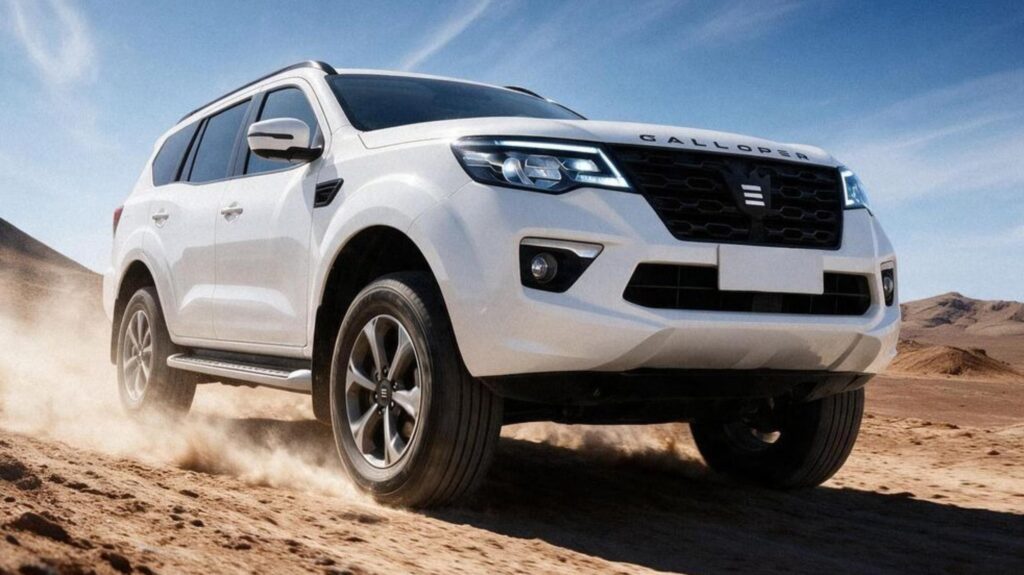
The Galloper Ayanet pickup truck is fundamentally a rebranded iteration of the Nissan Navara D23, a globally proven midsize workhorse. Meanwhile, its stablemate, the Galloper Gredos, serves as the pre-facelift version of the Nissan Terra, a rugged, ladder-frame SUV sharing structural underpinnings with the Navara.

Externally, Galloper Ibérica has exercised a light touch in terms of redesign. Modifications are largely restricted to prominent Galloper lettering adorning the front fascia and tailgate, alongside a proprietary emblem featuring three horizontal lines. Interestingly, this new badge has drawn visual comparisons within the industry to the corporate identity of Volkswagen Group’s SEAT, albeit with distinct proportions.
While the exterior sheet metal remains largely faithful to its Nissan origins, the cabin environments have been thoroughly modernized. Both the Ayanet and the Gredos incorporate expansive infotainment displays stretching across the center console—interior architecture directly shared with the Dongfeng/Oting Paladin models marketed in select Asian and Eastern European territories. This fusion of Nissan structural durability and contemporary Chinese digital integration creates a compelling proposition for commercial and private buyers seeking modern amenities without sacrificing traditional off-road capability.
Powertrain Engineering and Regulatory Compliance
One of the most significant departures from the standard Nissan donor vehicles lies beneath the hood. Galloper Ibérica has elected to discard the stock Nissan diesel and gasoline powertrains in favor of a specialized powerplant sourced directly from Mitsubishi.
Both the Ayanet and the Gredos are powered by a turbocharged 2.0-liter four-cylinder gasoline engine. This powerplant generates a healthy output of 218 horsepower (162 kW / 221 PS) and 360 Nm (266 lb-ft) of torque. Power is transmitted to all four wheels through an advanced ZF eight-speed automatic transmission paired with a BorgWarner four-wheel-drive system. To ensure genuine off-road credentials, the setup includes a dedicated low-range transfer case and a locking rear differential, making both vehicles serious contenders in demanding terrain.
From a regulatory standpoint, Galloper Ibérica has engineered the Mitsubishi-sourced powerplant to comply with current Euro 6 emission standards. However, looking ahead to the notoriously stringent Euro 7 regulations set to reshape the European automotive market, the company has already outlined plans to introduce mild-hybrid and liquefied petroleum gas (LPG) powertrain variants to safeguard the longevity of its lineup.
Production Roadmap and Commercial Strategy
The manufacturing footprint of the Galloper brand spans continents. Currently, the Ayanet and Gredos are assembled by Anhui Coronet in China under the regulatory framework of the Zhengzhou Nissan joint venture. However, Galloper Ibérica has indicated that this arrangement may be a stepping stone rather than a permanent fixture. Company executives are actively evaluating the feasibility of transitioning final assembly operations directly to Spain at a later date, a move that could potentially improve supply chain logistics and bolster local employment.
The commercial rollout is scheduled to commence aggressively. Market launch in Spain is officially slated for October, with subsequent expansion into broader European markets planned over the following months.
Pricing strategy will play a critical role in the brand’s market penetration. The Galloper Ayanet pickup will debut with a competitive starting price of €26,000 (approximately $30,300 USD), positioning it as an attractive alternative to established mainstream workhorses. The more passenger-focused Galloper Gredos SUV will start at €39,000 (approximately $45,400 USD). To support this ambitious market entry, Galloper Ibérica aims to establish a dedicated retail and service network comprising 60 specialized dealerships across Spain by the conclusion of the year.

Market Implications and Industry Outlook
The return of the Galloper brand highlights a broader, accelerating trend within the European automotive sector: the revitalization of dormant European nameplates through Asian manufacturing partnerships. As traditional legacy automakers pivot heavily toward electrification and higher price points, a notable market gap has emerged for affordable, combustion-powered, body-on-frame utility vehicles.
By combining the structural integrity of Nissan’s proven platforms, the off-road heritage associated with Mitsubishi mechanicals, and the cost-effective manufacturing scale of Chinese industrial partners, Galloper Ibérica is attempting to rewrite the playbook for niche brand revivals. Whether European consumers will embrace a resurrected Spanish badge built on Chinese soil remains to be seen, but the aggressive pricing strategy and robust mechanical specifications ensure that the new Galloper will not easily be ignored.