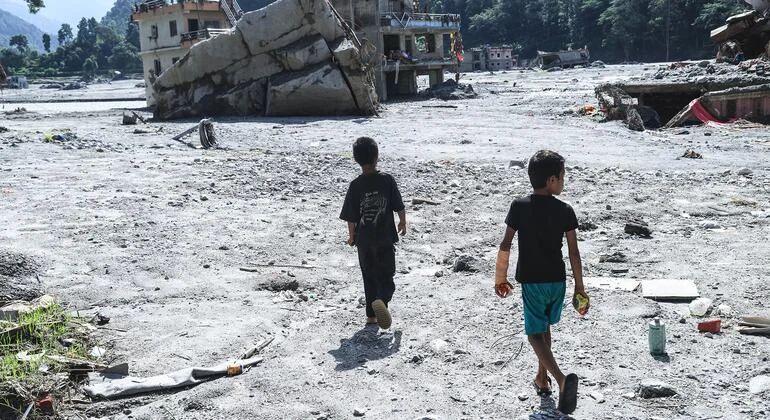
The catastrophic flash floods that swept through northern Nepal on the morning of August 26 have left behind a profound humanitarian crisis, extending far beyond the immediate physical destruction of infrastructure and homes. While emergency responders continue the arduous task of searching for the missing and providing basic necessities to the displaced, international organizations are raising urgent concerns about the psychological toll the disaster has exacted on the region’s youngest population. According to recent assessments by the United Nations Children’s Fund (UNICEF), thousands of children in the hardest-hit regions are in desperate need of specialized mental health and psychosocial support to process the trauma of the event, cope with the loss of loved ones, and navigate the destabilizing reality of displacement.
Triggered by a sudden and massive glacier collapse in the high Himalayas, the late-August disaster struck with terrifying speed, catching communities off guard at the very start of the school day. The resulting torrents of water, mud, and debris decimated critical infrastructure across the Rasuwa, Nuwakot, and Dhading districts of northern Nepal. Roads were pulverized, bridges swept away, and local power grids and water systems entirely disabled, cutting off entire communities from immediate external aid. Official tallies from local authorities paint a grim picture of the catastrophe’s human cost, reporting more than 1,300 deaths and over 5,000 individuals still unaccounted for on the Nepalese side of the border. Across the border in the Tibetan region, official Chinese Government figures indicate an additional 43 fatalities and 519 missing persons, underscoring the vast transnational scale of the glacial outburst flood.
A Chronology of the Disaster and Immediate Aftermath
The unfolding crisis began at precisely 8:37 a.m. local time on August 26, a moment when classrooms across northern Nepal were welcoming students for the morning session. The timing proved particularly devastating, as many children were either at school or on their way when the glacial lake outburst unleashed a wall of water and debris down the mountain valleys.
Within minutes, rushing water engulfed residential areas, agricultural lands, and educational institutions. Children caught in the path of the disaster were forced to flee for their lives, frequently witnessing the destruction of their homes and schools in real-time. Tragically, many also bore witness to the injury or disappearance of family members, friends, and teachers.
In the immediate aftermath of the event, local emergency services, augmented by national disaster management teams and security forces, mobilized to rescue survivors. However, the destruction of major roadways severely hampered search and rescue operations, leaving remote mountain communities isolated for days. As rescue teams slowly gained access to the worst-affected zones, the secondary humanitarian priorities rapidly shifted toward shelter, clean water, disease prevention, and family reunification.
By early September, relief agencies identified a particularly vulnerable subset of the affected population: unaccompanied and separated minors. UNICEF reported that at least 541 children remained separated from their parents or primary caregivers, heightening their exposure to exploitation, trafficking, and severe psychological distress. Concurrently, efforts began to establish temporary learning spaces and deploy medical personnel capable of addressing both physical injuries and the invisible wounds of trauma.
The Scale of Displacement and Vulnerability
The floods ultimately impacted more than 84,000 Nepalis, an estimated 32,000 of whom are children. For these young survivors, the disruption to their daily lives has been absolute. Displaced from their communities, thousands are currently living in temporary shelters, displacement camps, or with host families under highly precarious conditions.
The loss of physical infrastructure has compounded this instability. Nine schools across Rasuwa, Nuwakot, and Dhading were either severely damaged or completely destroyed, robbing children of the routine, safety, and socialization that educational institutions typically provide during times of crisis. Without structured environments, many children are left to ruminate on their experiences, amplifying feelings of helplessness and fear.
Furthermore, the displacement of families has strained local social protection networks. The separation of 541 children from their families represents an acute child protection emergency. In response, UNICEF and its governmental partners initiated accelerated family tracing and reunification protocols. To date, these efforts have successfully reunited 18 children with their families. For youngsters who have tragically lost both parents, child welfare agencies are actively arranging safe, alternative family-based care options while monitoring vulnerable households to prevent exploitation and abuse.
The Invisible Burden: Why Mental Health Support is Imperative
Physical injuries and damaged infrastructure are immediately visible, but the psychological scars inflicted by the disaster are far more insidious. Alice Akunga, the UNICEF Representative in Nepal, emphasized the gravity of this hidden crisis. "Beyond the visible destruction, these floods have left deep emotional scars on children and families," Ms. Akunga stated. "Alongside humanitarian supplies and restoration of critical infrastructure, children need mental health and psychosocial support to help them process what happened, regain a sense of security and begin to recover."
Medical professionals on the ground have corroborated these observations. Dr. Shitanshu Dhakal, a medical doctor at a regional hospital in Nuwakot and an active mental health advocate, described the heavy psychological weight carried by young survivors. Many children who witnessed the traumatic events are now exhibiting symptoms of severe anxiety, acute fear, grief-induced withdrawal, and selective mutism—some are entirely unable to speak about what they experienced.
"Children must be at the centre of the mental health response, with immediate psychological first aid and sustained support to prevent long-term consequences," Dr. Dhakal asserted.
Clinical evidence heavily supports this urgency. Mental health experts note that early psychological intervention is critical in disaster zones because it can prevent acute stress reactions from developing into lifelong, chronic mental health disorders such as post-traumatic stress disorder (PTSD), severe depression, and generalized anxiety disorders. By addressing trauma in its earliest stages, humanitarian workers can help restore a child’s emotional resilience and facilitate a healthier long-term recovery.
On-the-Ground Interventions and Child-Friendly Spaces
To combat the psychological fallout and protect vulnerable minors, UNICEF has scaled up its operational footprint in Rasuwa, Nuwakot, and Dhading. Working in close coordination with the Government of Nepal and local non-governmental organizations, the agency has established 13 specialized Child-Friendly Spaces (CFSs) within affected districts.
These Child-Friendly Spaces are designed to provide a safe, structured, and nurturing environment where children can play, interact with peers, and engage in recreational and educational activities under the supervision of trained facilitators. Crucially, these spaces also serve as hubs for psychological first aid, allowing professionals to identify children exhibiting severe trauma symptoms and refer them for specialized clinical counseling.
In addition to psychosocial programming, the operational response includes continuous monitoring by child protection teams. These teams operate within displacement sites to identify children at heightened risk of neglect, trafficking, or child labor, ensuring that protective measures are enforced swiftly and effectively.
Financial Commitments and the Educational Imperative
Recognizing that the restoration of normalcy depends heavily on the resumption of education, international funding bodies have begun mobilizing resources to support Nepal’s recovery. On Tuesday, Education Cannot Wait (ECW)—the United Nations’ global fund for education in emergencies—announced a critical US$1 million funding allocation aimed at sustaining hope and learning for children in the disaster zones.
The ECW investment is projected to directly benefit 17,000 children across Rasuwa, Nuwakot, and Dhading. Specifically, 5,000 children will receive targeted educational materials, formal learning support, and specialized protection services, while 12,000 will benefit from broader disaster risk reduction and community resilience interventions.
Despite this significant injection of capital, the sheer scale of the destruction means that much more financial backing will be required. Educational authorities have stressed that Nepal’s education system requires sustained investments from national governments, international philanthropic foundations, and the private sector to rebuild destroyed facilities and retrofit existing infrastructure against future climate shocks.
Maysa Jalbout, ECW Director of Education, underscored the vital linkage between education and crisis resilience. "With climate-related emergencies disrupting children’s education with increasing frequency, we must ensure that a temporary crisis does not turn into permanent learning loss," Jalbout noted.
Broader Implications: Climate Change and Vulnerability in the Himalayas
The glacial lake outburst flood that devastated northern Nepal is part of an increasingly alarming trend across the Hindu Kush Himalayan region. Rising global temperatures driven by climate change are accelerating the melting of Himalayan glaciers, leading to the rapid formation of unstable glacial lakes held back precariously by moraine dams. When these natural dams fail, the resulting glacial lake outburst floods (GLOFs) unleash catastrophic volumes of water downstream with virtually no warning.
The human and developmental implications of this environmental crisis are profound. As extreme weather events increase in frequency and severity, developing mountainous nations like Nepal find their hard-won development gains threatened by sudden ecological shocks. The destruction of schools, roads, water systems, and power grids not only sets back local economies by years but also places an unprecedented strain on national social security and healthcare systems.
For the children of Rasuwa, Nuwakot, and Dhading, the August 26 floods serve as a stark and painful introduction to the realities of the global climate crisis. The imperative to rebuild physical infrastructure is undeniable, but the international community’s response highlights a vital evolution in disaster management: recognizing that mental health and psychosocial support are just as essential to survival and recovery as clean water, food, and shelter.
As relief efforts continue on the ground, humanitarian agencies emphasize that sustained, multi-year commitments will be necessary to heal the psychological wounds of Nepal’s children. Ensuring that these young survivors receive the mental health care they need is not only a moral obligation but a fundamental prerequisite for safeguarding the future stability and resilience of the entire region.