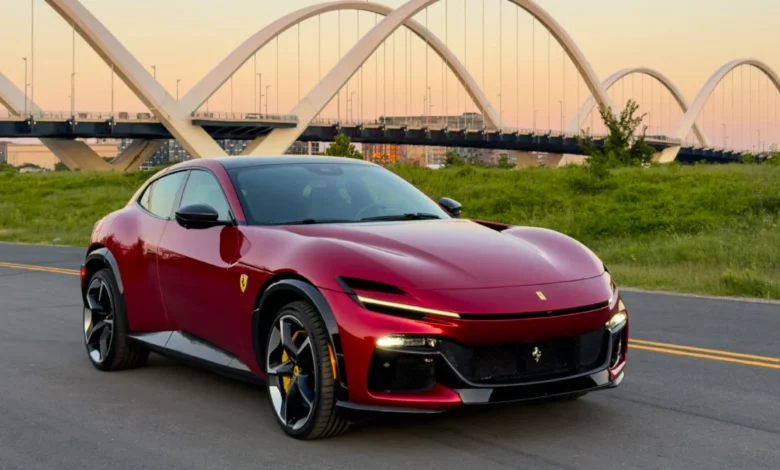
The automotive landscape has shifted dramatically over the past decade, with nearly every legacy manufacturer of high-performance sports cars eventually bending to the lucrative demands of the utility vehicle market. When Maranello finally announced its entry into this segment, purists gasped, yet the market responded with unprecedented enthusiasm. At a base retail price of $393,350, the Ferrari Purosangue represents a bold departure from traditional low-slung Italian exotics, blending the visceral roar of a naturally aspirated V12 engine with the practical layout of a four-door vehicle. However, as recent testing of a $576,544 heavily optioned model reveals, the ownership experience is defined as much by its mechanical brilliance as by its unique ergonomics, digital interfaces, and astronomical cost of entry.
Ergonomic Evolution: Physical Buttons Versus Capacitive Controls
One of the most immediate points of praise for the Purosangue interior is Ferrari’s retreat from the frustrating capacitive touch panels that plagued previous models, such as the 296 GTB. In that vehicle, touch-sensitive steering wheel controls often proved nearly unusable while driving dynamically. Fortunately, the Purosangue features actual physical buttons across most of its multifunction steering wheel.
This mechanical tactile feedback allows drivers to manage complex functions—such as interacting with Apple CarPlay—without ever taking their eyes off the road. When integrated, Apple CarPlay populates directly within the main instrument cluster stationed immediately in front of the driver, effectively sharing space with or replacing the traditional central tachometer. Yet, while steering wheel controls mark a step forward, the broader cabin ergonomics introduce a distinct learning curve.
Adjusting core comfort features like seat ventilation, climate control, and massage settings requires a departure from traditional layouts. Occupants must interact with a rotating controller that physically pops out of the dashboard, relying on precise swipes and taps across its tiny touchscreen display. While relatively straightforward while parked, adjusting fan speeds or temperatures via small touch targets while navigating traffic can prove challenging. A secondary, identical dial is positioned between the rear seats, granting back-row passengers the same level of granular climate and seat control.
Cabin Tech and Passenger Isolation
Infotainment architecture in the Purosangue breaks conventional industry standards by completely omitting a central dashboard display for the driver and front passenger to share. Instead, the vehicle incorporates a dedicated full screen exclusively for the front-seat passenger.
Engineered with heavy polarization and specialized filtering, this passenger display is invisible from the driver’s seat. This deliberate design choice ensures that the driver remains entirely undistracted by whatever media or navigation tasks the front passenger chooses to manage. Passengers can freely access native media applications via this dedicated screen, though they cannot mirror or project Apple CarPlay onto it, maintaining a distinct technological boundary between the driver’s ecosystem and the passenger’s interface.
Meanwhile, the rear passenger compartment offers a level of support and comfort that matches the front bucket seats. This stability is critical, given the high levels of lateral G-force the Purosangue can generate when pushed through corners by an enthusiastic driver.
Design, Customization, and Daily Usability
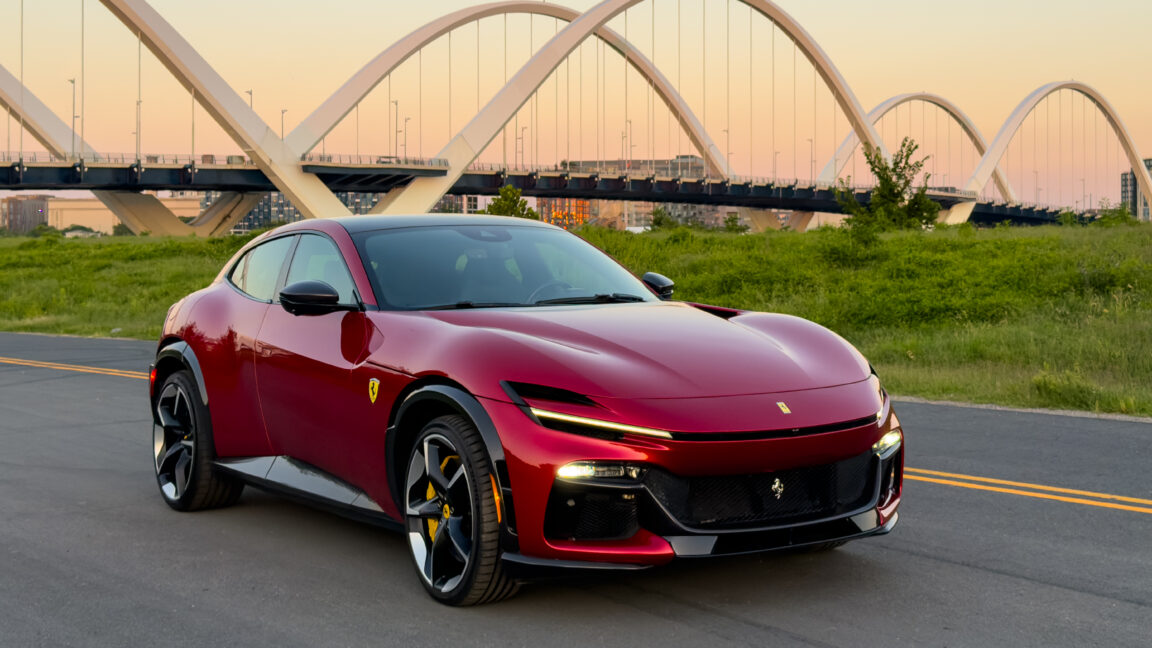
Finished in a lustrous Rosso Portofino paint that glitters intensely under direct sunlight, the tested Purosangue model commands attention far more effectively than some of the more muted metallic hues, such as the yellowy-green variants previewed earlier in Rome. Nevertheless, Ferrari’s bespoke customization programs—namely Atelier and Tailor Made—ensure that exterior paints and interior materials are virtually limitless, bounded only by a buyer’s financial capacity and imagination.
While few owners might initially consider a V12-powered Ferrari as a daily driver, the Purosangue is surprisingly accommodating in daily use. With the right set of winter tires, it could theoretically function as an exceptionally capable cold-weather tourer. However, its fuel economy presents a distinct hurdle for routine commuting. Averaging a combined 12 mpg (19.6 L/100 km), its thirsty 12-cylinder engine makes it far less suited for daily urban grind than upcoming battery-electric alternatives in the broader luxury sector, such as Ferrari’s anticipated EV initiatives. Instead, the Purosangue serves as a rolling showcase for sharing a classic V12 powertrain with family or friends on long-distance road trips.
Market Positioning and Financial Realities
The pricing structure of the Purosangue underscores its ultra-exclusive market positioning. While the baseline figure sits at $393,350, the inclusion of Ferrari’s extensive options catalog can rapidly inflate the bottom line. The test vehicle evaluated by automotive journalists climbed to $576,544, illustrating how quickly bespoke finishes, carbon fiber components, and enhanced interior options add up.
Compared to its traditional rivals in the ultra-luxury performance utility segment—such as the Aston Martin DBX and the Lamborghini Urus SE—the Ferrari commands a significant financial premium. Maranello has intentionally positioned the Purosangue above these competitors, leveraging its heritage, the rarity of its naturally aspirated V12 powerplant, and its status as the first four-door, four-seater production vehicle in the brand’s history.
Background Context and Evolution of the Maranello Utility Vehicle
The arrival of the Purosangue is the culmination of years of internal debate and shifting market dynamics within Ferrari. For decades, company leadership—most notably former CEO Sergio Marchionne—publicly resisted entering the utility vehicle space, insisting that a Ferrari must remain a low-slung sports car or grand tourer. However, the runaway commercial success of high-performance offerings from Porsche, Lamborghini, and Aston Martin proved impossible to ignore.
Development of the project, internally designated as the 175, began in the late 2010s. Ferrari engineers faced the daunting challenge of packaging a front-mid-mounted V12 engine while preserving the near-50/50 weight distribution characteristic of the brand’s sports cars. The solution involved mounting the transmission at the rear in a transaxle layout and pairing it with an advanced all-wheel-drive system derived from the FF and GTC4Lusso models. When the vehicle was officially unveiled in late 2022, global demand immediately exceeded production capacity, forcing Ferrari to temporarily close order books to manage the staggering backlog.
Broader Implications and Industry Impact
The Purosangue’s market reception highlights the shifting priorities of ultra-high-net-worth consumers, who increasingly demand everyday usability, cargo space, and all-weather capability without sacrificing elite performance credentials or heritage badges. By retaining a naturally aspirated V12 engine in an era dominated by turbocharging and electrification, Ferrari has managed to appeal to traditionalists while capturing a lucrative new demographic of buyers.
Despite minor ergonomic complaints regarding the pop-up climate dials and the complexities of the cabin interface, the Purosangue successfully proves that a high-riding vehicle can still deliver an authentic Ferrari driving experience. As internal combustion engines face tightening global emissions regulations, vehicles like the Purosangue stand as monumental achievements in engineering, balancing raw mechanical celebration with modern luxury demands—albeit at a price point reserved for the world’s most elite collectors.