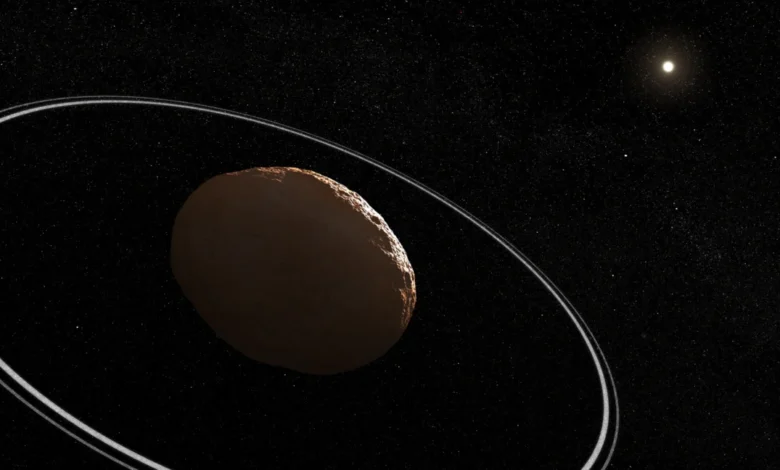
For decades, the conventional wisdom of planetary science held that magnificent, distinct rings were the exclusive domain of the Solar System’s gas and ice giants—massive titans like Saturn, Jupiter, Uranus, and Neptune. That long-standing paradigm was radically upended in 2013, when astronomers discovered a pair of dense, narrow rings encircling a tiny, dark centaur asteroid known as 10199 Chariklo. Measuring a mere 250 kilometers (approximately 155 miles) across, this minor body orbitally positioned between Saturn and Uranus defied expectations.
Now, more than a decade after that initial discovery, fresh observational data captured by the James Webb Space Telescope (JWST) has revealed an even more astonishing phenomenon: Chariklo’s rings are not static relics of a primordial collision, but are actively evolving, shifting, and changing density in real time.
The findings, published in the journal Science Advances by an international team of researchers led by astronomer Pablo Santos-Sanz of the Instituto de Astrofísica de Andalucías in Granada, Spain, offer a rare window into the dynamic and complex mechanics of small-body ring systems. By leveraging the unparalleled sensitivity of space-based infrared instrumentation, scientists are beginning to realize that ring systems across the Solar System—regardless of the size of their host bodies—may be far more dynamic than previously imagined.
The Anatomy of an Accidental Discovery
The story of Chariklo’s rings began inauspiciously through an astronomical technique known as stellar occultation. This method involves predicting the exact trajectory of a Solar System object as it passes directly in front of a distant background star from the perspective of Earth. As the minor body blocks the starlight, it casts a shadow across our planet. By meticulously measuring the sudden drop, duration, and recovery of the starlight, researchers can reconstruct the silhouette, size, and shape of the occulting body with remarkable precision.
In June 2013, a collaboration of European and South American astronomers utilized a network of ground-based telescopes across South America to observe an occultation of a star by Chariklo. To their profound astonishment, the light curves did not merely record a single dip caused by the asteroid’s body. Instead, they revealed two sharp, symmetrical drops in starlight just before and after the main occultation event.
These twin signatures indicated the presence of two distinct, highly confined ring structures, designated C1R and C2R. Located approximately 390 kilometers and 405 kilometers from the center of Chariklo, respectively, these rings measured only a few kilometers wide and were separated by a pristine, dark gap of roughly 7 kilometers.
The discovery stunned the astronomical community. Prior to 2013, planetary rings were theoretically thought to require the immense gravity wells of giant planets to clear gaps and confine particles within Roche limits. Finding a stable ring system around a body smaller than many terrestrial counties forced theorists to rethink the gravitational dynamics and collisional physics of the outer Solar System. Ever since, the central questions for researchers like Santos-Sanz have focused on the precise composition of these rings, their long-term stability, and the mechanisms preventing them from rapidly dissipating into space.
Peering Through the Cosmos with the James Webb Space Telescope
To answer these lingering questions, Santos-Sanz and his colleagues turned to humanity’s most advanced space-based infrared observatory: the James Webb Space Telescope. Observing Chariklo via stellar occultation from space, however, introduced an entirely new tier of technical and logistical complexity.
Unlike ground-based telescopes that can quickly adapt to minor adjustments in ephemeris data, JWST operates from the second Lagrange point (L2), roughly 1.5 million kilometers from Earth. Because of its distant orbit and the stringent operational constraints required to protect its delicate optics and sunshield, JWST observations must be locked in and planned at least 14 days in advance. Furthermore, flight controllers must periodically nudge the telescope to maintain its orbital stability.
Preparing for a targeted occultation in August 2022, the research team engaged in a high-stakes, iterative prediction process. Every single week leading up to the event, updated positional data for both Chariklo and the target star shifted the projected line of sight. Between the initial scheduling window and the final days before the observation, the calculated trajectory shifted by a dramatic 110 kilometers—a margin wide enough to miss the tiny asteroid entirely.
“We did this maybe a bit blindly, because we didn’t know exactly where the line of sight was,” Santos-Sanz remarked, reflecting on the operational tension. “I’m going to move one of the biggest, best telescopes in space, and we don’t know if finally we will catch this or not.”
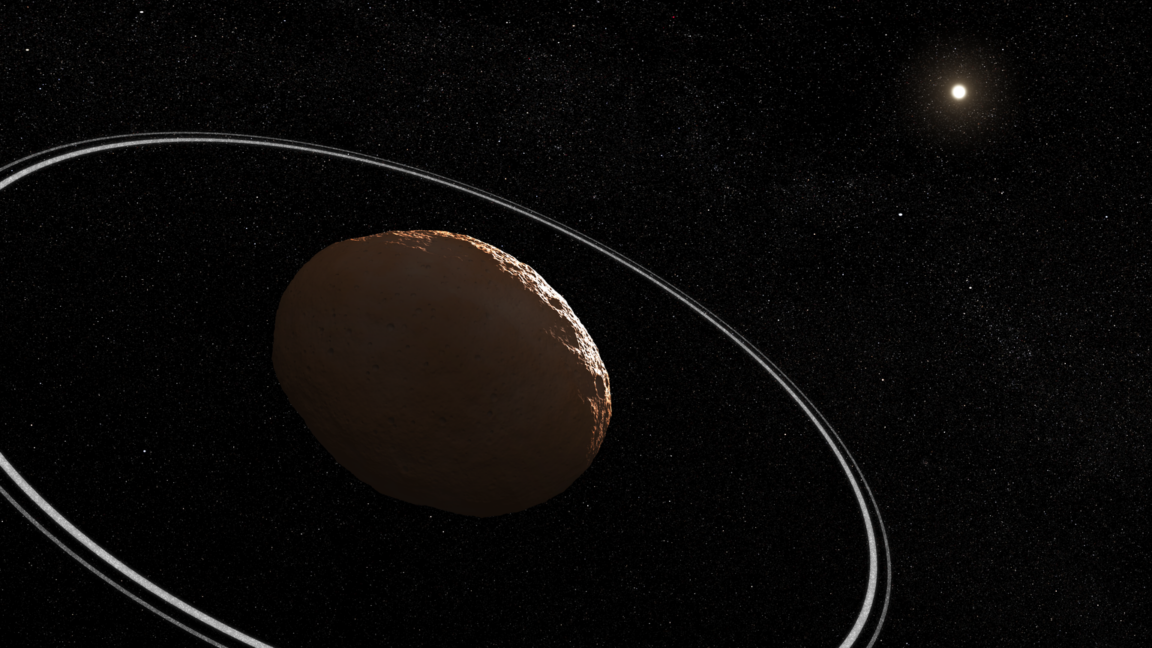
Despite the narrow margins, the calculated gamble paid off on October 18, 2022. Reconstructed geometric models of the event revealed that JWST’s line of sight skimmed a mere 7.4 kilometers above Chariklo’s rocky surface, completely missing the main body of the asteroid but slicing precisely through its intricate ring system.
Unprecedented Infrared Insights
The October 2022 observation marked a major milestone in planetary astronomy. JWST recorded the occultation simultaneously across two distinct near-infrared bandpasses: 1.5 micrometers and 3.2 micrometers. This achievement represented the first time scientists successfully captured the occultation of a minor body’s ring system at wavelengths exceeding three micrometers—a spectral range that is largely blocked or heavily absorbed by Earth’s moisture-rich atmosphere, rendering it invisible to terrestrial telescopes.
Upon analyzing the incoming data, the researchers encountered a startling anomaly. The inner ring (C1R) remained clearly visible with sharp, well-defined boundaries, but its optical properties had drastically altered.
For a decade, ground-based observations capturing roughly 10 previous stellar occultations had measured C1R’s normal opacity—the fraction of background starlight blocked by the ring particles—at a relatively consistent average of 0.303. When JWST measured the ring during the 2022 event, however, the opacity had spiked dramatically to 0.431.
“We didn’t believe it at the beginning, so we fought a lot with the data,” Santos-Sanz admitted, noting the initial skepticism of the research team.
To ensure the reading was not merely a statistical fluke or an observational artifact caused by cutting through an abnormally dense clump of material in a non-uniform ring, the team subjected their hypothesis to rigorous numerical testing. They constructed a sophisticated lumpy ring model and executed 10 million simulated occultations.
The statistical results were definitive. The probability of randomly reproducing an opacity value as high as the one recorded by JWST was approximately 1 in 1,000 for the 1.5-micrometer band, and a staggering 4 in 100,000 for the 3.2-micrometer band. Because the telescope successfully captured the inner ring twice—once as it entered the shadow and once as it exited—the cumulative odds against a random geometric coincidence became virtually insurmountable. The inner ring had undeniably grown thicker and denser.
The Mystery of the Fading Outer Ring
While the inner ring intensified, the outer ring (C2R) exhibited precisely the opposite behavior. During the same simultaneous multi-wavelength transit, C2R barely registered at the 1.5-micrometer band and completely vanished from detection at 3.2 micrometers.
“At the beginning we didn’t even see the outer ring in the light curve,” Santos-Sanz explained. “We had to use models. It was really barely visible, so we said, ‘What is happening here?’”
The research team evaluated two primary hypotheses to explain the dramatic discrepancy. The first suggested that the observation was primarily a wavelength-dependent optical effect, wherein dust grains and icy particles scatter infrared light at longer wavelengths differently than they scatter visible light.
The second hypothesis posited that the rings had undergone a genuine physical transformation. To test this, the team ran advanced radiative transfer models incorporating historical visible-light observations alongside the new JWST infrared data points. The models revealed that no combination of known particle sizes, compositions, or material mixtures—such as traditional blends of water ice and silicates—could adequately reconcile the older visual data with the new JWST profiles using a static-state assumption.
Consequently, Santos-Sanz and his colleagues concluded that the scientific community was observing real-time, physical evolution within the ring system. Interestingly, mass conservation calculations indicated that the material gained by the inner ring could not be entirely accounted for by material migrating inward from the fading outer ring; the inner ring had gained roughly ten times more equivalent width than the outer ring had lost.

Clues Point Toward a "Ghost Moon"
The realization that extra material was actively populating the inner ring without a simple transfer from the outer ring forced researchers to look for external sources. The leading theoretical framework to explain this phenomenon involves the gravitational influence of an undiscovered companion body.
Scientists suspect the existence of a small, embedded shepherd moon orbiting within or near the outer ring. Such a satellite would naturally explain the long-term containment of the rings, the maintenance of their remarkably sharp edges, and the continuous generation of fresh debris capable of replenishing C1R through collisional grinding or tidal disruption.
“This satellite has not been detected yet, if it exists,” Santos-Sanz noted cautiously.
Additionally, computer simulations utilizing JWST’s photometric data have begun to shed light on the physical composition and particle size distribution of the rings. The preliminary models suggest that C1R consists of larger, more substantial macroscopic particles, whereas the outer ring, C2R, is likely dominated by finer, highly reflective dust grains. However, the researchers emphasize that these compositional insights remain preliminary and subject to refinement as new observational campaigns are organized.
Broader Implications for Minor Body Dynamics
The confirmation that Chariklo’s ring system is actively evolving adds a new layer of complexity to the study of planetary dynamics across the Solar System. Historically, long-term structural changes were documented primarily in giant planet ring systems—such as the measurable shrinkage of Saturn’s delicate D ring or the ongoing rearrangement of Neptune’s Adams arcs over months and years.
Chariklo, however, is no longer an isolated oddity. In the years following its initial discovery, astronomers have identified ring systems or ring-like debris structures around other distant minor bodies, including the centaur Chiron, the dwarf planet Haumea, and the large trans-Neptunian object Quaoar.
The revelation that small-body rings can undergo significant structural transformations over the span of a single decade suggests that these distant systems are governed by delicate, highly active equilibria involving micrometeoroid bombardment, collisional cascades, and unseen gravitational shepherds.
To untangle the remaining mysteries, Santos-Sanz and his team are actively scanning ephemeris databases to identify and forecast future stellar occultations by Chariklo. By capturing subsequent events using visible-light instrumentation to pair alongside infrared datasets, researchers hope to definitively decouple true physical evolution from wavelength-dependent scattering effects.
“I think this work is just a piece of the puzzle,” Santos-Sanz concluded, “but it could be an important clue for broader studies about the rings around minor bodies and around giant planets.”
As observational techniques continue to advance, the rings of distant centaurs are proving that even the smallest worlds in our cosmic neighborhood can harbor surprisingly complex, dynamic, and ever-changing secrets.