For over a decade, American expedition leader Adrian Ballinger, founder of Alpenglow Expeditions, maintained a steadfast policy of avoiding the southern route of Mount Everest. His professional stance was rooted in a deep ethical commitment to climber and staff safety, citing the notorious Khumbu Icefall, the environmental degradation caused by human waste, and the logistical hazards inherent in the Nepalese side of the world’s tallest peak. For years, Ballinger advocated for the northern approach in Tibet, which offered a more controlled, vehicle-accessible, and stable environment. However, as of November 2026, a significant shift in strategy has emerged: Alpenglow Expeditions is now actively preparing to resume operations on the South Col, intending to lead expeditions on both sides of the mountain simultaneously.
This pivot is not merely a change in geographic preference but a response to the increasing instability of the northern route and the transformative potential of emerging technologies. By balancing operations between Tibet and Nepal, Ballinger aims to insulate his clients from the volatile closure policies of the Chinese government while leveraging recent advancements in aerial cargo transport to mitigate the traditional risks associated with the Khumbu Icefall.
The Shift in Strategy: A Response to Northern Instability
The primary driver behind this strategic realignment is the recurring and often unpredictable closure of the Tibetan side of Everest by the Chinese authorities. Since 2008, when the peak was shut down to facilitate the passage of the Olympic torch, the northern route has faced periodic closures that have disrupted the livelihoods of local mountain workers and the plans of international mountaineers.
The chronology of these closures reveals a pattern that has proven difficult for expedition outfitters to navigate:
- 2008: Total closure for the Olympic torch relay.
- 2016–2019: Sporadic restrictions and closures based on political and environmental concerns.
- 2020–2023: A prolonged, multi-year closure primarily driven by the COVID-19 pandemic and subsequent government policies.
- 2026: An abrupt cancellation in early March, leaving expedition teams with limited time to adjust logistics, pay staff, or coordinate with alternative operators.
Ballinger described the 2026 cancellation as a financial and logistical challenge that underscored the necessity of a backup plan. Despite the disappointment, Alpenglow committed to paying its Sherpa staff and guides their full salaries, reflecting the high standards of corporate responsibility expected in the high-stakes world of commercial mountaineering. This financial burden, coupled with the need to relocate clients to the south on short notice, served as the catalyst for the firm’s renewed presence in Nepal.

The Khumbu Icefall and the Drone Revolution
The most significant barrier to the southern route has historically been the Khumbu Icefall, a treacherous section of the glacier characterized by shifting, crumbling seracs and constant avalanche risk. Sherpa porters traditionally bear the brunt of this danger, making dozens of round trips to ferry essential supplies—oxygen, food, and tents—to Camp I and beyond.
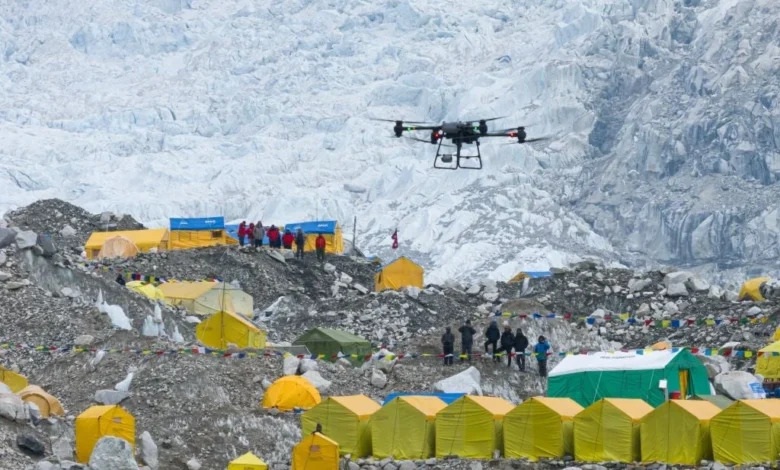
The emergence of cargo-carrying drone technology has fundamentally altered the risk-reward calculus of this route. In 2026, the deployment of heavy-duty drones by firms like Airlift Technologies marked a turning point in high-altitude logistics. These aerial vehicles, capable of transporting significant payloads from Base Camp (17,500 feet) to Camp I (19,900 feet), offer a potential solution to the "human cost" of the icefall.
The mechanics of this operation are complex. Piloting a drone through the thin, turbulent air of the Himalayas requires a dual-pilot system: one operator handles the ascent from Base Camp, while a second operator at a higher elevation takes control to navigate the craft past ice towers and rock faces to a secure landing zone. This technological intervention not only enhances safety for the local support staff but also speeds up the supply chain, allowing for more efficient expedition timelines.
Implications for the Future of Mountaineering
The integration of drones into the Everest ecosystem is not without its detractors or technical hurdles. The 2026 season saw a four-day grounding of cargo drones by the Nepalese government, highlighting the regulatory ambiguity that still surrounds the use of UAVs in high-altitude, sensitive regions. Furthermore, environmentalists have raised concerns about the noise pollution and potential for battery waste in a fragile, protected ecosystem.
However, from an industry standpoint, the implications are profound. If the South Col can be made safer and more efficient through the use of technology, the traditional, high-risk labor model of the Nepalese climbing industry may undergo a permanent transformation.
For Alpenglow Expeditions, the move to dual-side operations is a hedge against geopolitical risk. "We still consider the north side of Everest to be superior for our clients due to the stability and infrastructure," Ballinger noted. "However, the south side is now a necessary component of our long-term strategy. By operating on both, we ensure that a single government decision cannot unilaterally end our season."

Economic and Ethical Considerations
The decision to return to the south also brings the issue of "mountain ethics" back to the forefront. The South Col route has been heavily criticized for overcrowding and the accumulation of waste. While the use of drones may reduce the number of human trips through the icefall, it does not directly address the broader issues of trash management or the crowding of the summit ridge.
Industry analysts suggest that the return of high-end, safety-conscious operators like Alpenglow might actually force improvements in local standards. By working alongside established Nepalese agencies, these operators can influence better environmental practices and safety protocols. The economic impact is also substantial: with international climbers paying tens of thousands of dollars per permit and expedition, the ability to pivot between jurisdictions ensures that the local economy—from high-altitude workers to local service providers—retains a measure of stability that was previously threatened by sudden closures.
Looking Toward 2027 and Beyond
As Alpenglow Expeditions finalizes its plans for the upcoming season, the industry is watching closely. The success of the 2026 drone trials provides a template for future logistics, but the true test will be the integration of these systems into a broader, more ethical mountaineering model.
The strategy for 2027 is clear: maintain a presence in both Tibet and Nepal to ensure operational continuity. For the clients of Alpenglow, this provides a level of security previously unavailable in the high-altitude sector. For the local mountain workers of Nepal, the integration of drone technology may signal a new era of employment, one where the focus shifts from dangerous load-carrying to skilled technical support.
Ultimately, the convergence of geopolitical necessity and technological innovation is reshaping the way we interact with the world’s highest peak. As the industry matures, the traditional "expedition-at-all-costs" mentality is being replaced by a more pragmatic, technology-driven approach that prioritizes risk mitigation and professional resilience. Whether the South Col will ever truly rival the logistical consistency of the north remains to be seen, but for leaders like Ballinger, the path forward is clearly defined by the ability to adapt to a changing climate, both meteorological and political.