Australia avoid ODI series whitewash in South Africa with morale-boosting win in rain-affected Potchefstroom finale

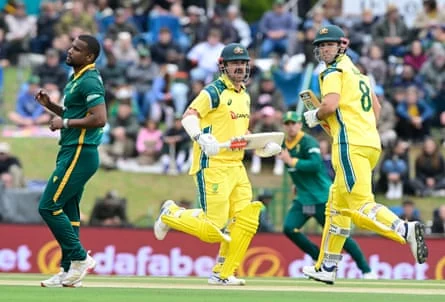
Australia successfully navigated a challenging tour of South Africa to avoid a clean sweep in the ODI series, securing a 45-run victory via the Duckworth-Lewis-Stern (DLS) method in the third and final match at Potchefstroom. The result provides a significant confidence boost for the tourists, who had struggled to mount successful chases in the opening two fixtures of the series. While rain ultimately curtailed the final contest under the lights on Wednesday, the clinical nature of Australia’s performance in the preceding phases of the game cemented a deserved win.
The victory was built on a collective batting effort that saw the visitors post a competitive 322-9, followed by a disciplined bowling display that left the Proteas at 145-4 when the elements intervened. The win marks a turning point for an Australian side that has been searching for consistency in their middle-order batting and rhythm in their spin department.
A Masterclass in Batting Recovery
Sent in to bat under overcast conditions, Australia’s top order sought to set an aggressive tempo from the first ball. Mitch Marsh, who has assumed the mantle of leadership in the absence of Pat Cummins, continued his rich vein of form. His 56-run contribution off just 42 deliveries underscored his status as the premier aggressor in the Australian lineup. This performance marked his third consecutive half-century of the series, following scores of 60 and 84 in the preceding matches.
Marsh and opening partner Travis Head established a foundation that was both rapid and damaging, putting on a 78-run stand at a rate of nine runs per over. Despite the early loss of Marsh to an lbw decision from Bjorn Fortuin and the dismissal of Cooper Connolly via a searing yorker from Gerald Coetzee, the middle order demonstrated uncharacteristic patience.
The emergence of 20-year-old Ollie Peake was perhaps the most significant takeaway from the innings. His 48-run contribution, paired with a vital 74 from Alex Carey, stabilized the innings. Carey’s knock was particularly crucial; the wicketkeeper-batter had been under pressure following a prolonged period of limited international returns. Having not scored a half-century in 17 innings across ODI and Test cricket since his century in the Adelaide Ashes Test last December, Carey’s 88-ball innings was a testament to his mental resilience and technical recalibration.
While Peake was denied a maiden international half-century by a spectacular diving catch from Fortuin at point, his composure suggests a bright future for the young prospect. The tail-end acceleration was somewhat stifled by Corbin Bosch, who finished with impressive figures of 4-60, but the target of 323 proved insurmountable for the Proteas on a tricky surface.
Tactical Shifts and South African Roster Management
South Africa entered the third ODI having already secured the series, prompting a strategic rotation of their squad. In a move aimed at managing player workload ahead of upcoming assignments, the hosts opted to rest captain Temba Bavuma and player-of-the-series Keshav Maharaj. These four changes to the playing XI appeared to disrupt the Proteas’ rhythm, particularly in the spin-bowling department, where Maharaj’s absence was acutely felt.
The Proteas’ chase never gained the required momentum. After losing Quinton de Kock to Xavier Bartlett—who removed the opener with a short-pitched delivery—and captain Aiden Markram to a perfectly executed swinging full-ball, the hosts were forced into a defensive posture. Ryan Rickelton stood as the lone pillar of resistance, finishing unbeaten on 71 off 81 balls, but he lacked the support necessary to challenge the required run rate.
Cummins Returns to Bolster the Attack
The return of Pat Cummins to the field provided an immediate psychological lift for the touring side. Though he relinquished the captaincy duties to Marsh for this specific fixture, his role as a frontline bowler was pivotal. Operating with precision and intent, Cummins bowled five probing overs for just 17 runs.

His performance was closely monitored by the Australian coaching staff, particularly with the opening Test of the series scheduled for October 9 in Durban. Cummins’ ability to hit the pitch hard and maintain a consistent line suggested he is returning to full match fitness. His presence served as a stabilizing force for a bowling attack that had been hampered by the absence of Nathan Ellis and Jack Edwards.
Injury Concerns and Tactical Complications
The match was not without its tribulations. Cameron Green, one of Australia’s most versatile assets, endured a physically demanding outing. During his time at the crease, he was struck by a sharp bouncer from Bosch, taking a fearful blow to his protective equipment. Despite the pain, Green courageously dispatched the subsequent delivery—another high full toss—for a six. However, his luck ran out shortly after when he was dismissed by a short ball, during which he appeared to sustain a muscle injury.
The injury necessitated that Green play no further part in the match as a bowler. This left Australia’s attack depleted, yet the remaining bowlers rose to the challenge. Xavier Bartlett, in particular, stepped into the breach with authority, finishing with 2-25 from his five overs, effectively dismantling the Proteas’ top order.
Statistical Context and Series Implications
The DLS victory serves as a critical morale reset for Australia. Throughout the first two matches, the team had struggled significantly in second-innings chases, often folding under pressure. By setting a high target and successfully defending it, the team has proven that their strategic approach to the 50-over format remains sound when the execution holds.
Key Statistical Summary:
- Australia: 322-9 (50 overs)
- South Africa: 145-4 (28 overs)
- Top Scorers: Alex Carey (74), Mitch Marsh (56), Ryan Rickelton (71*)
- Best Bowlers: Corbin Bosch (4-60), Adam Zampa (2-34), Xavier Bartlett (2-25)
The analysis of the series indicates that while Australia’s top-order power remains elite, the consistency of the middle-order has been the primary variable. Carey’s return to form provides a significant selection headache—in a positive sense—for the selectors as they look toward the upcoming Test series. For South Africa, the series win remains the headline, but the lack of depth shown in the final match may prompt a re-evaluation of their bench strength when facing high-intensity opposition.
Looking Ahead to the Test Series
The conclusion of the ODI series shifts the focus toward the red-ball format. With the first Test set for October 9, both nations will need to pivot their tactical preparations. For Australia, the performance in Potchefstroom provides a blueprint for resilience. The integration of young players like Peake, combined with the veteran experience of Cummins and the re-emerging form of Carey, offers a balanced squad profile.
Conversely, South Africa will look to reintegrate their senior leadership, including Bavuma and Maharaj, to regain the momentum they enjoyed earlier in the tour. The rain in Potchefstroom may have denied the spectators a tense final-hour finish, but it could not wash away the significance of the result for an Australian side that desperately needed to validate their efforts before moving on to the longer format of the game.
The transition from white-ball to red-ball cricket often serves as a litmus test for international squads. Australia’s ability to close out the ODI series on a high note suggests that the locker room atmosphere remains intact, a vital factor as they prepare to face the Proteas in the more demanding environment of the five-day format in Durban.