The Evolution of Aerial Cinematography: A Comprehensive Analysis of the Antigravity A1 Drone System

The landscape of aerial photography has undergone a significant transformation since the consumer drone market first emerged in the early 2010s. For years, the industry standard has relied on single-sensor, gimbal-stabilized cameras that capture forward-facing footage. However, the release of the Antigravity A1 in late 2025 has introduced a paradigm shift, effectively rendering traditional mechanical gimbals obsolete for a substantial segment of the creator economy. By utilizing a dual-lens, 360-degree capture system, the A1 allows for a "capture-everything" workflow that fundamentally changes how footage is composed, edited, and distributed.
Chronology of Development and Market Entry
The development of the Antigravity A1 follows a multi-year trend toward miniaturization and algorithmic stabilization. While traditional drones—such as the ubiquitous DJI Mavic series—dominated the market by prioritizing high-resolution, fixed-angle imaging, a secondary movement focused on "cinewhoop" style drones and 360-degree cameras sought to provide more immersive content.
In early 2024, industry analysts noted a plateau in traditional drone sales, as consumers expressed fatigue with the repetitive nature of standard "point-and-shoot" aerial footage. Antigravity Tech, an emerging player in the field, began prototype testing in mid-2024, aiming to solve two primary problems: the complexity of manual framing during flight and the logistical burden of registering aircraft over 250 grams. By the time the A1 was officially released in Q4 2025, the manufacturer had refined its "FlowState" stabilization software and perfected the 249-gram weight threshold, positioning the device as both a regulatory-compliant tool and a high-performance creative instrument.
Technical Specifications and Sensor Architecture
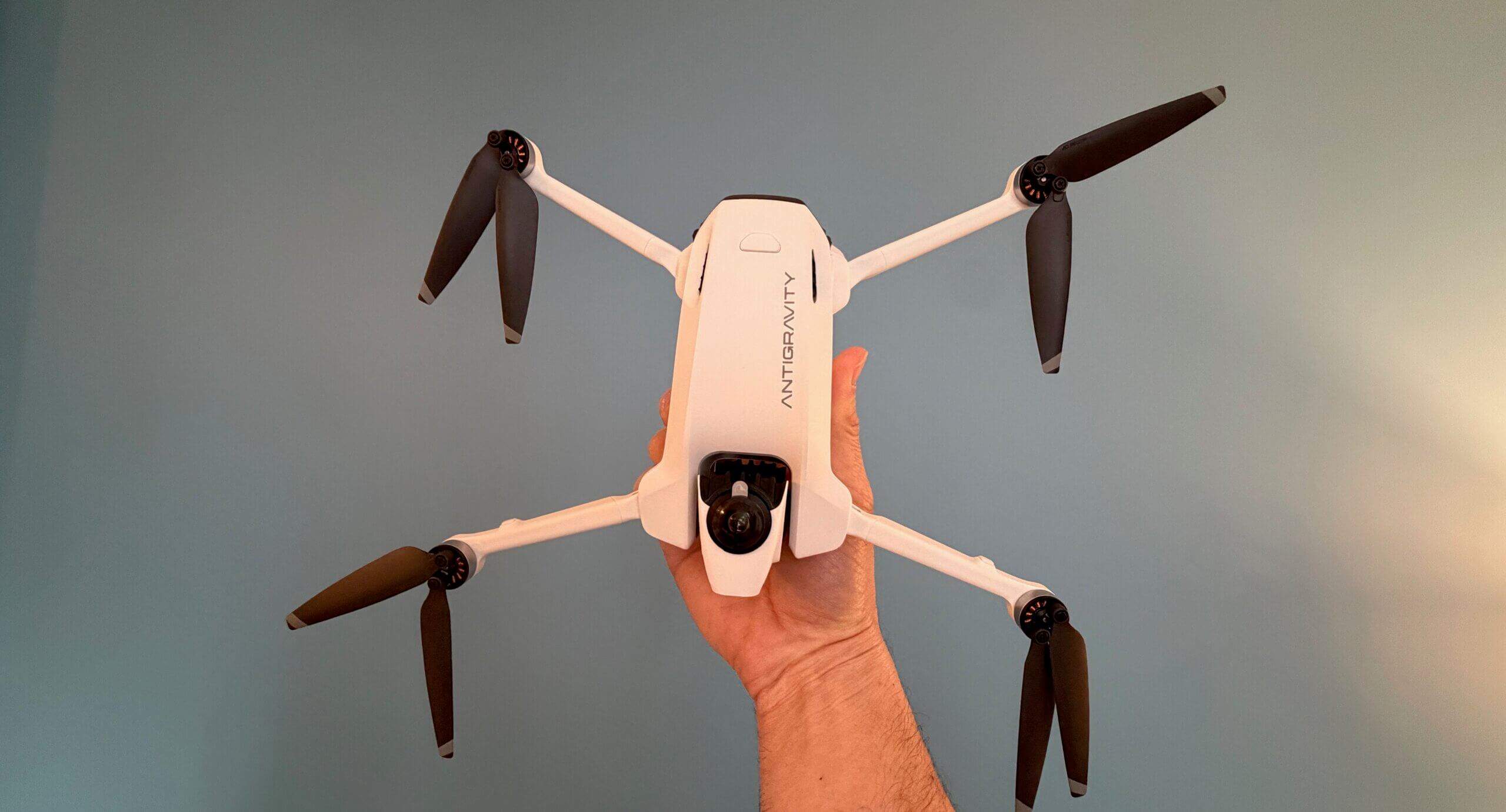
At the heart of the A1’s performance is its dual-lens array. Unlike standard drones that utilize a single camera mounted on a motorized gimbal, the A1 features two ultra-wide-angle lenses positioned on the top and bottom of the central fuselage. Each lens captures a 200-degree field of view, creating a 40-degree overlap. This redundant data is stitched together in real-time to create a seamless 360-degree sphere.
The hardware utilizes 1/1.28-inch CMOS sensors. While these are smaller than the 1-inch sensors found in top-tier professional cinema drones, they represent a significant advancement over the sensors historically found in 360-degree action cameras. The larger sensor size directly correlates to improved low-light performance and expanded dynamic range. In high-contrast environments, such as mid-day sun or deep shadows, the A1 is capable of retaining detail that smaller, legacy sensors would typically crush into absolute black or blow out into pure white.
A critical design choice by Antigravity was the strict adherence to the 249-gram weight limit. In many jurisdictions, including the United States (FAA) and parts of the European Union (EASA), drones weighing 250 grams or more are subject to mandatory registration and more stringent flight path restrictions. By keeping the A1 at 249 grams with its standard battery, the manufacturer has effectively lowered the barrier to entry for casual users while providing professional-grade stabilization for content creators.
The Shift Toward Virtual Directing
The A1 fundamentally changes the pilot’s role. Traditional drone operation requires a pilot to simultaneously manage the flight path, the altitude, and the camera’s pitch, yaw, and roll. The A1’s "fly now, frame later" workflow replaces this mechanical complexity with a post-production approach. Because the drone records the entire sphere of the environment, the user is essentially "directing" the camera after the flight has concluded.
This workflow is supported by the Antigravity Studio app, which allows users to wirelessly offload footage at speeds of up to 80MB/s. Within the app, users can utilize the gyroscope in their smartphone to "re-frame" the footage, moving their device to point at subjects of interest as if they were filming in real-time. This is supplemented by "Auto-Frame," an AI-driven tool that automatically identifies subjects and generates a sequence of cuts, keeping the primary focus consistent without manual input.
Flight Dynamics and Control Systems
The A1 is classified as a "cinewhoop," a style of drone characterized by its ducted propellers and focus on stable, controlled flight rather than high-speed racing. While the drone features a top speed of approximately 36 mph—sufficient for following cyclists or moving vehicles—its primary design goal is predictability.
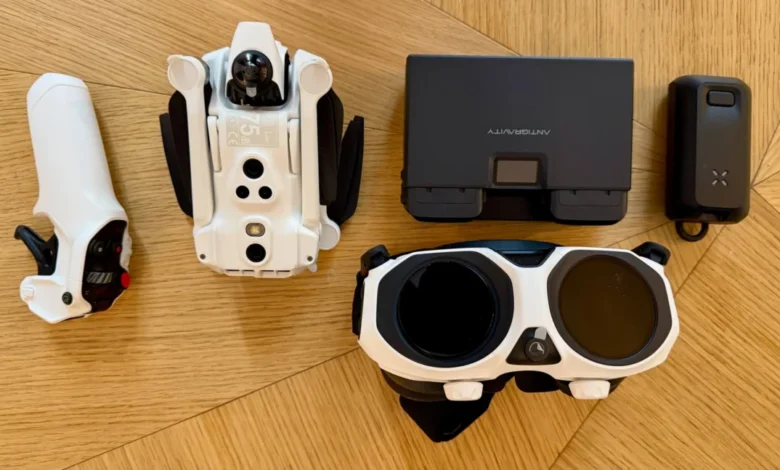
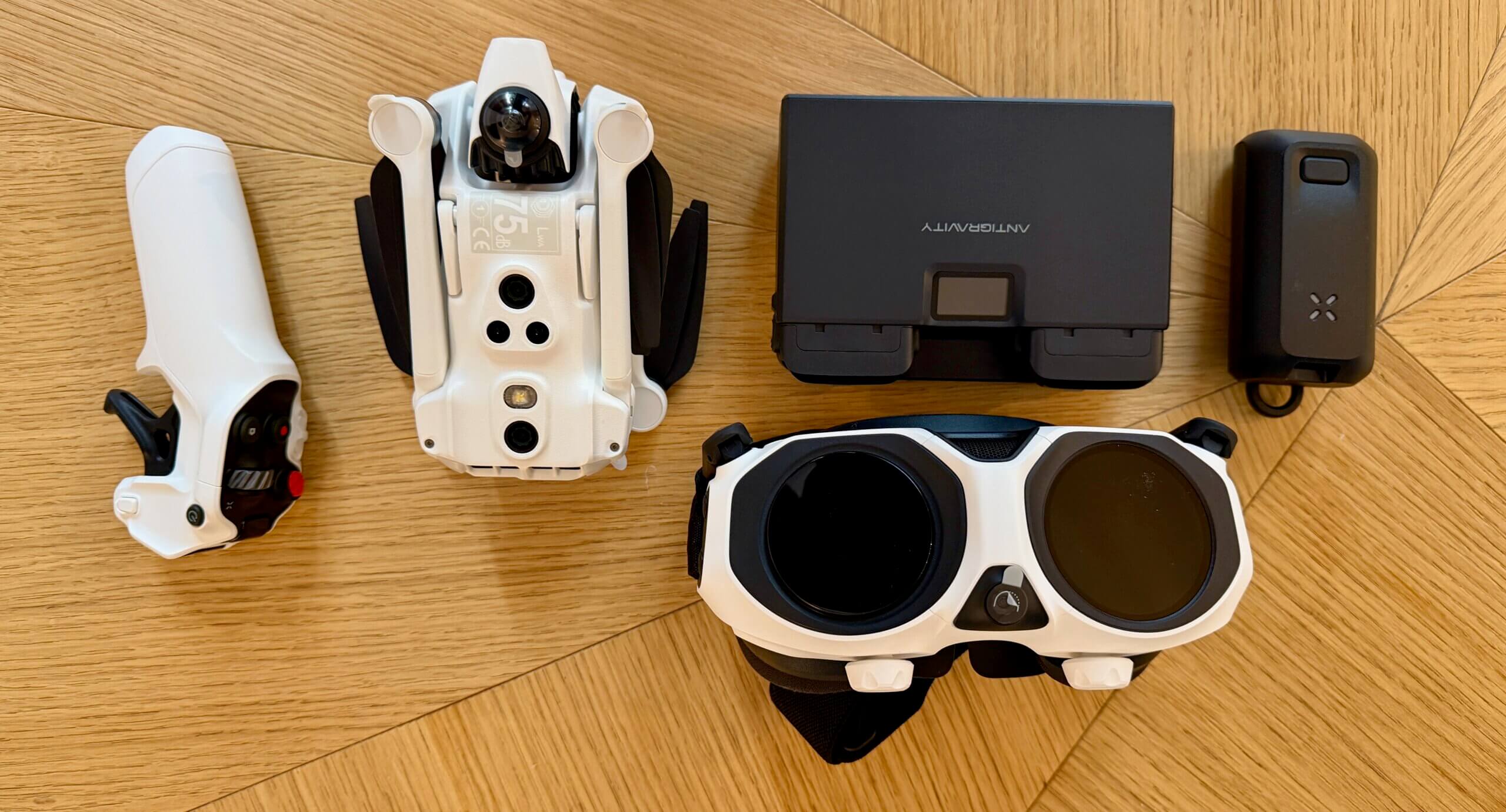
The control interface departs from the traditional dual-stick layout. The system utilizes a single-handed motion controller that mimics the orientation of the aircraft. Tipping the controller triggers a banking maneuver, while pulling the trigger controls acceleration. For experienced FPV (First-Person View) pilots who require the high-precision tactile feedback of a "Mode 2" stick controller, the A1 provides full compatibility. However, data from early adopters suggests that the intuitiveness of the motion controller has led to a significant increase in flight hours among novice users.
The "Vision Goggles" add to this immersive experience. Equipped with dual 4K micro-OLED displays and a 120Hz refresh rate, the goggles provide near-zero latency. Because the recording is 360 degrees, the pilot is not confined to the front-facing feed. Head-tracking technology allows the user to look around the environment while the drone is in flight, a feature that provides a level of spatial awareness previously unavailable in fixed-camera systems.
Industry Implications and Market Impact
The introduction of the A1 has implications that extend beyond consumer hobbyism. In the commercial sector, real estate agencies and tourism boards are increasingly utilizing 360-degree content to create virtual tours. The ability to capture an entire room or landscape in a single pass reduces the time required on-site, effectively increasing the productivity of professional videographers.
However, the technology is not without its limitations. The primary bottleneck, as with most small-form-factor aircraft, remains battery life. The standard intelligent flight battery provides approximately 20 minutes of real-world flight time, though this can be extended to 39 minutes with the "Pro" battery. The trade-off is weight; the Pro battery pushes the aircraft over the 250-gram limit, necessitating regulatory registration in most jurisdictions.
Furthermore, the delicate nature of the dual-lens system remains a point of concern for durability. While the carbon-fiber-reinforced polymer chassis provides a robust frame, the lenses are necessarily exposed. Antigravity has addressed this with a "Turtle Mode," which allows the drone to flip itself over if it crashes, potentially preventing damage to the rotors, but the lenses remain vulnerable in high-impact scenarios.
Future Outlook
As of early 2026, the Antigravity A1 stands as a bridge between traditional aerial photography and the emerging field of virtual reality (VR) content creation. By democratizing access to 360-degree flight, the device has challenged the incumbent market leaders to rethink the necessity of mechanical gimbals.
Industry analysts suggest that the next phase of development will likely involve the integration of more advanced obstacle avoidance sensors, which are currently limited in the A1 due to the constraints of the 249-gram weight limit. As sensor technology continues to shrink and battery energy density improves, the integration of 360-degree capture into standard commercial drones is expected to become the industry norm rather than the exception.
For the modern creator, the A1 represents a pivot from hardware-limited cinematography to software-driven creativity. By removing the technical burden of framing, the device allows the pilot to focus on the narrative elements of their project, marking a definitive evolution in the history of aerial drone technology. Whether the industry follows Antigravity’s lead or continues to iterate on traditional fixed-lens designs remains to be seen, but the impact of the A1 on the current landscape of digital media is already established.