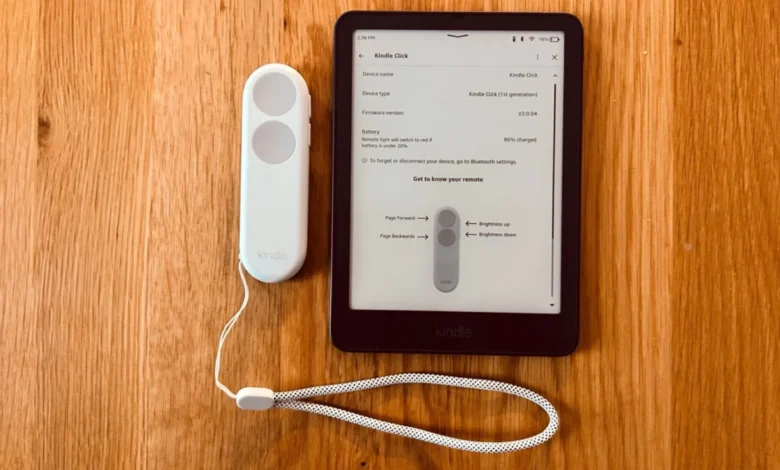
Amazon has long held a dominant position in the global e-reader market, serving as the primary gateway for millions of consumers transitioning from physical books to digital formats. Despite this market penetration, the company has historically faced criticism from power users and technology enthusiasts for moving slowly when it comes to hardware and software innovation. While competitors such as Barnes & Company, Kobo, and Boox have frequently pioneered features like temperature-adjustable front lighting and full-color electronic paper displays, Amazon has traditionally waited for these technologies to mature before adopting them into its own Kindle lineup. Furthermore, the company has maintained strict controls over its device ecosystems, historically limiting Bluetooth functionality exclusively to wireless headphones and preventing third-party hardware integration. This strategy of strict ecosystem control shifted significantly with the release of the Kindle Click, a proprietary Bluetooth page-turn remote designed specifically to bridge a long-standing gap in the Kindle user experience.
The absence of native remote-control support had been a persistent point of friction for Kindle owners, particularly as e-reader accessories gained widespread popularity across social media platforms like TikTok under the digital book-loving community known as BookTok. Prior to Amazon’s official entry into the peripheral market, users seeking hands-free reading experiences were forced to rely on external, clip-on mechanical devices. These third-party clickers attached physically to the bezel of the device, using a rubber-tipped stylus to simulate a human finger tapping the screen. While functional, these clip-on accessories presented notable drawbacks: they obscured portions of the text, could only advance pages in a single direction, and added bulk to otherwise sleek, lightweight hardware. Meanwhile, competing ecosystems like Kobo and Boox offered seamless Bluetooth integration, allowing users to pair sleek, dedicated remote controls without obstructing the display. The limitation on Kindle devices stemmed entirely from software restrictions, as hardware iterations released as early as 2018 already included the necessary Bluetooth chips for wireless audio connectivity, yet kept the protocol firmly locked down against non-audio peripherals.

The release of the Kindle Click marks a notable policy shift for Amazon, coinciding with a broader firmware update that opens up Bluetooth communication protocols on compatible devices. Retailing for approximately $35, the Kindle Click is a compact, dedicated remote control featuring a simple button layout designed to execute specific reading commands. However, hardware compatibility limitations remain a crucial factor for prospective buyers. The new firmware and the Kindle Click accessory itself are strictly limited to Kindle models manufactured in 2024 or later, such as the newly refreshed Kindle Paperwhite Signature Edition. Owners of older generations of hardware, regardless of their device’s physical Bluetooth capabilities, are locked out of the official accessory ecosystem unless they rely on the aforementioned mechanical clip-on solutions—though reports suggest select generic Bluetooth devices may find limited functionality under the updated firmware.
Evaluating the practical utility of a page-turn remote often requires context for non-users who view physical interaction with an e-reader as standard practice. Industry analysts and ergonomic specialists note that hands-free reading configurations serve distinct physical and lifestyle needs. The primary use cases involve scenarios where holding an electronic device is impractical or physically straining. Fitness environments represent a major demographic for page-turn accessories; reading a book while maintaining balance on an elliptical trainer or an indoor stationary bicycle makes manual page-turning difficult due to motion and vibration. By securing the Kindle to a console or a secure mount, users can maintain their reading pace via a compact remote held in hand or attached to workout equipment. Another prominent use case centers on ergonomic comfort during stationary leisure, such as reading in bed during cold weather while keeping arms comfortably tucked beneath heavy blankets or thermal covers. For avid readers, eliminating the minor physical friction of exposing one’s hands to cold air or shifting posture significantly enhances the overall reading experience.
From a functional standpoint, the Kindle Click operates through a streamlined setup process integrated directly into the updated device firmware. Users initiate pairing by holding a designated button on the remote, navigating to the newly added Accessories menu within the Kindle’s system settings, and selecting the device from a list of discovered hardware. Once paired, the remote maintains a stable connection whenever both devices are powered on and within range, eliminating the need for repeated manual synchronization. The device features prominent physical buttons that can be customized to advance or reverse pages according to user preference, alongside secondary side buttons dedicated to adjusting the brightness level of the device’s integrated front light. Despite these functional conveniences, early assessments highlight notable limitations regarding versatility. Unlike competing peripherals such as the Boox Tappy—which features multi-mode switches allowing users to control media playback, navigate browser windows, or jump between tracks in audiobooks—the Kindle Click is strictly confined to basic navigation within an open e-book. Notably, the accessory cannot be utilized to control Audible audiobooks, skip chapters, or manipulate the warmth settings of the display, leading critics to argue that Amazon missed an opportunity to deliver a more comprehensive control interface.

The strategic implications of the Kindle Click point to a gradual softening of Amazon’s walled-garden approach to hardware accessories, driven by consumer demand and competitive pressure from open-platform alternatives. By acknowledging the market demand for hands-free reading peripherals, Amazon has created a new revenue stream through proprietary add-on hardware while simultaneously modernizing its software infrastructure to accommodate standard industry expectations. However, the decision to restrict compatibility exclusively to devices manufactured in 2024 and later risks alienating a vast installed base of loyal customers who possess fully functional, slightly older hardware generations. As the e-reader market continues to evolve with increased consumer demand for cross-compatibility and ergonomic accessories, Amazon’s willingness to expand or restrict its firmware capabilities will likely remain a central factor in how users evaluate the long-term value of the Kindle ecosystem relative to its competitors.