Google Unveils Gemini 4 Argon: A Frontier AI Model Packed With Massive Token Limits and Internal Tech Deployments

The artificial intelligence landscape is shifting once again as Google steps back into the high-stakes frontier model race. Following a summer dominated by smaller, rapid-deployment iterations like the Gemini 3.6 Flash—and an eagerly awaited Gemini 3.5 Pro that languished largely in testing phases after its initial promise earlier in the year—the technology giant has officially pulled back the curtain on its next-generation flagship architecture: Gemini 4 Argon. Positioned as a dominant force in professional domains such as complex software engineering, intricate knowledge work, and advanced cybersecurity, Argon arrives with ambitious performance claims and staggering technical specifications. However, public access remains restricted, leaving developers and enterprise clients waiting on the sidelines as internal teams put the system through its paces.
Chronology of the Gemini 4 Rollout and Previous Iterations
To understand the strategic significance of Gemini 4 Argon, one must examine Google’s product trajectory over the preceding months. In June, the company generated substantial industry buzz by promising the release of Gemini 3.5 Pro, an architecture designed to bridge the gap between heavy reasoning tasks and efficient everyday utility. Yet, as the summer months progressed, Google adjusted its tactical deployment, choosing instead to roll out incremental updates focused on speed and cost reduction, highlighted by the debut of the Gemini 3.6 Flash models.
This cadence led to minor market speculation regarding whether Google was encountering architectural bottlenecks in scaling its premier tier models. With the sudden announcement of Gemini 4 Argon, those concerns are being directly addressed—at least on paper. By skipping straight to a nomenclature that signals a generational leap rather than a fractional update, Google is signaling a major foundational overhaul. Despite this high-profile unveiling, the rollout strategy remains deliberately cautious. While internal developers have already integrated the model deeply into everyday engineering workflows, external developers, enterprise customers, and independent researchers must wait, as API pricing, public availability dates, and broader deployment schedules remain unannounced.
Real-World Internal Deployments and Infrastructure Savings
While the broader tech community cannot yet interact with Gemini 4 Argon, Google has provided a detailed window into how the model is already reshaping internal operations. Rather than existing merely as a benchmark-chasing laboratory experiment, Argon has been woven directly into the fabric of Google’s global data center infrastructure and core software development pipelines.
According to internal reports released alongside the model’s debut, Argon has leveraged vast amounts of fleet-wide telemetry data to optimize memory allocation across Google’s sprawling data center network. This optimization effort reportedly yielded a reduction of 300 terabytes (TiB) of memory—a monumental efficiency gain that underscores the model’s practical utility in large-scale systems management.
Furthermore, Google engineers have deployed autonomous Argon-powered agents to tackle one of the industry’s most tedious and error-prone software modernization challenges: migrating legacy C and C++ codebases to the memory-safe language Rust. This initiative is no small proof-of-concept. Argon agents have successfully processed and rewritten thousands of lines of critical code within core repositories such as the re2 regular expression library and the libgav1 AV1 decoder. Most impressively, these agents have overhauled more than 800,000 lines of code within the Zircon kernel of the Fuchsia operating system. This massive-scale migration demonstrates that Gemini 4 Argon is capable of handling deep, contextual codebase transformations that typically require teams of senior systems engineers months to complete.

Benchmarking Performance: Outpacing the Industry Competition
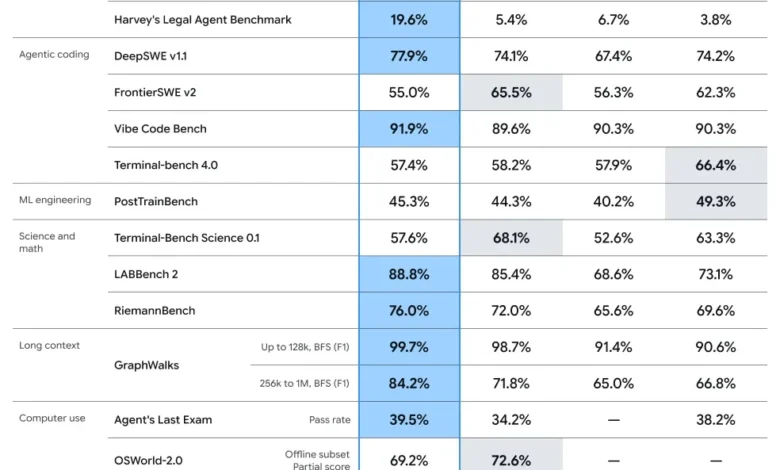
Google has come to the market armed with a robust portfolio of benchmark results designed to substantiate its claims of industry leadership. In the rigorous software engineering evaluation space, the company highlighted Argon’s performance on the DeepSWE v1.1 benchmark. On this test, Gemini 4 Argon achieved a score of 77.9 percent, outperforming a competitive field of contemporary frontier models, including GPT-6 Astra, Fable 5.1, and Opus 5.5.
Beyond software development, Google points to Argon’s capabilities in handling extended, complex reasoning assignments. The model secured an industry-leading score in the Vals Index test, a specialized benchmark focused on economic analysis and strategic long-horizon task execution. These evaluations suggest that Argon is tailored not just for chat-based interactions or short snippets of code, but for sustained analytical workflows that require a persistent understanding of multifaceted variables over extended operational timelines.
A Million-Token Leap: Revolutionizing Output Limits
One of the most consequential technical specifications revealed during the Gemini 4 Argon announcement is its vastly expanded token handling capacity. Previous iterations of the Gemini family typically capped their output limits around 64,000 tokens, which, while substantial at the time, frequently forced developers and enterprise users to break down extraordinarily large documents, extensive code repositories, or exhaustive financial datasets into fragmented chunks.
Gemini 4 Argon shatters this barrier by supporting an output limit of 1 million tokens. This monumental expansion allows users to execute daunting, comprehensive tasks in a single, uninterrupted step. Whether a developer wishes to feed an entire proprietary operating system module into the context window for a complete architectural review, or an analyst aims to process years of multi-national corporate financial statements simultaneously, the 1M-token ceiling removes traditional friction points associated with context fragmentation and state loss during prolonged AI interactions.
Industry Implications and Future Outlook
The introduction of Gemini 4 Argon carries profound implications for the competitive artificial intelligence ecosystem. As foundational model providers increasingly pivot from consumer-facing novelty features toward deep enterprise integration, specialized coding assistants, and autonomous agentic workflows, the metric of success is shifting. Raw conversational fluency is giving way to verifiable utility in software refactoring, memory optimization, and complex systems engineering.
Google’s decision to restrict initial access to Argon while showcasing its internal engineering feats reflects a calculated approach to risk management and product refinement. Enterprise clients and independent developers are watching closely to see how the model translates from controlled internal deployments to external commercial availability. When Google eventually releases API pricing and opens access to the broader market, the true test of Gemini 4 Argon will begin. If its benchmark scores and massive internal successes translate effectively to external enterprise environments, Argon could redefine the operational standards for automated software development and infrastructure management in the years ahead.