Historic Milestone Achieved as Pakistani Astronaut Muhammad Zeeshan Ali Completes Groundbreaking Mission Aboard China’s Tiangong Space Station

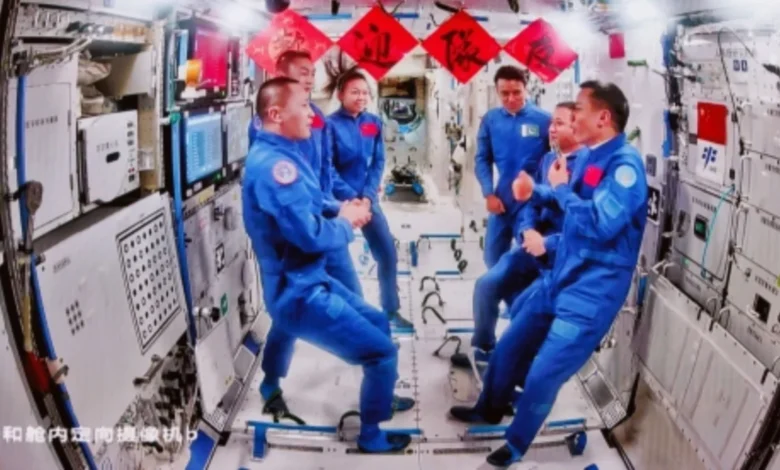
International space exploration entered a new era of cross-border collaboration late last month when Pakistani payload specialist Muhammad Zeeshan Ali stepped aboard China’s orbiting Tiangong space station. Serving as a milestone for both international cooperation in low Earth orbit and bilateral ties between Beijing and Islamabad, Ali’s journey marked the first time a foreign national has ever visited the Chinese orbital outpost. Though his stay in microgravity was remarkably brief, the operational, scientific, and geopolitical implications of the mission reverberate far beyond the confines of the three-module space complex.
The mission, officially designated as Shenzhou-24, lifted off from the Jiuquan Satellite Launch Center in the Gobi Desert on Tuesday evening, November 24. Propelled by a powerful Long March 2F carrier rocket, Ali roared into the final frontier alongside Shenzhou-24 commander Tang Hongbo and flight engineer Wu Yi. For Ali, a former military pilot turned payload specialist, the launch fulfilled a lifelong ambition while making him the first citizen of Pakistan to ever reach orbital space. While fellow compatriot Namira Salim previously crossed the Kármán line during a suborbital space tourism flight with Virgin Galactic in October 2023, Ali’s arrival at Tiangong represented the nation’s inaugural entry into sustained orbital human spaceflight.
A Chronology of the Historic Journey
The pathway to Tiangong began long before the roar of the Long March 2F engines pierced the Gobi desert skies. The framework for Ali’s historic flight was established in February 2025, when the China Manned Space Agency (CMSA) and Pakistani authorities signed a landmark bilateral agreement. This accord laid the legal and technical groundwork for foreign astronauts to train within China’s civilian space infrastructure and participate directly in crewed missions.
Training protocols for Ali were rigorous, requiring him to integrate seamlessly with his Chinese counterparts, master Mandarin terminology for spacecraft operations, and undergo intensive simulation training to prepare for the unique physical and psychological demands of long-duration spaceflight.
On November 24, 2025, the Shenzhou-24 spacecraft successfully docked with the T-shaped Tiangong space station, expanding the orbiting population to six individuals. Ali joined the resident crew of the ongoing Shenzhou-23 mission—commander Zhu Yangzhu, pilot Zhang Zhiyuan, and payload specialist Li Jiaying—who had been aboard the station since late May.
During his whirlwind operational window, Ali did not merely serve as a symbolic passenger. He actively participated in four joint Chinese-Pakistani scientific experiments, focusing on material sciences, life support technologies, and microgravity physiology.
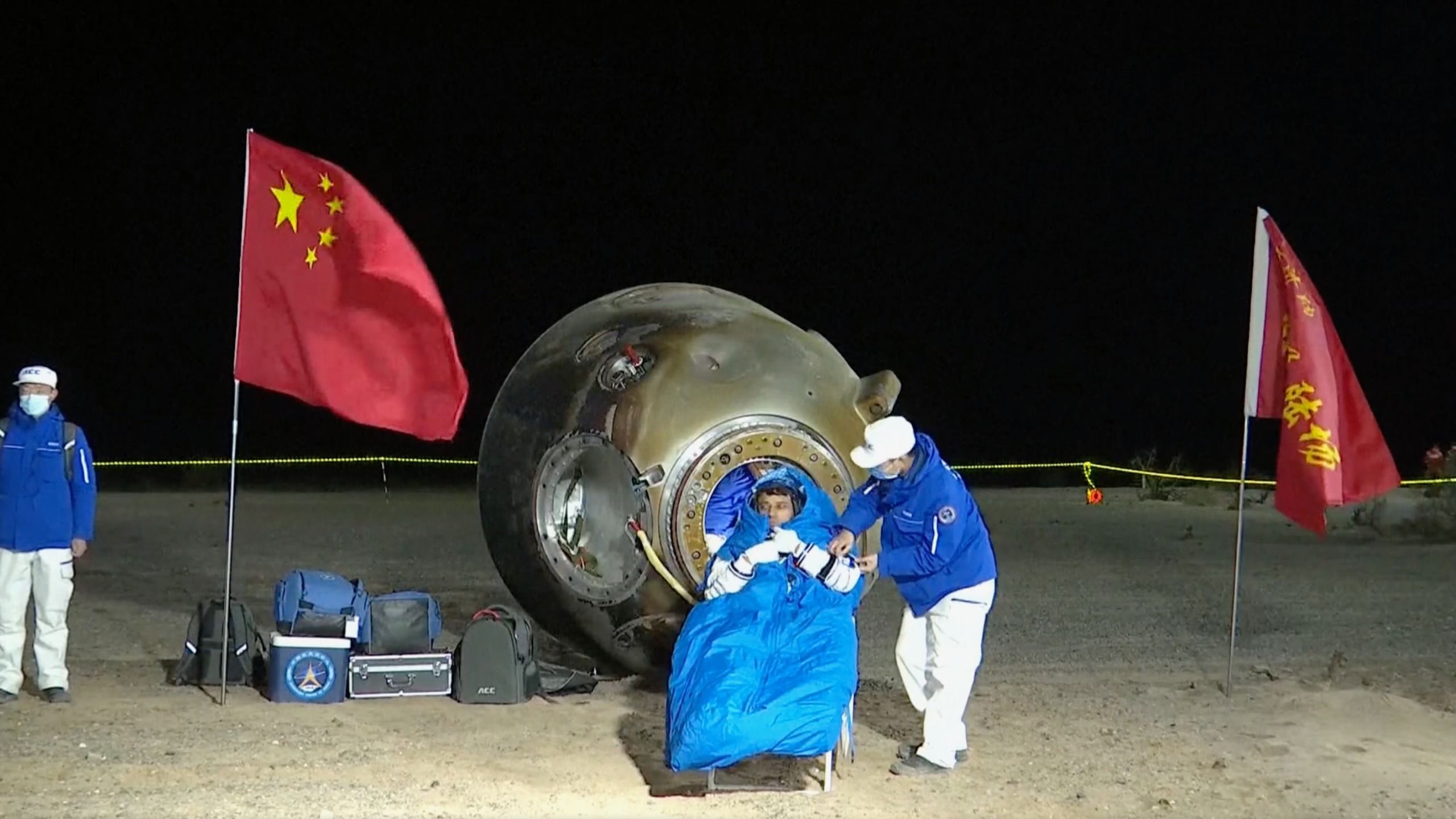
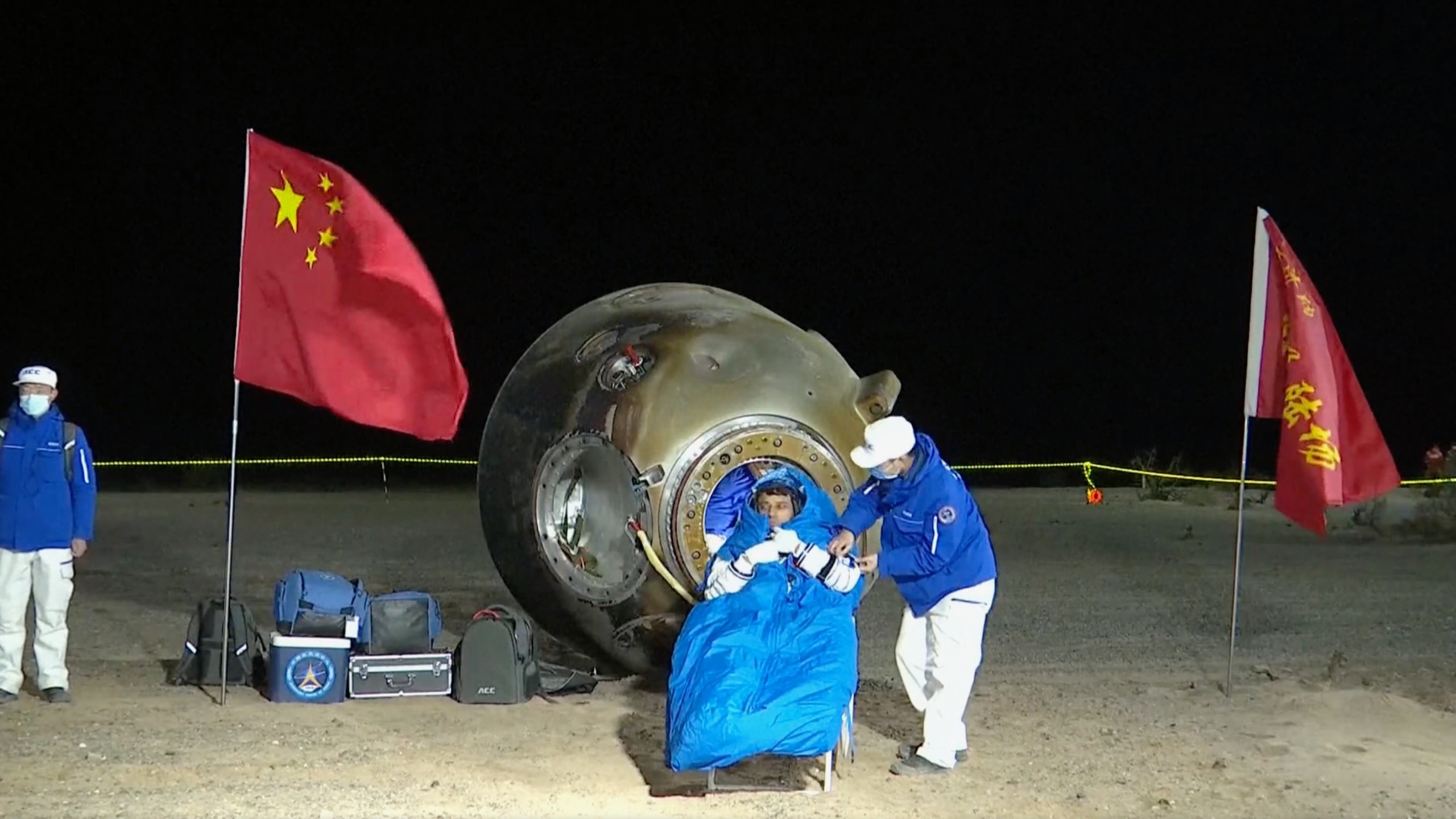
After completing his mission objectives, Ali transitioned to the returning Shenzhou-23 spacecraft alongside Zhang Zhiyuan and Li Jiaying, who were concluding their standard six-month rotation. The spacecraft successfully undocked from Tiangong and parachuted down to the Dongfeng landing site in northern China, concluding a tightly orchestrated handover and return sequence.
Structural Operations and Crew Rotation Dynamics
The logistics of the Shenzhou-24 and Shenzhou-23 crew swaps highlight the growing sophistication and maturity of China’s human spaceflight program. While Ali and two members of the Shenzhou-23 crew returned to Earth, Shenzhou-23 commander Zhu Yangzhu remained aboard Tiangong. Zhu will integrate with the incoming Shenzhou-24 crew, setting the stage for a monumental achievement in Chinese space history: Zhu is slated to spend a continuous year in orbit, returning to Earth approximately six months from now alongside Tang Hongbo and Wu Yi.
This extended-duration mission structure allows Chinese aerospace physiologists and medical researchers to gather vital longitudinal data regarding the long-term degradation of human bone density, muscle mass, and cardiovascular health under microgravity conditions—data traditionally dominated by research conducted aboard the International Space Station (ISS).
Upon exiting the Shenzhou-23 re-entry capsule following touchdown in the Gobi Desert, Ali expressed deep emotion regarding his time in orbit. Speaking to Chinese state broadcaster CCTV in Mandarin, he remarked that the experience was difficult to capture in words, adding that his heart truly remained in the sky aboard the space station.
Geopolitical and Strategic Implications
The successful integration of a foreign national into China’s sovereign space infrastructure represents a deliberate pivot in international space diplomacy. For decades, access to orbital real estate was heavily dominated by the United States, Russia, and their partners within the Intergovernmental Agreement of the International Space Station—a cooperative framework from which China has been largely excluded due to legislative barriers such as the Wolf Amendment in the United States.
By opening Tiangong to international partners, Beijing is positioning itself as an alternative hub for global space exploration, particularly for nations in the Global South and nations maintaining close strategic alliances with China. The China Manned Space Agency explicitly noted in its February 2025 documentation that the agreement with Pakistan signifies the dawn of a new chapter in manned spaceflight cooperation and serves as a foundational template for future international astronaut selections.
Analysts note that space diplomacy often mirrors terrestrial geopolitical alignments. The "All-Weather Strategic Cooperative Partnership" between China and Pakistan has historically encompassed defense, economic corridors, and infrastructure development. Expanding this partnership into low Earth orbit elevates bilateral technological cooperation to new heights, demonstrating to domestic and international audiences that non-Western space programs possess the technical competence to independently launch, dock, and sustain international crews in orbit.
Scientific Dividends and Future Outlook
Beyond the diplomatic milestones, the four joint experiments conducted by Ali and his Chinese colleagues are expected to yield valuable empirical data. Microgravity research remains a critical frontier for manufacturing novel alloys, growing protein crystals for pharmaceutical development, and testing advanced semiconductor materials free from the convective interference of Earth’s gravity.
Furthermore, the successful execution of this mission provides the CMSA with operational confidence in handling multilingual, multinational flight crews. As Tiangong continues its operational lifecycle—slated to host scientific payloads and international researchers for at least another decade—experts anticipate that additional nations will seek bilateral agreements to send their own payload specialists to the orbital outpost.
Muhammad Zeeshan Ali’s brief but impactful tenure aboard the Tiangong space station has permanently altered the landscape of international space exploration. By bridging national borders and demonstrating operational interoperability in the harsh environment of low Earth orbit, the mission has not only cemented a technological triumph for Pakistan and China but has also signaled that the future of human spaceflight will increasingly feature diverse global partnerships operating across multiple independent orbital platforms.