Astronomers Directly Witness Star Engulfing Companion in Andromeda Galaxy for the First Time

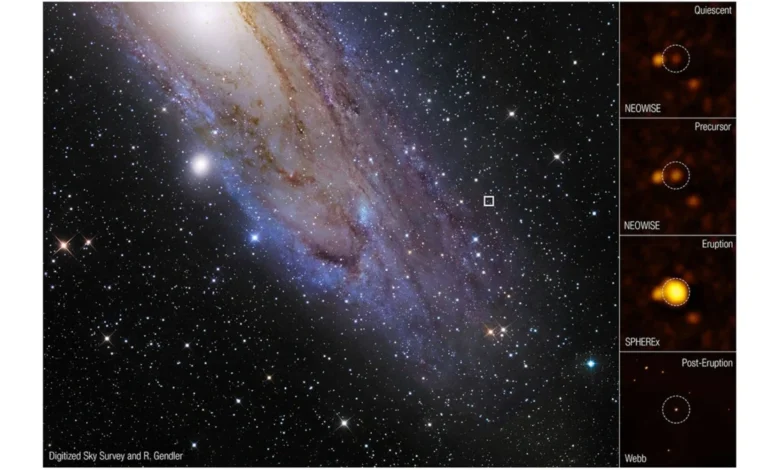
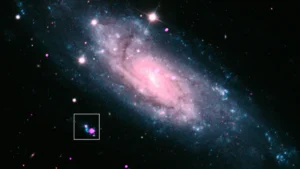
In a landmark astronomical discovery that confirms decades of theoretical astrophysics, researchers have captured the direct observation of a dying red giant star consuming its binary companion. Located approximately 2.5 million light-years away in the neighboring Andromeda galaxy (M31), the stellar system—designated WNTR23bzdiq and nicknamed "Bao"—has provided scientists with an unprecedented view of one of the universe’s most violent and elusive cosmic interactions.
For generations, astrophysicists have understood that as stars approach the ends of their lifespans, they undergo dramatic transformations. When stars with masses comparable to or somewhat larger than our sun exhaust their primary nuclear fuel reserves in their cores, they expand outward, growing up to hundreds or even thousands of times their original diameters. As these celestial bodies balloon into red giants, any planets, asteroids, or smaller companion stars orbiting within their expanding radii are inevitably swallowed up.
While this stellar lifecycle phase is a cornerstone of modern stellar evolution theory, actually catching a star in the act of engulfing a companion has remained an elusive holy grail for observational astronomy. Because binary star systems are common throughout the universe, mass transfer and stellar mergers are thought to play a vital role in shaping galactic populations, yet the physical manifestations of the final engulfment phase are notoriously subtle. Prior to this breakthrough, researchers had identified the aftermath of such mergers or inferred their occurrence through indirect spectral signatures, but a real-time capture had eluded detection until now.
The Unfolding Chronology of the Bao Binary System
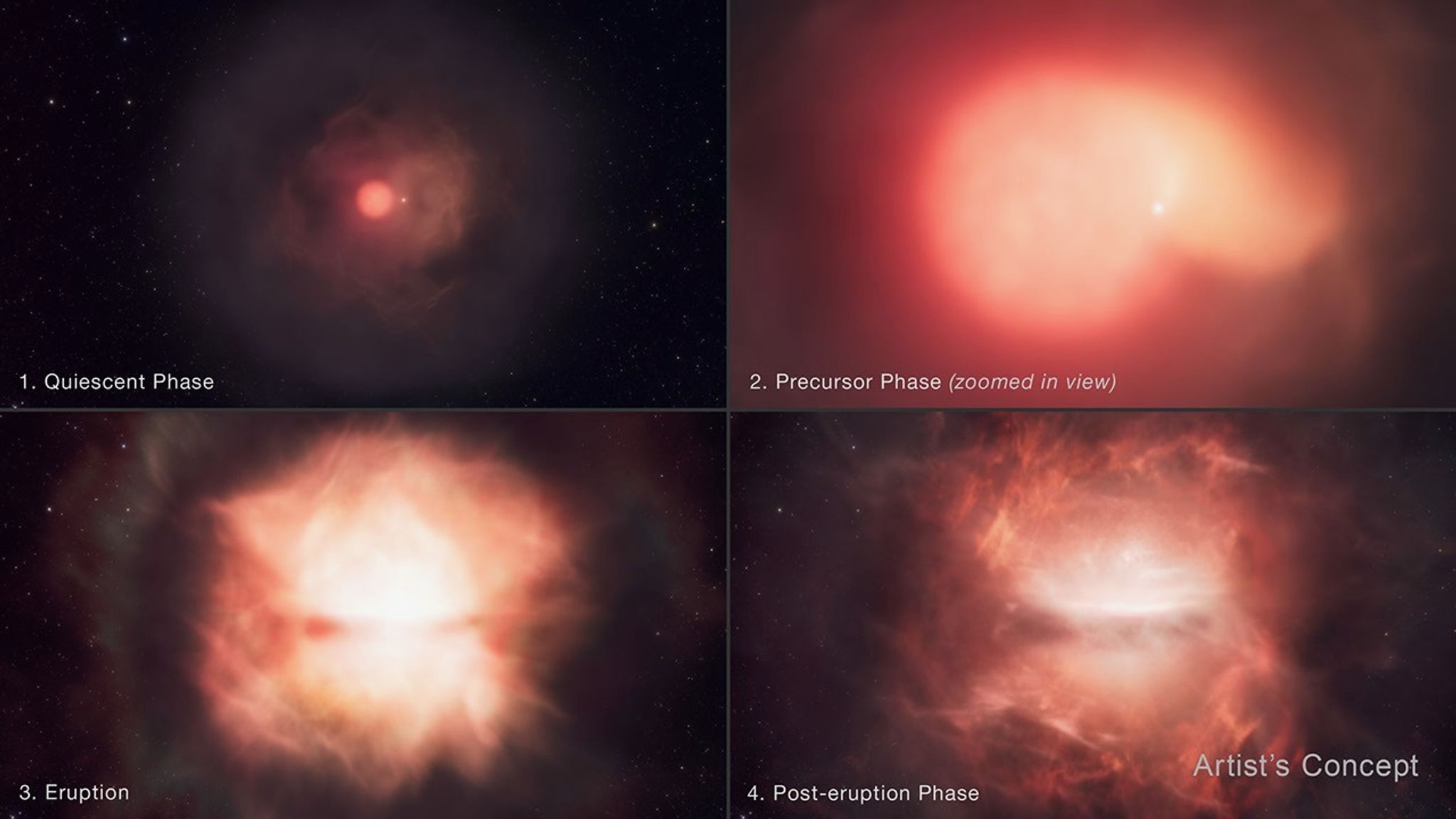
The discovery of the Bao system’s dramatic event is the result of a multi-year, multi-telescope monitoring campaign that pieced together a timeline spanning nearly a decade. The chain of events began quietly in 2018, deep within the spiral arms of the Andromeda galaxy.
According to data analyzed by the research team, led by Columbia University astrophysicist Viraj Karambelkar, the red giant star WNTR23bzdiq began an unusually steady and prolonged brightening phase. Red giants naturally exhibit fluctuations in brightness, but this particular brightening trend did not match standard stellar pulsation models. Instead, the gradual increase in luminosity was driven by the inward spiral of the system’s smaller companion star. As this secondary star orbited closer and closer to the bloated envelope of the red giant, immense gravitational forces and friction generated escalating amounts of heat, light, and kinetic energy, which slowly leaked out into space.
The subtle brightening caught the attention of astronomers in 2023 through observations conducted by NASA’s now-retired NEOWISE (Near-Earth Object Wide-field Infrared Survey Explorer) space telescope and the WINTER (Wide-field Infrared Transient Explorer) telescope located at the Palomar Observatory in California. By sifting through historical archival records, the research team managed to trace the timeline back to the initial luminosity increase in 2018, confirming that the system had been evolving toward a catastrophic climax for years.
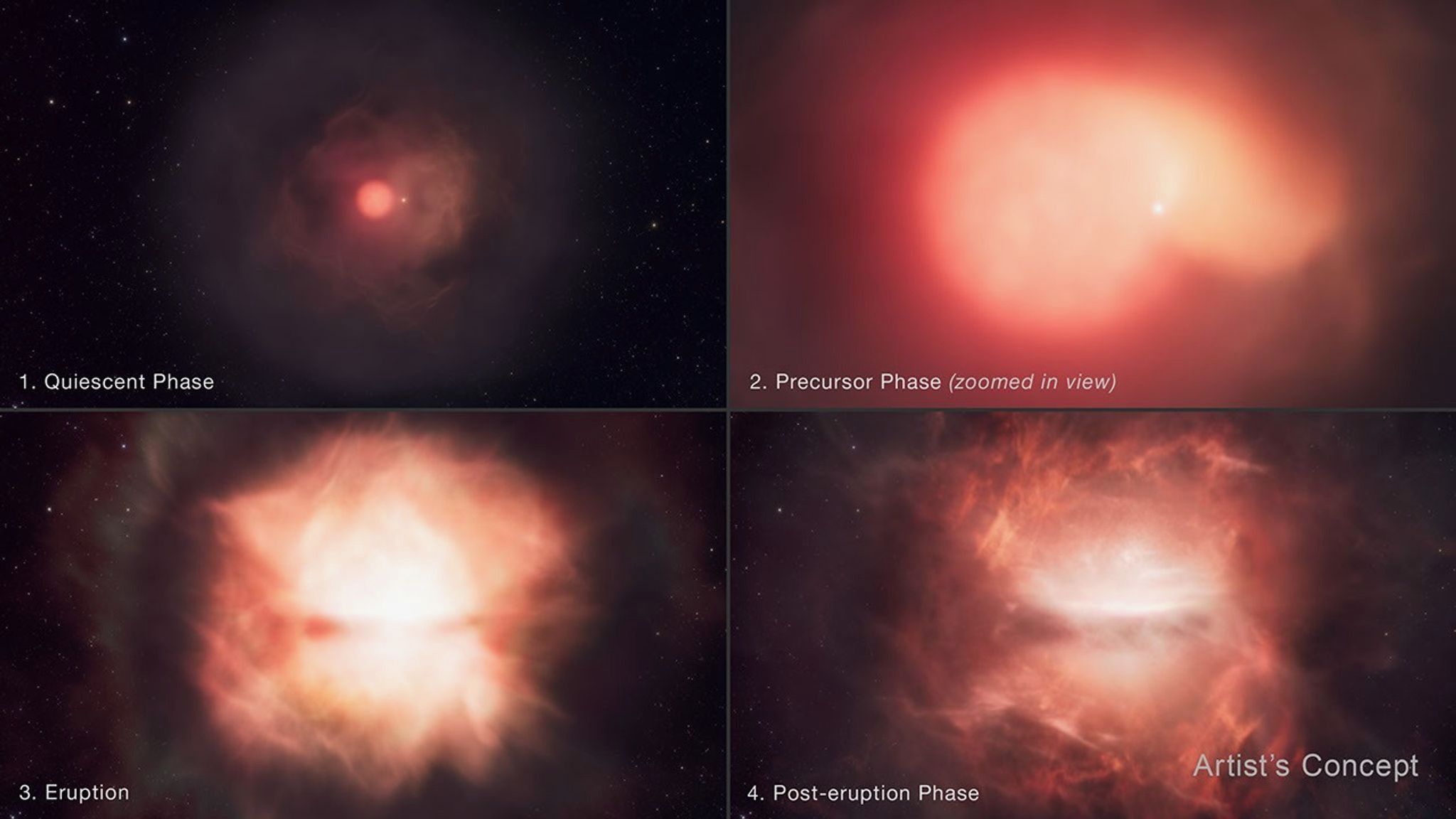
The climax arrived near the end of 2025, marked by a massive, high-energy eruption of light. Recognizing the significance of the transient event, the research team quickly mobilized premier observing assets, utilizing NASA’s James Webb Space Telescope (JWST) just 47 days after the peak explosion. The high-resolution infrared eyes of JWST provided the crucial data needed to peer through the dense shroud of dust and gas surrounding the system, allowing scientists to reconstruct the complete narrative of what occurred before, during, and after the merger.
Data, Dimensions, and the Physics of a Merger
The primary star in the Bao system is a massive red giant, possessing a mass roughly seven times that of our sun and stretching across a diameter approximately 350 times larger than the solar radius. Its doomed companion was significantly smaller, estimated to have been a star with approximately 70 percent of the sun’s mass.
As the companion star spiraled inexorably inward, it breached the dense outer layers of the red giant, plunging directly toward the stellar core. This terminal plunge triggered the violent outburst observed by astronomers in late 2025. Calculations derived from the JWST observations indicate that the resulting eruption expelled an immense volume of stellar material—equivalent to roughly 10 to 20 percent of the total mass of our sun—flinging gas and newly formed dust out into the surrounding interstellar medium.
Dr. Karambelkar expressed astonishment at the clarity of the observations, noting that catching such an event is akin to noticing a single bucket of water poured into a vast ocean. The subtlety of the initial spiraling phase makes wide-field, long-term monitoring an absolute necessity, while space-based infrared observatories are required to cut through the obscuring dust shells that typically form around merging stellar pairs.
Alternative Scenarios and Scientific Caution
While the prevailing interpretation of the Bao system points directly to a complete stellar merger—wherein the two stars fused into a single, highly modified stellar remnant—the researchers maintain a rigorous, objective approach to the data.
Dr. Karambelkar noted that although a total merger is the most robust hypothesis fitting the observed mass expulsion and luminosity curves, it is not the sole theoretical possibility. An alternative scenario suggests that the two stars may have narrowly avoided total destruction, surviving the close encounter but settling into an extremely tight, highly eccentric mutual orbit.
To definitively rule out alternative explanations and confirm the ultimate fate of the Bao system, the research team emphasizes the need for continued, long-term monitoring. Once the immediate aftermath of the eruption settles and the ejected dust shell expands and cools further, subsequent observations will reveal the true nature of the remaining core or cores. The findings of this landmark study were officially detailed and published on November 18 in the prestigious scientific journal Nature.
Broader Implications for Stellar Astrophysics
The identification and documentation of the Bao system mark a major turning point in stellar astrophysics, bridging a long-standing gap between theoretical models and empirical observation. For decades, numerical simulations of binary evolution have predicted that stellar engulfment events should occur with a certain frequency in galaxies like the Milky Way and Andromeda. However, without direct observational anchors, these models relied heavily on theoretical assumptions about friction, common-envelope physics, and mass-loss rates.
By providing the first concrete observational baseline for a stellar engulfment in progress, the Bao system gives astrophysicists a physical benchmark to test and refine their computer simulations. Understanding how stars consume their companions is not only vital for charting the life cycles of binary systems—which make up a significant fraction of the stars in the universe—but also sheds light on the origins of exotic astronomical phenomena, such as luminous red novae and certain types of supernovae.
Looking to the Future of Transient Astronomy
Buoyed by the success of this discovery, the astronomical community is already preparing for a new era of discovery. The detection of the Bao system relied heavily on serendipitous timing and the combination of infrared survey telescopes and space observatories. However, upcoming technological advancements promise to turn such discoveries from rare anomalies into routine fields of study.
Researchers anticipate that upcoming facilities, such as the Nancy Grace Roman Space Telescope and the Vera C. Rubin Observatory in Chile, will revolutionize the field of time-domain astronomy. With their unprecedented wide-field survey capabilities, deep imaging sensitivity, and rapid data processing pipelines, these next-generation observatories are expected to discover numerous additional stellar merger and engulfment events across the local universe.
As astronomers catalog more of these cosmic collisions, science will gain a much clearer understanding of how binary interactions shape the stellar landscape, ultimately offering a more comprehensive picture of the evolutionary forces that govern the life, death, and transformation of stars across the cosmos.
Related posts: