In the heart of Manhattan’s Tribeca neighborhood, where the cobblestone streets whisper stories of 19th-century industrial commerce, producer and AP Studio founder Alexis Piqueras has successfully realized a sanctuary that balances urban grit with high-design refinement. Returning to New York after a transformative three-year period in Los Angeles, Piqueras sought a residence that could serve as both a private retreat from the relentless pace of the city and a testament to the aesthetic evolution of post-industrial living. The result is a 2,500-square-foot loft located in a former 19th-century caviar factory, a space that has been meticulously pared back to its structural essence to provide a backdrop for a sophisticated collection of art and mid-century furniture.

The Architectural Foundation: A Post-Industrial Restoration
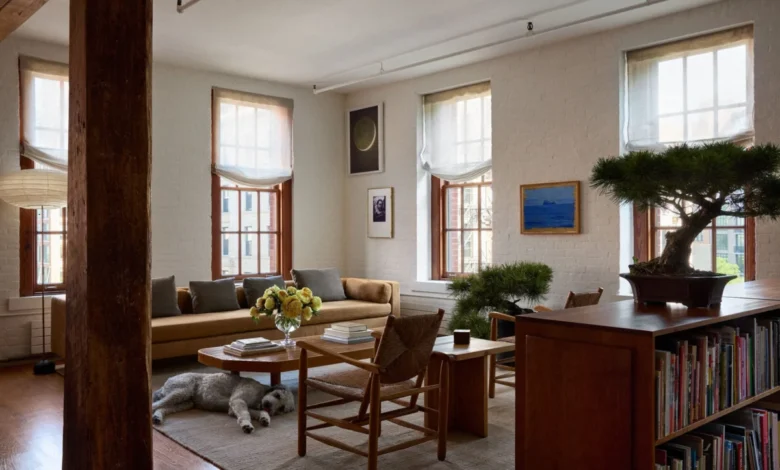
The property, which sits near the Hudson River, offered the specific architectural vernacular Piqueras desired: original brick walls, robust timber columns, and the high-ceilinged proportions typical of Manhattan’s late-1800s manufacturing era. This aesthetic aligns with the city’s historical post-industrial waterfront, a style that gained significant architectural cachet during the "loft-living" movement of the 1970s.
Piqueras collaborated with Brazilian-born designer Pali Xisto Cornelsen to execute a renovation that prioritized subtraction over addition. The previous iteration of the apartment featured various dated interventions that obscured the raw character of the building. By stripping away extraneous ornamentation and removing intrusive recessed lighting, the team managed to restore a sense of historical integrity to the floor plan.

The renovation timeline, which spanned several months, focused on creating a "neutral canvas" that would allow the structural elements—and the curated art collection—to take center stage. Walls were finished in Benjamin Moore’s Simply White, and floorboards were painstakingly refinished to match the natural warmth of the timber columns. In the kitchen, the team replaced high-gloss cabinetry with white-painted fronts, punctuated by chunky solid-cherry pulls and stainless-steel countertops, providing a functional yet tactile update that respects the building’s industrial lineage.
Curating a Narrative of Queer Identity and Activism
While the architectural shell serves as the foundation, the true personality of the loft is derived from Piqueras’s extensive art collection, assembled in partnership with art advisor Joe Sheftel. The collection is not merely decorative; it functions as a deliberate archival project, with a distinct focus on Queer talents whose works address themes of community, activism, and the history of New York’s subcultures.

Notable pieces include photographs by Wolfgang Tillmans, Peter Hujar, and Alvin Baltrop, the latter of whom is recognized for documenting the clandestine social life of the Hudson River piers during the 1970s and 80s—a period marked by both liberation and the looming shadow of the AIDS crisis. The presence of these works, alongside portraits by Larry Stanton and David Hockney, creates a dialogue between the private nature of the home and the public history of the city.
Art advisor Joe Sheftel notes that the collection serves a dual purpose: it grounds the apartment in a narrative of resilience and creativity while maintaining a sense of domestic intimacy. The inclusion of works by David Wojnarowicz, known for his raw, politically charged commentary on the AIDS epidemic and institutional neglect, further elevates the space, turning the loft into a living gallery that honors the history of queer creative struggle.

The Synthesis of Design and Functionality
The interior design strategy utilized by Cornelsen reflects a reverence for 20th-century masters. The living area is anchored by an Alvar Aalto prototype cocktail table, flanked by Charlotte Perriand dining chairs and a custom sofa. This combination of vintage Scandinavian pieces and modernist classics creates an environment that feels lived-in rather than curated for exhibition.
Custom millwork was introduced throughout the residence to enhance both utility and visual cohesion. A daybed and wall-mounted desk were installed in the office, while the dining area features a custom DJ station—a nod to Piqueras’s time spent in Berlin, where he developed a deep appreciation for electronic music and club culture. This specific corner, which he affectionately refers to as his "little Berlin," represents the synthesis of his personal history with his current professional life.

Further design elements include:
- Lighting: The use of Paavo Tynell pendants and Isamu Noguchi floor lamps, which offer soft, ambient illumination that contrasts with the starkness of the exposed brick.
- Seating: A Märtas Blomstedt lounge chair provides a focal point for the morning routine, while pieces by Axel Einar Hjorth emphasize the Scandinavian influence on the loft’s overall composition.
- Textiles: The windows are dressed in simple linen roman shades, which filter the natural light and maintain the "neutral rhapsody" established by the design team.
Economic and Cultural Context: The Evolution of Tribeca
The transformation of this caviar factory into a high-end residence reflects the broader economic shift of Tribeca from a manufacturing hub to one of the most desirable residential neighborhoods in the world. Since the 1970s, the conversion of "warehouses into homes" has defined the real estate market in downtown Manhattan.

According to urban planning data, the influx of capital into neighborhoods like Tribeca has led to a significant increase in property values, often resulting in the homogenization of interior spaces. However, the project undertaken by Piqueras stands out for its restraint. By choosing to preserve the original brick and timber rather than opting for luxury-grade marble or glass-heavy modernism, the project underscores a growing trend among affluent homeowners: the desire for "authentic" architectural history.
The "production" of a home, as Piqueras describes it, mirrors his professional career as a producer for luxury brands like Louis Vuitton, Celine, and Loewe. Just as he orchestrates complex visual campaigns for these global entities, he has orchestrated his domestic environment to act as a counterweight to his high-pressure professional life.

Implications of the "Disconnected" Home
In an era defined by digital saturation, the Piqueras residence serves as a case study for the "offline" interior. The deliberate lack of focus on technology and the emphasis on tactile materials—such as the solid-cherry wood pulls and linen drapery—suggest a shift in how urban professionals are choosing to interact with their living environments.
The psychology of this space is rooted in the concept of "hiding in plain sight." By creating an environment where a phone can be misplaced without concern, Piqueras has successfully engineered a space that provides psychological relief from the "insane" streets of New York. The impact of this design philosophy is clear: the home is no longer just a place of residence; it is an active participant in the inhabitant’s mental well-being.

As Piqueras continues to balance his work with AP Studio, the loft serves as the physical manifestation of his values. It is a space where the history of the building, the legacy of the artists displayed, and the aesthetic sensibilities of the mid-century modern movement coalesce into a single, cohesive narrative. Whether it is the soft glow of a candle by Phoebe Helander or the structural lines of a Pierre Chapo table, every element has been chosen to facilitate a life that is as intentional as it is quiet, marking a definitive departure from the hyper-connected, high-speed reality of modern New York City.
Related posts: