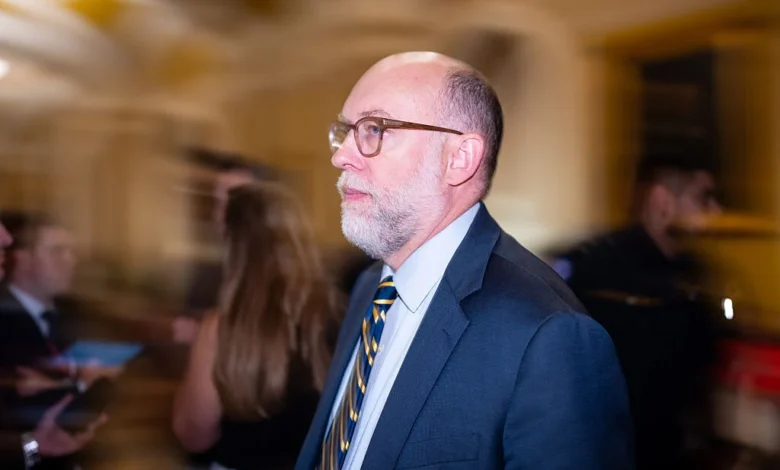
The federal government’s longstanding firewall protecting scientific research funding from political interference is facing an unprecedented collapse following reports of a high-stakes confrontation in the Oval Office. The administration is reportedly drafting an executive order that would grant Russell Vought, the director of the Office of Management and Budget (OMB), individual veto authority over every single grant distributed by the National Institutes of Health (NIH). The move, which follows months of escalating tension between White House budget officials and federal health agencies, threatens to upend the foundational structures of American biomedical research.
The pending directive emerged after a contentious Friday meeting detailed by The Washington Post, in which NIH Director Dr. Jay Bhattacharya reportedly attempted to block a concerted push by Vought to exert direct political control over agency funding allocations. Despite Bhattacharya’s resistance, the OMB chief appears to have secured the upper hand. If formalized, the executive order would establish a dual-approval committee requiring unanimous consent from both Vought and Bhattacharya for any NIH grant to proceed, effectively giving the budget director a unilateral veto over billions of dollars in scientific research.
A Chronology of Friction: From Funding Freezes to Executive Overreach
The current standoff is the latest chapter in a protracted battle between the White House and the scientific establishment over federal research priorities. The conflict began immediately after the start of the administration’s second term, when the NIH abruptly terminated a wide range of active grants focusing on politically sensitive topics, including pandemic preparedness, infectious disease tracking, and health disparities. Concurrently, the administration proposed a federal budget that would have slashed the NIH’s operational capacity by nearly half.
Those early efforts met swift resistance on multiple fronts. Congress ultimately rejected the steep budget cuts, while federal courts intervened to void the administration’s sweeping grant terminations, ruling that the cancellations lacked required administrative justifications and independent scientific reviews.

Undeterred by judicial and legislative pushback, Vought pivoted toward systemic structural changes. In May, the OMB introduced new rulemaking guidelines designed to embed political considerations directly into the grant-making apparatus. When Congress placed those rules on hold through a legislative budget agreement slated to run through December, Vought reportedly sought an alternative avenue to rein in the agency. Leveraging longstanding political grievances—particularly regarding disputes with academic institutions such as Harvard University—the OMB director positioned tighter grant controls as a mechanism to pressure higher education institutions facing federal scrutiny.
The Scale and Significance of the NIH Budget
The stakes of this bureaucratic struggle are immense. As the world’s premier engine for biomedical innovation, the NIH commands an annual budget of approximately $47 billion—a figure that eclipses the combined funding of the next ten largest global research sponsors. The agency distributes the vast majority of these funds through competitive peer-reviewed grants to universities, medical centers, and research institutes across the United States.
This funding stream supports the entire lifecycle of American medical progress, underpinning foundational basic science, expansive clinical trials, and the commercial biotechnology sector. Historically, the distribution of these funds has relied on objective scoring systems based on scientific merit, evaluated by panels of independent academic and clinical experts. By inserting political appointees into the final approval chain, the proposed executive order risks dismantling a merit-based infrastructure that has driven global scientific leadership for decades.
Practical and Operational Challenges
Independent policy analysts and legal scholars have raised profound questions regarding the logistical viability of the proposed veto system. During recent fiscal years, the NIH has routinely issued upwards of 64,000 grants annually. Observers note that neither Vought nor Bhattacharya possesses the specialized expertise or the operational bandwidth required to conduct rigorous, individualized evaluations of tens of thousands of complex scientific proposals.

Furthermore, critics argue that the mechanism threatens to create massive fiscal bottlenecks. Because the committee would presumably review funding decisions after standard scientific allocations have been made, unresolved disputes could leave substantial portions of congressionally appropriated funds unspent. Given Vought’s history of attempting to downsize federal agency footprints, administrative obstructionism may be the intended outcome rather than an incidental byproduct.
Legal Vulnerabilities and Broader Implications
Legal experts suggest that the executive order, if enacted, faces immediate challenges in the federal court system. Administrative law standards dictate that executive actions must not be arbitrary, capricious, or outside the scope of statutory authority. Critics argue that using budgetary oversight to systematically stall congressional appropriations without statutory justification fails to meet basic legal muster.
However, navigating the judicial system presents a significant hurdle. To challenge the executive order in court, prospective plaintiffs must first establish legal standing by demonstrating direct and quantifiable harm. Consequently, researchers warn that even if the directive is eventually struck down by the judiciary, the intervening delays and uncertainty could inflict lasting damage on the national research ecosystem, discouraging young scientists, disrupting ongoing clinical trials, and driving vital talent away from American academic institutions.