Mariona Caldentey penalty saves Arsenal from Champions League stagnation in narrow victory over HB Koge

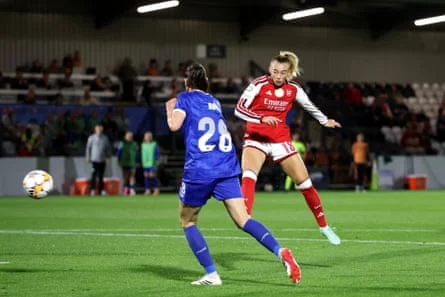
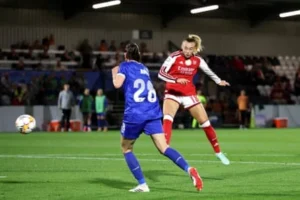
The UEFA Women’s Champions League league phase opener at Meadow Park provided a stark illustration of Arsenal’s current malaise, as a 93rd-minute penalty from Mariona Caldentey secured a 1-0 victory over Danish side HB Koge. While the result officially places three points on the board for the Gunners, the performance raised significant questions regarding the clinical efficiency of a squad that appears to be suffering from a deep-seated, systemic struggle in front of goal.
For manager Renée Slegers, the victory offered a temporary reprieve rather than a solution. Her visible frustration on the touchline mirrored the sentiment of the home supporters, who witnessed a side dominant in possession yet curiously paralyzed when tasked with the final finish. Arsenal finished the match with 21 total attempts on goal, yet only two managed to test the Koge goalkeeper, Alberte Vingum. This ratio—less than 10 percent accuracy in terms of forced saves—highlights a profligacy that threatens to derail their domestic and European ambitions.
A Chronology of Frustration
The match began with high expectations for a clinical display, particularly given the squad rotation implemented by Slegers. With an eye on the upcoming high-stakes clash against Chelsea at Stamford Bridge, the manager made eight changes to the starting lineup that had salvaged a late point against Manchester United just days prior. Only Leah Williamson, Steph Catley, and Stina Blackstenius retained their places, signaling a desire to keep the squad fresh while testing the depth of the roster.
The first half saw Arsenal establish a suffocating territorial advantage. By the 10th minute, Chloe Kelly and Frida Maanum had both forced fingertip saves from Vingum, setting a pattern that would persist for the remaining 80 minutes. The closest the Gunners came to an early breakthrough occurred in the 13th minute. A fluid build-up involving Caitlin Foord and Taylor Hinds culminated in a precise flick from Kyra Cooney-Cross, which Kelly volleyed into the net. However, a lengthy intervention from the Video Assistant Referee (VAR) determined that Blackstenius was in an offside position, effectively obscuring the goalkeeper’s view. The goal was ruled out, and the momentum, at least in terms of the scoreboard, remained stagnant.
As the match progressed into the second half, the atmosphere at Meadow Park shifted from expectation to mounting anxiety. The introduction of Alessia Russo at the break did little to break the deadlock. The Danish visitors, led by manager Kristian Mørch Rasmussen, demonstrated tactical discipline, maintaining a compact defensive block that grew in confidence as the clock ticked toward stoppage time.
The defining moment finally arrived in the dying seconds. A rare lapse in concentration from Koge defender Yukina Sakabe, who brought down Selina Cerci in the penalty area, presented Caldentey with the opportunity to break the stalemate. The cool finish from the spot finally silenced the celebrations of the Koge bench, though the relief felt by the home crowd was palpable and underscored by the underlying fragility of the team’s current form.
Statistical Analysis and Performance Metrics
The gulf in possession and attacking volume between the two sides was substantial, yet it served to emphasize Arsenal’s inefficiency. Arsenal maintained roughly 70 percent possession throughout the contest. Despite 21 shots, the Expected Goals (xG) metric, while not officially finalized, suggested that the quality of chances created was frequently neutralized by poor decision-making or a lack of composure in the final third.

In contrast, HB Koge’s defensive strategy—focusing on low-block positioning and rapid recovery tackles—proved highly effective. Koge, who entered the competition after a grueling qualifying campaign that saw them overcome Riga, Hearts, and PSV Eindhoven, played with the discipline of a side that understood their underdog status. Their ability to force Arsenal into speculative long-range efforts rather than high-percentage opportunities in the box was a testament to their defensive organization.
Broader Context and Managerial Implications
The current predicament for Arsenal extends beyond a single 90-minute fixture. With only five points from their opening three Women’s Super League (WSL) matches, the team is currently trailing the early pace-setters in the domestic table. Consecutive draws against Crystal Palace and Manchester United, followed by this narrow win against Danish opposition, indicate that the squad is struggling with a "mentality block."
Manager Renée Slegers faces the immediate challenge of addressing the lack of ruthlessness. In professional football, the inability to convert dominance into goals is rarely a matter of luck alone. It suggests a lack of rhythm in the final third, which can be attributed to tactical rigidity or a loss of confidence among the forward line. When a squad of Arsenal’s technical caliber—boasting international stars and proven goalscorers—fails to hit the target, the conversation inevitably turns to the training ground.
Furthermore, the external pressure is mounting. The looming fixture against Chelsea is not merely another game; it is a barometer for the season. Should Arsenal fail to find their clinical edge against a stronger side, the current "stuttering" narrative will likely harden into a full-blown crisis of confidence.
Media and Operational Distractions
Adding a layer of absurdity to the evening was the broadcast situation. Fans following the match remotely via Disney+ were treated to a viewing experience that many described as disjointed. Technical issues, including the presence of a "bored" studio dog and intrusive advertising breaks during active play, became a significant point of social media contention. While the broadcast failures did not influence the on-field result, they served to amplify the sense of frustration surrounding the evening. The juxtaposition of a high-profile Champions League fixture against such a haphazard broadcast environment mirrored the feeling of a club currently struggling to find its professional equilibrium.
Looking Ahead: The Road to Stamford Bridge
The victory over HB Koge provides the three points necessary for a strong start to the league phase, but it does little to mask the issues inherent in the team’s current structure. The reliance on late-game heroics and penalty kicks to overcome sides they are expected to dominate is not a sustainable model for success at the highest level of European competition.
As Arsenal prepares for their upcoming domestic challenges, the focus for Slegers will undoubtedly be on transition speed and composure in the box. The team has shown it can move the ball effectively through the thirds, but until they can demonstrate the ruthlessness required to put games away early, they will remain vulnerable to defensive-minded opponents who are content to sit deep and absorb pressure.
For the supporters in the North Bank, the win was a moment of relief, but the path forward remains fraught with questions. The Champions League demands a higher standard of clinical precision, and if Arsenal intends to progress deep into the knockout stages, they must rediscover the swagger and lethal efficiency that has historically defined the club’s identity. The win against Koge was a start, but it was far from a statement of intent.