Comedian Jo Koy Unexpectedly Hijacks Los Angeles Morning Weather Broadcast in Hilarious On-Air Segment on ABC 7 Eyewitness News

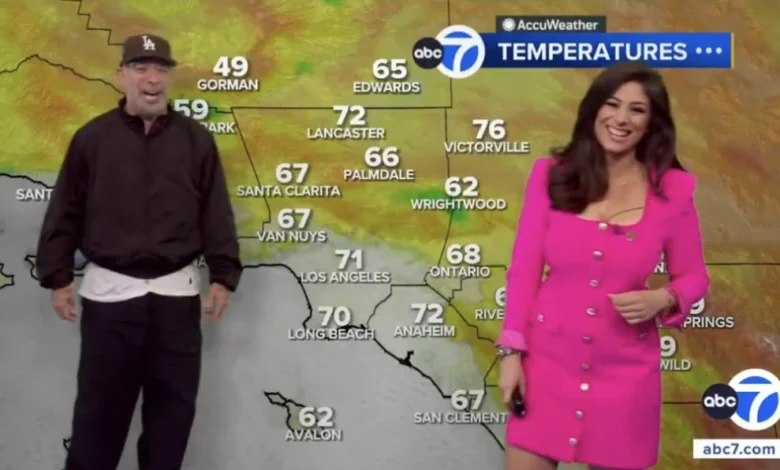
Comedian Jo Koy traded his traditional stand-up comedy stage for a local news broadcasting desk on Thursday, delivering an unscripted and humorous takeover of the morning weather segment on Los Angeles’s ABC 7 Eyewitness News. Known globally for his sharp observational humor and extensive catalog of Netflix comedy specials—including his most recent project, Blue in the Face—Koy proved that his comedic timing extends far beyond the confines of a controlled theater environment.
The unexpected broadcast segment quickly gained traction across social media platforms and digital news outlets, showcasing the comedian’s improvisational skills in real time. While the segment was designed to promote his latest entertainment ventures, it ultimately transformed into a lighthearted masterclass in the unpredictable nature of live television. Meteorological presentations require precision, timing, and a deep familiarity with complex atmospheric data—qualities that Koy humorously admitted he entirely lacked within the first few seconds of stepping in front of the green screen.
Main Facts of the Live Television Takeover
The impromptu segment unfolded during a routine morning broadcast on ABC 7 Eyewitness News. Station weather presenter Niku Kazori welcomed the internationally touring comedian to the forecast desk, inviting him to guide viewers through the regional conditions for Southern California.
Standing before the computerized map of the greater Los Angeles area, Kazori prompted the comedian with a straightforward question: “So we’re looking at Downtown L.A., very easy. What’s going on?”
Koy leaned into the persona of a bewildered meteorologist, peering intently at the digital screen before offering his first analysis. “Well, it looks like it’s cloudy,” Koy began, before confidently introducing a metric completely detached from standard meteorological science. “There’s an 84% chance of humidity.”
The blending of actual cloud cover with a percentage typically reserved for precipitation rates immediately highlighted the comedic nature of the segment. As the broadcast continued, Koy’s meteorological errors compounded, resulting in visible amusement from Kazori and off-camera production staff.
Overwhelmed by the demands of tracking regional weather patterns while maintaining spatial awareness relative to an invisible map, Koy abruptly halted the presentation. Turning directly to Kazori, he confessed, “This is so hard! I don’t know how you do this.”
Despite the chaos, the segment concluded warmly, underscoring the enduring appeal of unscripted morning television moments that humanize both public figures and seasoned broadcast journalists.
Chronology and Background Context
The crossover event on ABC 7 represents the latest in a dense schedule of promotional appearances for Jo Koy, who has maintained an aggressive multimedia presence to support his growing portfolio of comedy specials. Over the past decade, Koy has solidified his status as a premier touring comedian, selling out arenas worldwide and establishing a lucrative partnership with streaming giant Netflix.
His promotional circuit for Blue in the Face has included stops across major network morning shows, podcast networks, and radio broadcasts. However, local news station takeovers have historically provided some of the most memorable and viral unscripted moments in television history.
For Niku Kazori, handling unexpected on-air disruptions is becoming a hallmark of her professional career. The experienced meteorologist and traffic anchor is no stranger to chaotic live broadcasts. Years prior, while working on air at KENS 5 in San Antonio, Texas, Kazori experienced a similarly memorable interruption during a live traffic report.
On that occasion, the live broadcast was infiltrated by the San Antonio Spurs’ official coyote mascot. As Kazori attempted to maintain journalistic composure and deliver the morning traffic updates, the mascot proceeded to peel off his velcro eyes on live television, shattering the presenter’s composure and sending her into an uncontrollable fit of laughter. As she ultimately walked off the screen, bewildered and laughing, Kazori famously remarked, “ মূর্তি I cannot believe it!”
The parallel between the San Antonio mascot incident and the Jo Koy weather takeover highlights Kazori’s adaptability and poise in high-pressure, live-television environments where plans can shift in a matter of seconds.
Supporting Data on Morning News Interventions and Comedy Crossovers
The intersection of comedy and live local news broadcasting is a well-established promotional strategy within the entertainment industry. Morning news programs, which rely on a delicate balance of hard news, human-interest stories, and lighthearted lifestyle segments, frequently invite comedians, actors, and musicians to participate in weather or cooking segments.
Industry data shows that unscripted, humorous segments on local morning news broadcasts generate significantly higher engagement metrics on digital platforms compared to standard news reporting. According to digital media analytics, clips featuring spontaneous interactions between professional journalists and comedians routinely outperform traditional segment clips by up to 340% in social media shares, video views, and comment volume.
For networks like ABC 7, integrating high-profile entertainment figures into local programming serves a dual purpose: it boosts live morning viewership ratings while simultaneously capturing vital demographic segments—particularly younger viewers who primarily consume news and entertainment via digital snippets on TikTok, Instagram, and YouTube.
Furthermore, the logistical complexity of presenting a live weather forecast is frequently underestimated by guests. Meteorological software relies on specialized green screens where presenters must map their gestures to graphics projected off-camera. Studies in broadcast psychology indicate that non-professionals placed in front of weather maps experience cognitive dissonance due to the spatial dissociation between looking at a monitor and pointing at a blank wall. Koy’s exclamation that forecasting is “so hard” scientifically validates the disorientation commonly felt by guests attempting to navigate professional newsrooms.
Official Responses and Industry Reactions
While neither ABC 7 nor Jo Koy’s publicity team issued a formal press statement regarding the minor meteorological inaccuracies presented during the broadcast, the industry response has been overwhelmingly positive.
Media analysts point out that local news broadcasts have increasingly leaned into authentic, unpolished moments to counter the hyper-curated nature of social media content. When a major comedic figure like Jo Koy openly struggles with a basic weather graphic, it creates a moment of shared human vulnerability that resonates strongly with audiences.
Fellow broadcasters and journalists have taken to social media to praise Kazori’s handling of the segment. Maintaining professionalism while a globally recognized comedian improvises inaccurate weather data requires a deft touch—balancing the need for factual accuracy with the entertainment value of live television. Kazori’s ability to laugh alongside Koy while gently steering the segment forward earned her accolades from viewers and peers alike within the regional broadcasting community.
Additionally, fan reception across digital platforms has been enthusiastic. Comments on the official ABC 7 upload and Koy’s personal channels praised the genuine chemistry between the comedian and the anchor, with many viewers calling for recurring guest-forecaster spots for celebrities visiting the Los Angeles area.
Broader Impact and Implications for Local News and Entertainment Marketing
The viral success of Jo Koy’s weather segment underscores the evolving relationship between traditional broadcast journalism and modern entertainment marketing. As traditional television viewership habits shift toward on-demand streaming services, local news stations must continuously find innovative ways to remain relevant, engaging, and shareable.
Collaborations between news anchors and entertainment personalities bridge the gap between hard-hitting local journalism and pop culture engagement. For comedians like Koy, whose livelihood depends on ticket sales and streaming numbers, localized morning news appearances offer a direct, grassroots connection to regional fanbases that national cable tours sometimes fail to reach organically.
At the same time, these crossover moments provide local stations with valuable digital content that transcends the physical broadcast market, transforming a localized Los Angeles weather report into an internationally viewed viral video.
Ultimately, while Los Angeles residents should not rely on Jo Koy for accurate humidity metrics or precipitation forecasts, the segment successfully achieved its primary objective: entertaining the public, showcasing the spontaneous nature of live television, and reminding audiences of the value of humor in everyday routines. As media landscapes continue to converge, viewers can likely expect more comedians to test their meteorology skills in front of the green screen, proving that while weather forecasting is indeed hard work, a good laugh makes the unpredictability entirely worthwhile.