High-Profile Protesters, Artists, and Activists Detained Near United Nations as Benjamin Netanyahu Delivers Defiant Address

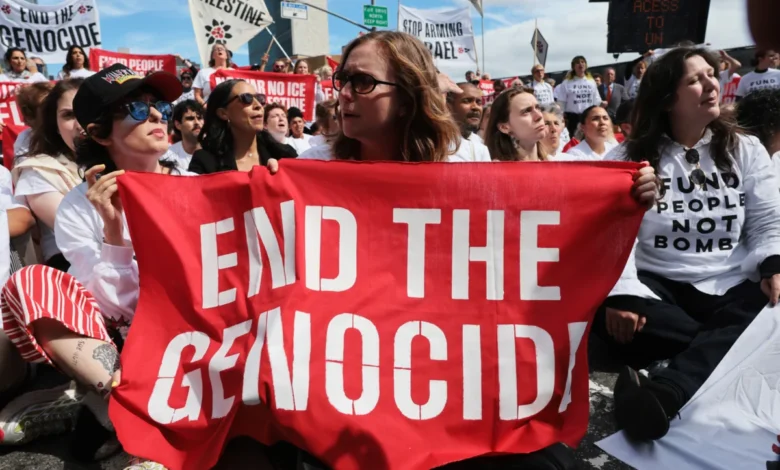
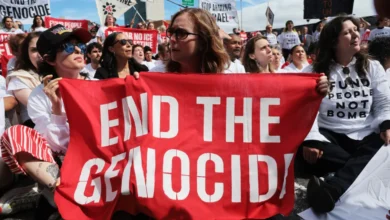
The intersection of First Avenue and 39th Street in Manhattan transformed into a focal point of international dissent as high-profile entertainers, political figures, and grassroots activists gathered to protest the arrival of Israeli Prime Minister Benjamin Netanyahu. Organized primarily by the advocacy group Jewish Voice for Peace (JVP), the demonstration unfolded just blocks away from United Nations headquarters where world leaders convened for the annual General Assembly high-level week.
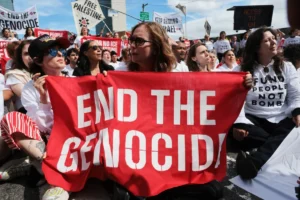
The demonstration brought together a diverse coalition of artists, musicians, actors, and elected officials who sat directly on the asphalt, deliberately courting arrest via civil disobedience. Among those present in the front rows were actress Hannah Einbinder, musicians Julien Baker and Lucy Dacus of the indie rock band boygenius, and comedian Mary Beth Barone. Prominent political figures, including New York City Councilmember Chi Osse and several congressional candidates, joined the blockade. Veteran activist Chelsea Manning and acclaimed actress Susan Sarandon were also spotted among the crowds, moving through the gathering before police initiated mass detentions using flexible zip ties.
The protest served as a physical manifestation of months of mounting global fury over the humanitarian crisis in the Gaza Strip. Demonstrators chanted slogans condemning the military campaign, aligning their messaging with international legal findings—including a 2025 commission report—that have scrutinized the conduct of the ongoing war. Despite heavy police perimeters and barricades restricting direct access to the diplomatic delegates’ entrance, the assembly captured significant media attention, broadcasting images of cultural figures and everyday citizens being led onto NYPD transport buses.
Background Context and Diplomatic Tensions
The protest outside the United Nations doors occurred against a backdrop of unprecedented diplomatic friction. The humanitarian situation in the Gaza Strip has deteriorated severely since the escalation of hostilities following the October 7, 2025, attacks led by Hamas. International organizations, United Nations agencies, and various human rights bodies have repeatedly reported catastrophic levels of food insecurity, medical supply shortages, and infrastructure collapse within the enclave.
For months, civil society organizations worldwide have organized walkouts, campus encampments, and economic disruption campaigns calling for an immediate and permanent ceasefire, an end to military aid provisions, and unhindered humanitarian access at border crossings. Jewish Voice for Peace has emerged as one of the leading Jewish-led progressive anti-Zionist organizations driving direct action in the United States, frequently collaborating with progressive lawmakers, labor unions, and cultural workers to amplify Palestinian solidarity messaging.
The choice of New York City as a flashpoint was strategic. The United Nations General Assembly brings heads of state and foreign ministers into close proximity with one of the most politically active urban populations in the United States. Local progressive politics have increasingly intersected with foreign policy debates, creating a tense domestic climate for visiting leaders whose nations face intense global scrutiny.
Chronology of the Demonstration and Arrests
The sequence of events on Thursday morning followed a well-rehearsed tactical blueprint typical of modern civil disobedience demonstrations in major metropolitan areas.
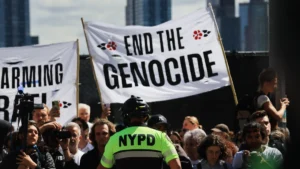
Beginning at approximately 10:00 a.m. local time, members of Jewish Voice for Peace and allied groups converged on the corner of First Avenue and 39th Street. Banners declaring opposition to genocide and ethnic cleansing were unfurled as participants occupied the active roadway.
By 11:15 a.m., law enforcement agencies had established a strong operational presence, deploying bicycle officers to encircle the demonstrators while transit and transport buses were positioned nearby to facilitate mass processing.
At approximately 11:45 a.m., police issued multiple loudspeaker warnings instructing the assembled crowd to disperse or face misdemeanor charges for disorderly conduct and blocking vehicular traffic. Choosing to remain seated, participants linked arms and chanted while law enforcement officers systematically moved through the rows.
By 1:00 p.m., the primary wave of detentions was underway. High-profile participants, including Susan Sarandon and Hannah Einbinder, were zip-tied by NYPD personnel and escorted toward the detention buses amid a scrum of international press photographers and videographers. Concurrently, a small group of counter-demonstrators gathered near the perimeter, resulting in brief verbal altercations that were largely managed by peacekeeping marshals and police intervention.
Inside the United Nations General Assembly Hall: The Speech and Walkout

Inside the fortified United Nations complex, the diplomatic atmosphere mirrored the turbulence on the streets outside. As Prime Minister Benjamin Netanyahu approached the podium to deliver his scheduled address, a substantial contingent of international delegates stood up and walked out of the General Assembly hall in a coordinated silent protest, while remaining attendees registered audible boos and jeers.
Undaunted by the mass exodus, Netanyahu delivered a combative and unyielding speech that directly addressed his critics both inside and outside the international body.
"To all those who are spreading these lies, whether they sit in this hall or in the office of the antisemitic Mayor of New York, I say shame on you," Netanyahu declared from the lectern, explicitly invoking local municipal leadership and prominent online commentators. He defended the military strategy pursued by the Israeli Defense Forces (IDF), maintaining that the state’s actions were necessary for national survival and regional security rather than violations of international humanitarian law. "Israel didn’t commit genocide, Israel prevented genocide," he asserted.
The Prime Minister’s remarks underscored a growing friction between foreign heads of state and local American municipal authorities, who increasingly find themselves navigating the domestic political fallout of international conflicts playing out on local streets.
Statements and Reactions from Participants and Observers
The convergence of celebrity culture and grassroots political activism provided the demonstration with immense visibility, a dynamic acknowledged by both participants and analysts.
Chelsea Manning, speaking to reporters just before her arrest in a sharp blue pantsuit, articulated the philosophical motivation behind the civil disobedience. "This is a way that we, as people, outside of these institutions can show a rejection of the policies of empire, of ethnic cleansing, of genocide," Manning stated. "We can’t be in there. This is the closest that we can get."
Musicians Julien Baker and Lucy Dacus, known internationally for their work with the indie rock group boygenius, emphasized their long-standing commitment to community-level organizing. "We have a history of protesting even before anyone was listening to us," Dacus noted. Baker added during a lull in police announcements, "No matter what level you’re at, direct action is possible."
Stefanie Fox, the executive director of Jewish Voice for Peace, contextualized the urgency felt by the demonstrators as they watched the ongoing humanitarian crisis unfold alongside their normal daily routines. "It feels deeply incoherent to try to live a normal life—making dinner with a full fridge, while aid trucks are stopped at the Gazan border," Fox said from the sidewalk as police tightened their perimeter. "Being here feels like the only coherent place to be."
Conversely, counter-protesters stationed near the fringes of the demonstration expressed fierce opposition to the pro-Palestinian movement. Amid shouting matches involving passersby and mobility scooter operators, differing political factions underscored the deep ideological polarization defining contemporary American public discourse regarding the Middle East.
Broader Impact and Geopolitical Implications
The protests outside the United Nations and the subsequent walkout inside the General Assembly hall highlight the deepening diplomatic isolation and cultural polarization surrounding the ongoing Gaza conflict. While state-level alliances at the United Nations remain complex, public opinion—particularly among younger demographics, cultural workers, and progressive political factions in Western democracies—has shown a pronounced shift toward skepticism of military strategies employed in densely populated urban zones.
The involvement of high-profile actors, musicians, and public figures serves a calculated tactical purpose within modern social movements. By leveraging their platform and cultural capital, these individuals generate immediate media coverage and social media amplification that transcends traditional news cycles. Analysts note that while civil disobedience arrests rarely alter foreign policy directly in the short term, they serve to maintain sustained public pressure, keep contentious issues on the legislative agenda, and mobilize volunteer bases for broader political organizing campaigns.
Following his address, Prime Minister Netanyahu reportedly departed New York City swiftly, avoiding an extended stay in a municipality where local sentiment was demonstrably hostile to his administration’s policies. As the global community continues to grapple with the intractable challenges of the Middle East conflict, demonstrations of this scale demonstrate that the grassroots resistance movement remains organized, visible, and deeply integrated into the cultural mainstream.
Related posts: