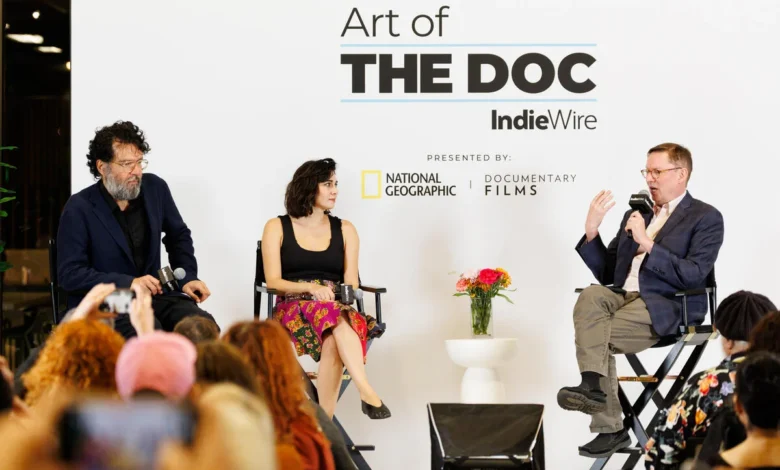
Pegah Ahangurani and Arash Ashtiani Discuss Rehearsals for a Revolution at IndieWire Art of the Doc Event in Los Angeles

Pegah Ahangurani’s documentary feature Rehearsals for a Revolution has emerged as one of the most compelling and politically urgent cinematic achievements in recent years. Fusing half a century of turbulent Iranian socio-political history with the director’s personal narrative of forced exile to London, the film constructs a sweeping visual tapestry rooted in a single, evocative Persian word: “Yad.”
The term, which translates to memory and remembrance, serves as the structural and thematic spine of the documentary. It enables Ahangurani and editor Arash Ashtiani to seamlessly interweave disparate timelines, operating under the foundational thesis that the act of remembering is, in itself, a potent form of revolution. During a recent panel appearance at IndieWire’s high-profile Art of the Doc event in Los Angeles, the creative duo sat down with IndieWire Editor-in-Chief Brent Lang for an expansive, deeply reflective conversation that explored the genesis of the film, its relationship with authoritarian censorship, and the psychological mechanics of reclaiming history.
The Power of Memory Against State-Sanctioned Erasure
At the core of the discussion in Los Angeles was the concept of historical revisionism practiced by repressive regimes. Ahangurani, who spent the vast majority of her life and career living and working within Iran before relocating to the United Kingdom, offered a searing critique of authoritarian tactics during her conversation with Lang. Rather than relying solely on direct suppression or physical confinement, authoritarian states systematically target the collective consciousness of the populace.
“I wanted to emphasize the act of remembering, because the central idea of my film is about remembering,” Ahangurani told the audience at the Art of the Doc event. Elaborating on the mechanics of state control, she noted the calculated nature of historical manipulation: “I grew up in Iran and I’ve lived there my whole life, and I know very well that the authoritarians, including the one in Iran, they don’t only censor people. They also try to erase our memories, erase our past, and replace it with their own version of history. They try to rewrite it, and we shouldn’t let them steal our memories. I think remembering is one of the few things we have. We should remember our past, we should remember our victims, we should mourn them. Only after that can we start to heal.”
This perspective positions Rehearsals for a Revolution not merely as a historical archive of unrest and resilience, but as an active psychological intervention. By confronting the deliberate voids left by state censorship, the documentary challenges viewers to bear witness to lives, struggles, and tragedies that the ruling apparatus seeks to obliterate.

Crafting the Tapestry: Chronology and Editing in Exile
Bringing half a century of complex geopolitical turmoil together with a deeply intimate personal migration story required an innovative editing strategy. Arash Ashtiani, working in tandem with Ahangurani, navigated a vast landscape of archival material, personal footage, and contemporary reflections.
The documentary avoids linear historical recounting in favor of a thematic chronology driven by emotional resonance. By anchoring the narrative arc around “Yad,” the filmmakers bridge decades of generational trauma and political upheaval—from pre-revolutionary eras through successive waves of domestic crackdowns and the realities of modern exile. This editing approach mirrors the fragmented yet persistent nature of memory itself, where past and present coexist continuously in the minds of those displaced from their homelands.
The logistical realities of producing such a project from London while dealing with the long shadow of the Iranian state highlight the vulnerabilities and resilience inherent in contemporary diaspora filmmaking. Exile imposes both physical separation and a heightened urgency to preserve cultural identity, themes that heavily inform the pacing and tonal shifts throughout Rehearsals for a Revolution.
Contextualizing the Art of the Doc Showcase
The Art of the Doc event in Los Angeles serves as a premier gathering for elite documentary filmmakers, industry executives, and critics to dissect the evolving landscape of non-fiction cinema. As global geopolitical tensions continue to manifest prominently in independent filmmaking, panels featuring directors whose works directly challenge state censorship draw significant attention from both the press and international distribution networks.
Rehearsals for a Revolution arrives at a critical juncture for documentary cinema, aligning with a broader movement of films that utilize archival excavation and personal testimony to counter authoritarian narratives. The inclusion of Ahangurani and Ashtiani’s masterclass in IndieWire’s programming underscores the increasing cultural and political weight carried by exiled artists working in the West.
The Broader Impact of National Geographic Documentary Films
As the profile of Rehearsals for a Revolution continues to rise on the international film festival and screening circuit, its trajectory benefits from the robust institutional backing defining contemporary prestige documentary distribution. Premium non-fiction storytelling has increasingly become a vehicle for global advocacy, bridging regional human rights crises with worldwide audiences.

National Geographic Documentary Films, operating as a joint venture between The Walt Disney Company and the National Geographic Society, has established a formidable pipeline for globally relevant, provocative, and timely stories. Reaching an estimated 300 million people across 180 countries and 33 languages via linear channels and direct-to-consumer platforms such as Disney+ and Hulu, the division specializes in elevating vital international narratives to a massive scale.
This global infrastructure has previously propelled numerous critically acclaimed and award-winning titles into the international spotlight. Recent milestones for the slate include the Emmy-nominated and IDA Award-winning Best Feature The Tale of Silyan; Academy Award and Peabody nominee Sugarcane; Academy Award nominee and Peabody Award winner Bobi Wine: The People’s President; Emmy Award winner Lost In The Jungle; Academy and BAFTA-nominated Fire of Love; Emmy and Peabody winner The Territory; BAFTA nominees The Rescue and Becoming Cousteau; and Academy and BAFTA winner Free Solo.
By engaging with complex geopolitical realities through deeply personal storytelling, films supported by these networks provide essential frameworks for public understanding and historical accountability.
Implications for Iranian Cinema and Diaspora Art
The release and critical reception of Rehearsals for a Revolution carry significant implications for the broader community of Iranian filmmakers operating inside and outside the country’s borders. For decades, Iranian cinema has achieved international renown for its poetic realism, allegorical depth, and humanist focus. However, increasing state crackdowns on independent creators, directors, and cultural figures have forced a massive exodus of creative talent.
Works like Ahangurani’s documentary represent a vital evolution in diaspora cinema. Rather than severing ties with the homeland, these projects maintain an active, critical dialogue with the history and ongoing struggles of the Iranian people. By defining memory as a revolutionary act, Ahangurani reclaims ownership over a national narrative that authorities have spent decades attempting to sanitize or rewrite.
As audiences continue to engage with Rehearsals for a Revolution—both through theatrical and streaming platforms and via in-depth discussions like the IndieWire Art of the Doc conversation—the film cements its status as a vital document of resistance. It offers a stark reminder that in the face of institutional erasure, the simple act of remembering remains an unyielding challenge to tyranny.