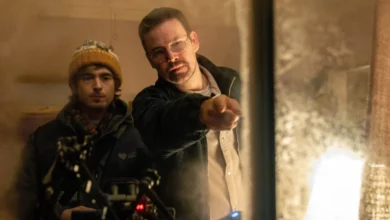
Behind the Magic of Steven Spielberg: How Disclosure Day Mastered High-Stakes Practical and Visual Effects Integration


Six decades into a legendary career that fundamentally redefined the grammar of modern cinema, Steven Spielberg continues to hold a singular place in Hollywood. Long celebrated as the chief architect of the modern summer blockbuster, the director remains a standard-bearer for a specific brand of cinematic spectacle and technical wizardry that few of his contemporaries or successors have ever successfully replicated. When Spielberg turns his lens toward a major popcorn blockbuster—as he has done with his latest high-stakes cinematic venture, Disclosure Day—audiences and industry insiders alike anticipate the kind of breathtaking, flawlessly executed sequences that have become his directorial hallmark.
Among the most pulse-pounding and technically demanding sequences in Disclosure Day is a terrifying, high-velocity collision in which a speeding train brutally smashes into a stranded automobile. This harrowing moment features principal cast members Josh O’Connor and Emily Blunt directly in the line of fire, pushing every major production department to its absolute limit. From camera operators and grips to the art and production design teams and the visual effects crew, the scene required an unprecedented level of interdepartmental coordination.
During IndieWire’s exclusive Craft Roundtables, Visual Effects Supervisor Matthew Butler pulled back the curtain on the massive production effort. Butler detailed the unique, highly intricate technical challenges of incorporating subtle, invisible digital effects into a colossal sequence where the vast majority of the chaos and kinetic energy was captured live, directly in-camera.
The Philosophy of Practical Filmmaking Under Spielberg
For decades, Steven Spielberg has maintained a well-documented preference for tangible, physical filmmaking whenever the laws of physics and human safety permit it. In an era dominated by green screens and fully digital environments generated in post-production, Spielberg famously champions the sensory weight of practical effects. This methodology anchors his narratives in a tangible reality that audiences can viscerally feel, even in fantastical or science-fiction settings.
"With Steven, he wants everything to be as practical as it can be," Matthew Butler explained during the roundtable discussion. "We had a real train. A real train, a real car attached to that train, it was being dragged on a real track. That actually did happen."
This commitment to physical reality means that the actors are frequently reacting to real-world stimuli, massive machinery, and authentic environmental hazards rather than imaginary CGI entities or blank space. By utilizing actual locomotives, physical tracks, and real tonnage, the production immediately established an authentic baseline of momentum, weight, lighting, and sound that digital artists could later enhance rather than build from scratch.
Bridging the Gap: The Synergy of Practical Stunts and Digital Effects

Despite Spielberg’s traditionalist leanings and preference for in-camera action, modern blockbusters of this financial and technical scale rarely rely on a simplistic binary choice between purely practical elements and digital imagery. Instead, the most effective, awe-inspiring sequences in contemporary cinema are born from a sophisticated hybrid approach. The seamless marriage between live-action human performances, physical stunt work, and cutting-edge post-production digital enhancement is ultimately what generates modern movie magic.
Butler was quick to clarify that framing the train collision purely as a "visual effects shot" or a "visual effects sequence" would fundamentally misrepresent the collaborative nature of the filmmaking process. While digital artistry was vital to the completion of the scene, it served to augment and protect rather than replace the physical danger and dramatic weight captured on set.
"When you combine some of the live-action blue screen work, clearly that’s your lead actor and actress there, and your stunt work where it’s like ‘Oh my God, that looks really real’ and the stuff that you just can’t do that’s just too dangerous… that’s where visual effects came in," Butler stated. "But I wouldn’t say it was a visual effects sequence. It was a sequence that contained all of those, and it came together in the right way."
This delicate balancing act requires an immense amount of pre-planning and real-time communication between departments. The physical setup—involving heavy rail equipment, moving vehicles, precise timing, and elite stunt professionals—had to be captured safely and effectively. Once the footage was securely in the can, the visual effects team stepped in to polish the rough edges, erase safety rigging, enhance environmental details, and amplify the sense of mortal peril facing O’Connor and Blunt’s characters.
The Evolution of Spielberg’s Visual Effects Integration
To fully understand the technical triumph of Disclosure Day, it is necessary to examine how Steven Spielberg’s relationship with visual effects has evolved over his historic career. When Spielberg directed Jaws in 1975, the famous mechanical shark (affectionately dubbed "Bruce" by the crew) malfunctioned constantly, forcing the director to rely on suspenseful framing, pacing, and John Williams’ iconic score to terrify audiences. That logistical nightmare forced Spielberg to become a master of suggestion and practical problem-solving.
Two decades later, with Jurassic Park (1993), Spielberg bridged the divide between traditional animatronics and the nascent revolution of computer-generated imagery (CGI). Stan Winston’s full-scale, life-sized robotic dinosaurs worked in tandem with Industrial Light & Magic’s groundbreaking digital dinosaurs, creating a watershed moment in film history. The philosophy established on Jurassic Park—that CGI should only be used when practical effects reach their absolute limits—has remained the cornerstone of Spielberg’s production ethos ever since.
In Disclosure Day, that philosophy reaches a mature, highly refined state. The integration of digital tools is no longer about showcasing flashy technological milestones, but rather about invisible enhancement. The audience is not meant to look at the screen and admire the computer graphics; instead, they are meant to feel the raw terror of a massive locomotive obliterating an automobile with two beloved actors trapped inside.
Logistics and Safety: The Unsung Heroes of the Train Sequence

Executing a sequence involving a runaway train and a car collision with high-profile talent on set requires an extraordinary degree of logistical precision. Risk management is paramount when A-list actors like Josh O’Connor and Emily Blunt are placed in proximity to heavy industrial machinery.
Stunt coordinators, safety inspectors, and camera crews worked in tight synchronization with the visual effects department long before cameras started rolling. Pre-visualization (previz) models were constructed to map out every single frame of the collision. This digital blueprint allowed the team to determine precisely where the physical cameras could be placed to capture the maximum dramatic impact without compromising the safety of the cast and crew.
While the primary train and car crash were executed practically on physical tracks, certain heightened camera angles, debris trajectories, and background enhancements required the intervention of Matthew Butler’s visual effects team. Furthermore, blue screen stages were utilized for specific close-up dialogue shots featuring O’Connor and Blunt, ensuring that their emotional performances could be captured with complete focus and safety while maintaining the illusion that they were mere feet away from an oncoming catastrophe.
Industry Implications and the Craft Roundtable Series
Insights into the production of Disclosure Day were brought to light as part of IndieWire’s ongoing Craft Roundtables, an initiative designed to spotlight the unsung heroes behind major motion pictures. By bringing together below-the-line talents such as cinematographers, production designers, costume designers, and visual effects supervisors, these panels provide a comprehensive look at the collaborative machinery that drives modern Hollywood.
The disclosures made by Matthew Butler regarding Disclosure Day offer a timely reminder to film enthusiasts and aspiring creators alike: the ongoing debate between practical effects and visual effects is largely a false dichotomy. The industry’s most respected auteurs do not view these methodologies as competing factions, but rather as complementary tools within a unified artistic toolbox.
As visual effects technology continues to advance—incorporating sophisticated artificial intelligence tools, real-time virtual production volumes, and increasingly hyper-realistic rendering engines—the role of the VFX supervisor has shifted toward preservation of physical intent. As demonstrated in Spielberg’s latest blockbuster, the most successful digital effects are often the ones the audience never notices, working quietly behind the scenes to elevate physical stunts, ground human performances, and preserve the tactile magic of cinema.
Broader industry coverage and extended interviews from IndieWire’s Craft Roundtables will continue to roll out in the coming weeks, promising further behind-the-scenes revelations about the meticulous craftsmanship required to bring Spielberg’s cinematic visions to life on the silver screen.
Related posts: