The Definitive Guide to Luxury Stays in Aspen: Balancing Alpine Heritage with Modern Sophistication

Aspen, Colorado, has long transcended its roots as a 19th-century silver mining camp to establish itself as the preeminent luxury mountain destination in North America. Today, the town serves as a global nexus for high-net-worth tourism, offering a unique convergence of four distinct ski mountains, a thriving arts scene, and a hospitality sector that consistently sets the benchmark for mountain-town excellence. With the winter season serving as the town’s economic engine, the local lodging market has evolved into a sophisticated ecosystem of five-star resorts and high-end private rentals, each catering to a demographic that demands seamless integration between rugged outdoor adventure and urban-level comfort.

The Evolution of the Aspen Hospitality Market
The transformation of Aspen from a sleepy mountain town to a premier global destination began in the post-World War II era, largely spurred by the visionary efforts of Walter Paepcke and the Aspen Institute. By the late 1940s, the establishment of the Aspen Skiing Company and the introduction of the first chairlift on Aspen Mountain shifted the economic focus from extraction to recreation.
According to data from the Aspen Chamber of Commerce, the region now welcomes over 1.5 million visitors annually. The hospitality infrastructure has had to adapt to this volume, transitioning from rustic lodges to expansive, multi-million dollar properties that offer amenities such as private ski valets, oxygen-enriched suites, and full-service wellness spas. This growth has not come without challenges; the local housing market and labor supply have faced immense pressure, leading to a recent, concerted push by municipal leaders to incentivize sustainable, year-round tourism to balance the peak-season surges.

Iconic Hospitality Pillars
The current landscape of Aspen accommodations is anchored by institutions that have defined the town’s brand for decades.
The St. Regis Aspen Resort
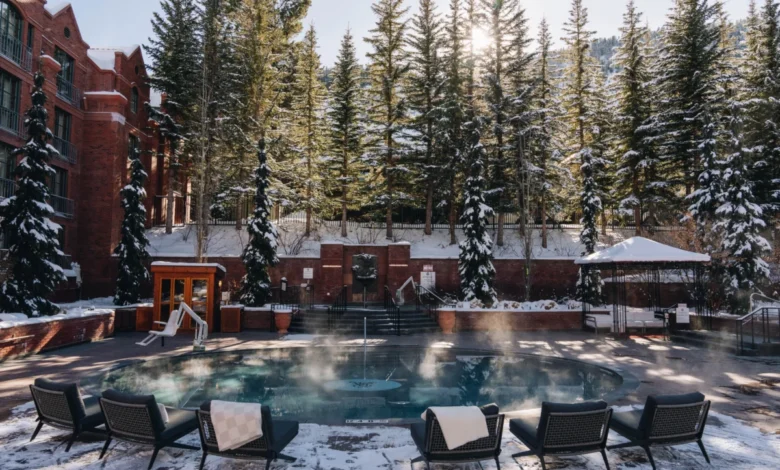
Located at the base of Aspen Mountain, the St. Regis represents the pinnacle of traditional luxury. Since its inception, the property has leveraged its proximity to the Silver Queen Gondola to provide an unmatched ski-in, ski-out experience. Beyond its physical location, the resort has strategically repositioned itself as a cultural hub. The 2023 integration of The Snow Lodge—a high-concept nightlife and supper club—marked a significant shift in the resort’s strategy, moving away from purely passive luxury toward an active, experiential model. By hosting world-class DJs and exclusive culinary events, the St. Regis has successfully attracted a younger, high-spending demographic that values social visibility alongside traditional comfort.

Hotel Jerome
As a designated historic landmark, the Hotel Jerome offers a counter-narrative to the modern glass-and-steel aesthetic. Originally opened in 1889, the property survived the decline of the mining industry to become the heart of Aspen’s social life. Under the management of Auberge Resorts Collection, the Jerome has meticulously preserved its Victorian-era architecture while upgrading the interior experience. The property’s J-Bar remains a focal point of regional lore, particularly for its associations with the writer Hunter S. Thompson, who utilized the establishment as his campaign headquarters during his run for Pitkin County Sheriff in 1970. This intersection of history and modern hospitality remains a primary draw for visitors seeking an authentic connection to the American West.
The Little Nell
The Little Nell holds the distinction of being the only AAA Five Diamond-rated property in the town. Its business model is built on high-touch concierge services and an unrivaled command of the local terrain. The property’s commitment to viticulture—exemplified by its 20,000-bottle wine cellar—has turned it into a destination for the international oenophile community. Furthermore, the hotel’s "Ski Concierge" program serves as a model for modern resort efficiency, effectively removing the logistical friction typically associated with high-altitude recreation.

The Rise of the Luxury Private Rental Market
While full-service hotels dominate the central core, the private rental sector has seen exponential growth, driven by platforms such as Airbnb and Vrbo. This segment now accounts for a significant portion of total visitor capacity in Aspen and Snowmass.
Modern travelers, particularly families and groups, are increasingly opting for private condominiums and chalets that offer complete autonomy. These properties, often located within walking distance of major lift infrastructure, have become highly competitive with traditional hotels. Data from local property managers indicate a trend toward "resort-style amenities" within private homes, including in-unit steam rooms, private hot tubs, and chef-grade kitchens. The influx of this inventory has provided a necessary release valve for the town’s limited hotel room count, though it has also sparked ongoing debates regarding the impact of short-term rentals on the local workforce housing availability.

Strategic Infrastructure and Economic Implications
The success of the Aspen model relies heavily on the integration of four distinct mountains: Aspen Mountain (Ajax), Aspen Highlands, Buttermilk, and Snowmass. The unified lift ticket system has effectively created a diversified experience that caters to all skill levels, from the professional-grade terrain at Highlands to the family-oriented slopes of Buttermilk.
This operational efficiency is supported by an sophisticated transportation network. The RFTA (Roaring Fork Transportation Authority) bus system is widely regarded as one of the most effective mountain-town transit systems in the country. By reducing the necessity for private vehicle travel within the town core, Aspen has managed to preserve a degree of pedestrian-friendly atmosphere that is increasingly rare in other North American resort destinations.

Future Outlook and Sustainability
The future of Aspen’s hospitality sector is inextricably linked to the broader challenges of climate change and sustainable development. As winters become less predictable, resorts are diversifying their revenue streams to ensure year-round viability. The success of the "Food & Wine Classic" in June is a testament to this strategy, proving that the luxury tourism market is as robust in the summer as it is in the winter.
From an economic perspective, the reliance on high-end tourism creates a high barrier to entry. The average nightly rate for a luxury room in peak season now frequently exceeds $800, with top-tier private homes commanding thousands per night. This creates a challenging environment for middle-income visitors, leading to a bifurcated market where Aspen is increasingly accessible only to the ultra-wealthy, while the surrounding valley absorbs the overflow of the workforce and mid-range tourists.

Summary of Key Accommodations
| Property | Primary Appeal | Ideal For |
|---|---|---|
| The St. Regis | Traditional Grandeur | Socialites and nightlife enthusiasts |
| Hotel Jerome | Historic Authenticity | Culture seekers and history buffs |
| The Little Nell | Five-Diamond Service | Serious skiers and wine connoisseurs |
| Mollie Aspen | Boutique Design | Modern, design-conscious travelers |
| Aspen Meadows | Bauhaus Architecture | Art lovers and those seeking quiet |
Concluding Analysis
Aspen’s continued dominance in the global luxury market is not accidental; it is the result of a calculated balance between preservation and innovation. By maintaining the historical integrity of the town while consistently investing in cutting-edge hospitality technology and experiences, Aspen ensures that it remains relevant to changing consumer demographics. However, the town’s leaders remain at a crossroads. As global demand for "mountain living" increases, the challenge will be to manage growth in a way that protects the very environment—and the unique local character—that makes the destination a global icon. For the prospective traveler, the range of options remains vast, provided they are willing to navigate a market that demands early planning and a premium for access to one of the world’s most sought-after alpine environments.
Related posts: