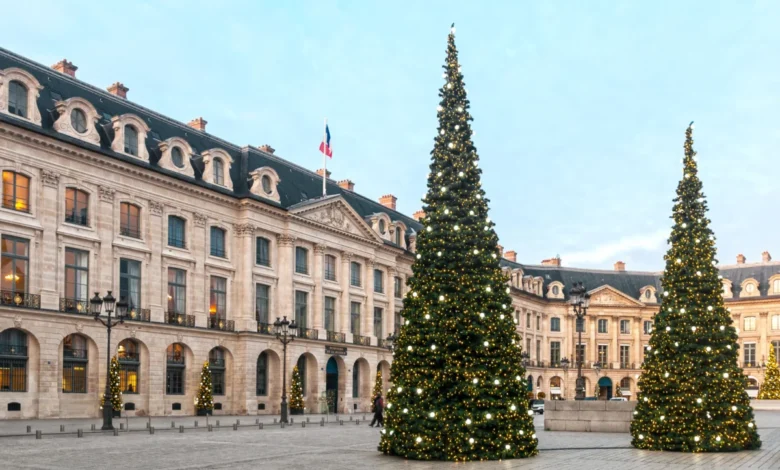
While Strasbourg in the Alsace region proudly holds the title of France’s official holiday capital, hosting the nation’s oldest recorded Marché de Noël, the winter season in Paris offers a distinct, high-end metropolitan spectacle that captivates international travelers year after year. As November transitions into December, the French capital undergoes a profound transformation. Thousands of cascading LED lights illuminate historic squares, grand boulevards, and architectural landmarks, most notably the Champs-Élysées, widely celebrated as one of the world’s premier avenues.

Holiday cheer permeates all twenty municipal arrondissements. Neighborhoods are systematically adorned with oversized decorative garlands, dense pop-up forests of bauble-strewn fir trees, and intricate sculptural light displays. Traditional wooden chalets materialize across the urban landscape, filling the crisp winter air with the aromas of steaming vin chaud (mulled wine) and regional holiday delicacies such as rich foie gras served over subtly sweet pain d’épices (traditional gingerbread).
Alongside these seasonal chalets, fresh oyster stands become a ubiquitous fixture of Parisian street life during the colder months, offering residents and tourists a classic French winter culinary tradition. Visitors can easily curate a movable feast, dining and drinking across the city’s most legendary historical institutions. These range from storied Left Bank cafés where generations of famous writers, philosophers, and artists once gathered, to the opulent palace hotels clustered gracefully around the Place de la Concorde and the Place Vendôme.

The city’s legendary retail sector also steps onto the global stage during this period. Paris’s grand magasins (historic department stores) craft holiday window displays that consistently rank among the finest worldwide, rivaling even the renowned festive installations of New York City. Executed with the meticulous style, engineering, and precision of a high-fashion couturier, these window displays serve as major tourist attractions in their own right. Although Paris rarely experiences heavy snow blankets during December, the city cultivates an alpine-level festive atmosphere, complete with specialized winter cuisine and pop-up chalet villages that rival the ambiance of ski resorts in the French Alps.
The Historical Evolution of Parisian Holiday Celebrations
The tradition of celebrating the winter holidays in Paris through public illumination and commerce has deep historical roots that have evolved significantly over the centuries. While religious observances have marked the season for millennia, the modern secular and commercial celebration of Christmas in the French capital began to take shape during the mid-19th century, coinciding with the rise of the modern department store.

During the Haussmannization of Paris in the 1860s and 1870s, wide boulevards and grand department stores—such as Le Bon Marché and later Galeries Lafayette and Printemps—revolutionized urban consumer culture. These institutions quickly realized that elaborate, narrative-driven holiday window displays could draw crowds during the dark, cold winter months. By the early 20th century, these window unveilings had transformed into formal cultural events, drawing families from across France and international travelers alike.
In parallel, the tradition of municipal and commercial street illumination expanded rapidly post-World War II. Business associations along major arteries like the Champs-Élysées formed committees dedicated to funding massive lighting displays to boost winter foot traffic for local retailers, hotels, and restaurants. Over the decades, these displays shifted from simple incandescent bulb strings to sophisticated, energy-efficient LED networks designed by renowned lighting designers, architects, and fashion houses.

The integration of Alsatian-style Christmas markets into the Parisian urban fabric is a more recent phenomenon, gaining significant traction in the late 1990s and early 2000s. Recognizing the immense popularity of regions like Alsace and Germany for winter tourism, Paris municipal authorities and private event organizers began establishing curated alpine chalet markets near major transit hubs and cultural sites, including La Défense, the Tuileries Garden, and Saint-Germain-des-Prés.
Chronology of the Parisian Winter Holiday Season
The Parisian holiday calendar follows a structured timeline that dictates tourism flows, municipal preparations, and commercial activities from late autumn through the new year.

- Late October to Early November: Municipal authorities and commercial unions begin the logistical rollout of holiday infrastructure. Electricians and installation crews commence the mounting of overhead illumination wiring along the Champs-Élysées, Haussmann boulevards, and historic bridges spanning the Seine.
- Mid-November: Major department stores (grands magasins) unveil their highly anticipated holiday window displays and central interior Christmas trees, typically accompanied by celebrity ribbon-cutting ceremonies and heavy media coverage.
- Late November: Traditional Christmas markets officially open to the public. Prominent markets, such as the Marché de Noël at the Jardin des Tuileries and smaller neighborhood pop-ups, begin serving seasonal foods, mulled wine, and artisanal crafts.
- First Week of December: The official illumination ceremony of the Champs-Élysées takes place, often presided over by a designated French celebrity or cultural figure. Simultaneously, neighborhood holiday street lights across all twenty arrondissements are switched on simultaneously.
- Mid-December to December 24: Peak tourism and shopping period. Hotels near the major shopping districts report high occupancy rates, and local restaurants experience heavy demand for traditional Christmas Eve (Réveillon) menus featuring oysters, game, and classic bûche de Noël (Yule log cakes).
- December 25 to December 31: A shift toward fine dining, cultural exhibitions, and museum visits as families celebrate Christmas Day, culminating in New Year’s Eve (Réveillon de la Saint-Sylvestre) celebrations across Parisian bistros, private galas, and public viewing areas near the Eiffel Tower and the Arc de Triomphe.
- Early January: The holiday season officially concludes with the celebration of Epiphany (Le Jour des Rois), during which bakeries across the city sell traditional galette des rois (king cake) through the end of the month.
Economic Impact and Tourism Data
The winter holiday season represents a vital economic engine for the Paris region, generating billions of euros in revenue across the hospitality, retail, gastronomy, and transportation sectors. According to data from the Paris Convention and Visitors Bureau, the winter months—traditionally a shoulder season for European travel—have seen substantial revitalization due to targeted festive marketing campaigns.
Hotel occupancy rates in central Paris consistently rise during December, driven largely by short-stay European travelers and long-haul tourists from North America, the Middle East, and Asia seeking a quintessential European winter experience. Retail analytics indicate that the weeks leading up to Christmas account for a significant percentage of annual sales for independent boutiques, luxury flagships on Avenue Montaigne and Rue du Faubourg Saint-Honoré, and historic department stores alike.

Furthermore, the integration of artisanal food markets and pop-up chalets provides a crucial economic boost for small-scale agricultural producers, winemakers, and craftspeople from regions such as Alsace, Burgundy, and the Loire Valley. These vendors rely on the high-volume foot traffic of Parisian markets to sell regional specialties, including cheeses, cured meats, wines, and handmade ornaments, directly to urban consumers and international visitors.
Official Responses and Municipal Perspectives
City officials and tourism boards have increasingly emphasized sustainable practices in managing the massive logistical footprint of Paris’s holiday celebrations. In response to European energy conservation targets and broader environmental initiatives, the City of Paris, in collaboration with the Comité Champs-Élysées, implemented significant changes to the capital’s holiday lighting infrastructure.

In recent years, lighting displays have transitioned entirely to low-energy LED technology, significantly reducing power consumption without diminishing the visual impact of the installations. Additionally, municipal regulations now mandate automatic timers that shut off street illuminations and department store window lighting during late-night hours, typically between midnight and dawn, balancing festive ambiance with energy conservation goals.
Local trade organizations, including the Syndicat National de l’Hôtellerie, Restauration, Cafés, and Traiteurs (GHR), have consistently praised these measures, noting that they help maintain consumer confidence and public support for large-scale urban events. Industry representatives emphasize that while energy costs remain a fluctuating variable, the economic return generated by holiday tourism is indispensable for the survival of independent businesses navigating post-pandemic economic recovery and inflationary pressures.

Broader Cultural Implications and Future Outlook
The annual transformation of Paris into a winter wonderland underscores the city’s enduring soft power and cultural capital. Beyond the immediate economic metrics, the holiday season serves as a powerful medium for cultural diplomacy and international branding, reinforcing the global perception of Paris as a timeless center of art, gastronomy, and lifestyle.
As global tourism trends shift toward experiential and sensory travel, the city’s emphasis on authentic culinary traditions—such as seasonal oyster consumption, regional wine pairings, and artisanal pastry craftsmanship—positions Paris favorably against competing global destinations. Looking ahead, urban planners and tourism strategists are actively exploring ways to distribute holiday foot traffic more evenly across all twenty arrondissements, encouraging visitors to explore lesser-known neighborhoods and reduce congestion in traditional high-density zones like the 1st, 8th, and 9th arrondissements.

Through a careful balance of historical preservation, commercial innovation, and environmental responsibility, Paris ensures that its holiday traditions continue to captivate millions, maintaining its status as an unparalleled destination for winter travel and cultural celebration.