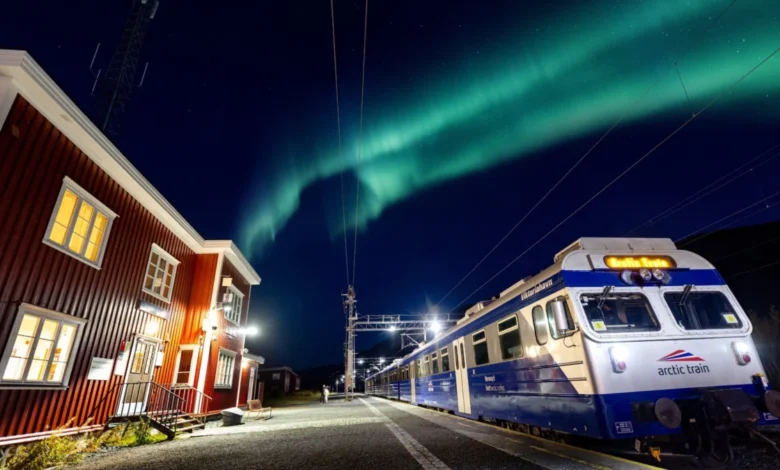
Travelers looking to see the northern lights this winter have a unique way to chase them: by train. As the 2026–27 aurora season reaches a critical juncture, the Northern Lights Train, operated by the Norwegian rail company Arctic Train, has emerged as a centerpiece of Scandinavian winter tourism. Departing from the coastal town of Narvik and traversing the rugged Ofoten Line toward the Swedish border, this specialized excursion offers an atmospheric, guided foray into the Arctic wilderness. While social media algorithms have occasionally conflated this service with futuristic, glass-ceilinged concepts born of artificial intelligence, the reality of the experience is grounded in history, geography, and the tangible pursuit of one of nature’s most elusive spectacles.
The Rise of the Arctic Train and the Myth of the Futuristic Carriage
Since its inception in 2022, the Arctic Train service has sought to bridge the gap between industrial history and modern tourism. However, the service saw a significant shift in its public perception during the winter of 2025. A series of viral, AI-generated images—depicting hyper-modern trains with floor-to-ceiling glass domes, reclining observatory seats, and integrated geomagnetic tracking systems—circulated globally. These images, while visually arresting, were entirely fabricated.
The actual experience, while devoid of digital displays and glass ceilings, offers something arguably more profound: a connection to the raw, unadulterated Arctic environment. The service is designed for the traveler who prioritizes authenticity over synthetic luxury. The train operates from October through March, a window carefully selected to align with the polar night, when the sun remains below the horizon for extended periods, maximizing the potential for aurora sightings.

Historical Context and the Ofoten Line
The route taken by the Arctic Train is steeped in significance. The Ofoten Line is not merely a tourist track; it is a vital artery of Norwegian history. Originally engineered to transport high-grade iron ore from the mines of Kiruna, Sweden, to the ice-free port of Narvik, the line has been essential to regional commerce for over a century. The construction of this railway at the turn of the 20th century was an engineering marvel, carving through mountainous terrain that was previously impassable in the harsh winter months.
Today, passengers traverse this same path, witnessing the dramatic transition from the fjords of the Norwegian Sea to the jagged, snow-dusted peaks of the interior. The train’s journey toward the Swedish border—specifically to remote stations like Bjørnfjell and Katterat—takes guests into an environment that remains inaccessible by road for most of the year. This isolation is a critical component of the tour’s success, as it places passengers in a landscape free from the light pollution of urban centers.
The Anatomy of the Aurora Expedition
The logistics of the excursion are meticulously planned to mitigate the unpredictability of solar phenomena. Tonny Mathiassen, general manager of Arctic Train, emphasizes that the service is structured as a comprehensive experience rather than a guaranteed spectacle. "The area is known for its stable climate with high chances of observing the northern lights," Mathiassen explains. "We have established a base camp at Katterat Station, a preserved historical site, which allows our guests to immerse themselves in the heritage of the region while waiting for the skies to clear."
The expedition involves a multi-modal approach:

- Departure: The journey begins in Narvik, where guests receive a briefing on the science of the aurora.
- Transit: As the train winds through the mountains, onboard documentaries provide historical context on the Sápmi people and the geological formation of the fjords.
- The Camp: At Katterat, the journey pauses. Guests disembark to enter a lavvu—a traditional Sápmi tent—where they are provided with hot beverages and snacks. This serves as a warming station and a communal hub for storytelling.
- Photography and Guidance: Because capturing the aurora requires specific camera settings and patience, guides are present to assist with long-exposure techniques.
Scientific Outlook: Why 2026–27 is a Prime Window
The scientific community has noted that the current period is particularly auspicious for aurora hunters. While the sun reached its solar maximum in October 2024, the subsequent two years often yield the most intense auroral activity as the sun enters a phase of "turbulent decline." Pål Brekke, a solar physicist at the Norwegian Space Agency, suggests that the geomagnetic disturbances occurring in the aftermath of the peak can result in frequent, vivid displays.
This phenomenon is due to the interaction between solar wind and the Earth’s magnetosphere. Because Narvik is situated roughly 130 miles north of the Arctic Circle, it sits in a favorable position relative to the auroral oval—the ring-shaped zone around the magnetic pole where the lights are most concentrated.
The Broader Landscape of Northern Rail Tourism
The success of the Arctic Train has highlighted a growing trend in "slow travel," where the journey becomes as integral as the destination. While dedicated aurora trains remain a niche segment of the global rail industry, several other regions have adapted their services to cater to this demographic.
In Finland, the Rovaniemi Insider Aurora Train offers a flexible schedule, allowing the train to halt if the aurora becomes visible, prioritizing the view over a strict timetable. In Canada, the route from Winnipeg to Churchill, Manitoba, has gained international acclaim. Churchill, located directly beneath the auroral oval, provides a stark, tundra-based backdrop that differs significantly from the mountainous fjords of Norway. Meanwhile, the Alaska Railroad’s Aurora Winter Train provides a 12-hour corridor from Anchorage to Fairbanks. While technically a daytime service, the early sunsets in Alaska’s interior mean that passengers are often on the move during prime darkness hours, making it a staple for those traveling in the high latitudes.

Implications for Regional Infrastructure
The rise of specialized winter rail tourism has necessitated upgrades to regional infrastructure in Northern Norway. Narvik, once primarily a transport and logistics hub, has transitioned into a year-round destination. The ease of access, facilitated by the proximity of the Harstad/Narvik Airport (Evenes) and the integrated rail connections from Oslo via the Nordland Line, has created a robust tourism ecosystem.
However, this growth brings challenges. The preservation of historical sites like Katterat Station is a priority for the regional government, as these locations are essential to the "Arctic experience" that tourists seek. Furthermore, the reliance on rail travel for tourism requires constant maintenance of tracks that are subjected to some of the most extreme weather conditions on the planet. The partnership between Arctic Train and the national rail authority ensures that the line remains operational even when snowdrifts reach several meters in depth, a testament to the durability of the original engineering designs.
Conclusion: Managing Expectations
Ultimately, the appeal of the Northern Lights Train lies in its honesty. By focusing on the historical, cultural, and geographical richness of the Arctic, the operators have created an experience that transcends the mere hunt for a light display. While the allure of the aurora is the primary draw, the inclusion of Sápmi cultural storytelling, the historical significance of the iron ore line, and the raw beauty of the Swedish-Norwegian borderlands provide a substantial itinerary regardless of the night’s solar activity.
For the modern traveler, the distinction between the viral, AI-generated fiction and the grounded, atmospheric reality of the Arctic Train is a reminder that the most compelling travel experiences are rarely the ones that look perfect on a screen. Instead, they are the ones that require travel into the dark, cold, and quiet corners of the world, where the reward is not just a photograph, but a deeper understanding of the environment and the history etched into the landscape.