Unearthing Veracruz: Inside Michelin-Starred Chef Lucho Martínez’s Culinary Homecoming and Mexico’s Overlooked Coastal Frontier

The state of Veracruz, stretching along the sun-bleached expanse of the Gulf of Mexico, has historically been viewed through a narrow lens of colonial ports, maritime shipping, and oil refineries. Yet, far from the heavily touristed enclaves of the Riviera Maya and Cabo San Lucas, a quieter Mexico thrives—one defined by volcanic gray-sand beaches, towering green mountain ranges, and pre-Columbian architectural marvels largely untouched by mass international tourism.
This juxtaposition between Mexico’s hyper-commercialized resort hubs and its wild, rugged hinterlands forms the backdrop of a culinary pilgrimage undertaken by Lucho Martínez, the chef and founder of Mexico City’s Michelin-starred restaurant, Em. For Martínez, returning to his home state is both a deeply personal homecoming and a calculated professional mission to reintroduce the world to Veracruz’s exceptional, yet underappreciated, agricultural wealth.
Main Facts: The Culinary Re-Discovery of Veracruz
Veracruz occupies a critical place in Mexican history, serving as the primary landing point for Spanish conquistadors in the 16th century. Geographically, the state is a narrow corridor bounded by the Sierra Madre Oriental mountains and the Gulf of Mexico, creating microclimates capable of yielding world-class coffee, high-grade vanilla, and rich indigenous produce.

Despite its historical and agricultural significance, modern domestic and international tourism has largely bypassed the region in favor of the Yucatán Peninsula or Baja California. Infrastructure challenges, including a three- to four-hour drive from major transit hubs like Mexico City or Veracruz City, have kept mass commercial developers at bay.
However, culinary leaders like Martínez are shifting the narrative. Sourcing approximately 90 percent of his restaurant’s ingredients directly from Veracruz—ranging from locally cultivated vanilla to specialized corn varieties—Martínez utilizes his platform to challenge the perception that the region is merely an industrial corridor. His efforts highlight an emerging shift in Mexican gastronomy: a move away from imported luxury ingredients toward hyper-local, historically grounded provenance.
Chronology of the Journey: From the Capital to the Gulf
The journey northward from Mexico City follows a deliberate geographic and cultural trajectory, tracing the steps of a chef reconnecting with his roots while mapping out the future of regional sourcing.
Morning Departure and Coffee Roots
The expedition began on a Saturday morning at Café Tormenta, Martínez’s coffee outpost in Mexico City, which exclusively brews beans harvested in Veracruz. The route immediately out of the capital requires navigating a narrow two-lane highway that winds upward into the towering, mist-shrouded peaks of the Sierra Madre Oriental.

The Vanilla Capital: Gaya Farm
Four hours into the drive, the landscape flattens into humid lowlands, leading to Gaya, a historic vanilla farm in San Rafael operated continuously by descendants of Italian immigrants who arrived in 1873. Historical records note that vanilla (Tlilxochitl), native to the tropical rain forests of Mesoamerica and originally cultivated by the Totonac people, was long misunderstood as an exclusive product of Madagascar. At the farm, Martínez inspects the curing process, emphasizing the physical characteristics of top-tier pods: flexibility, oiliness, and a rich, complex aromatic profile.
Midday Gastronomy in Gutiérrez Zamora
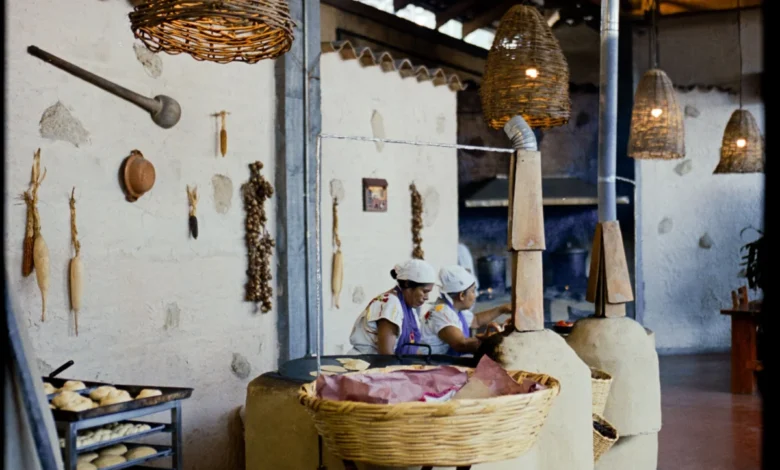
Continuing along the Tecolutla River, the route intersects with Gutiérrez Zamora, where a working lunch at La Galera, an open-air café, demonstrates the everyday baseline of coastal Veracruz cuisine. The menu features regional staples such as cheese empanadas, molotes (crispy deep-fried masa pockets filled with chicken), and thick, pillowy gorditas. Martínez’s appreciation for these vernacular flavors is so absolute that a sophisticated iteration of the regional gordita—topped with crème fraîche and imperial quantities of caviar—now anchors the tasting menu at his fine-dining establishment, Em.
Architectural Heritage: San Rafael and Maison Couturier
By late afternoon, the route navigates through dense corridors of banana plantations and lemon groves into San Rafael, a municipality heavily influenced by 19th-century French immigration. The area’s architectural footprint includes French Provincial structures, timber-shuttered windows, and pitched roofs. Here, Martínez is actively restoring a historic property, utilizing nearby Maison Couturier—a 19th-century agricultural estate transformed into a boutique design hotel by Grupo Habita—as a base during his intermittent returns from the capital.
Coastal Retreat: Hotel Azúcar and Costa Esmeralda
Further north along the Costa Esmeralda, where sun-bleached resorts line the dark volcanic sands, the journey pauses at Hotel Azúcar. Unlike the high-rise mega-resorts of Cancún, properties along this stretch of the Gulf maintain an unpretentious, low-impact footprint. Evenings here are defined by open-air, barefoot dining centered on freshly caught prawns and finfish grilled over open wood fires by local cooks.
Pre-Columbian Antiquity: El Tajín
The final leg of the journey loops inland to the UNESCO World Heritage archaeological site of El Tajín, built by the Totonac civilization. Featuring the Pyramid of the Niches—a striking six-tiered architectural masterpiece containing 365 carved niches corresponding to the solar year—the site stands in stark contrast to the crowded ruins of the Mayan Riviera. On a typical Sunday morning, visitors can walk the grounds in near-total solitude, a rarity in modern cultural heritage tourism. The trip concludes with a final meal at Nakú Restaurante Papanteco, an open-air establishment serving traditional tamales and hand-pressed corn tortillas prepared by local artisans.

Supporting Data and Agricultural Significance
Veracruz’s economic and ecological profile underscores its vital role in Mexican agriculture, a reality often overshadowed by its petrochemical industry.
- Agricultural Output: Veracruz ranks among Mexico’s top agricultural producers, leading national yields in citrus fruits (particularly limes and oranges), coffee, and vanilla.
- Vanilla Cultivation: While global markets are heavily dominated by production in Madagascar and Réunion Island, the Totonacapan region of northern Veracruz remains the historical cradle of Vanilla planifolia, where the orchid was first successfully domesticated and pollinated by indigenous populations prior to European contact.
- Tourism Disparity: According to national tourism metrics, the state of Quintana Roo (home to the Riviera Maya) welcomes millions of international air arrivals annually, whereas Veracruz receives a fraction of that international volume, relying instead on domestic weekend tourism from Mexico City and Puebla. This disparity has insulated the region’s culinary and architectural traditions from rapid homogenization.
Official Responses and Industry Perspectives
Culinary historians and regional authorities have increasingly recognized the strategic importance of culinary tourism in revitalizing economically isolated pockets of Mexico.
"The future of Mexican fine dining does not lie in replicating European techniques with imported goods, but in validating the deep historical memory embedded in our regional ingredients," notes a prominent food systems analyst based in Mexico City. "Chefs like Lucho Martínez act as critical bridges between rural agricultural producers and urban gastronomic markets, ensuring that small-scale farmers of vanilla, heirloom corn, and coffee receive the economic recognition they deserve."

Local tourism boards in Veracruz have likewise sought to promote the "Costa Esmeralda" and the Totonacapan cultural corridor as destinations for slow travel, emphasizing eco-tourism, archaeological preservation, and authentic culinary routes over mass-market resort development.
Broader Impact and Implications
The growing intersection of haute cuisine and rural exploration in Veracruz carries significant implications for regional economic development and cultural preservation.
By directing high-end supply chains away from major industrial distributors and toward family-owned agricultural enterprises—such as the historic vanilla farms of San Rafael—urban chefs help stabilize local economies against the volatility of traditional commodity pricing. Furthermore, the deliberate choice to highlight destinations like El Tajín and Gutiérrez Zamora demonstrates a viable model for sustainable tourism management.
As international travelers increasingly seek out authentic, unvarnished cultural experiences away from overcrowded hotspots, regions like Veracruz offer a compelling blueprint for the future of travel. By remaining "left to itself," the territory preserves the very qualities that make it invaluable: a living culinary heritage, profound historical continuity, and an uncompromising dedication to the unadorned rhythms of coastal Mexican life.