The aftermath of a powerful nor’easter that swept across the United States East Coast on Thanksgiving Day has triggered a new phase in the ongoing legal and environmental battle over the future of Washington, D.C.’s East Potomac Park. Following record-breaking coastal flooding that submerged large swaths of the municipal golf course, President Donald Trump declared the event an "Act of God," framing the destruction of the site as a justification to accelerate his administration’s plans to shutter the public facility and redevelop it into a private, championship-level golf course.
The storm, which resulted in widespread power outages for nearly one million residents and caused significant damage to regional infrastructure, left the low-lying East Potomac Park inundated with river water and debris. While the damage has prompted the Department of the Interior to officially close the course, the president’s public characterization of the event as divine intervention has reignited concerns among urban planners, environmental advocates, and legal experts regarding the viability of building high-end recreational infrastructure on a site that is increasingly vulnerable to climate-related hazards.
A Chronology of the East Potomac Dispute
The controversy surrounding East Potomac Park, often colloquially referred to as "Hains Point," has been a point of contention for much of the 2026 calendar year. The project has moved through several distinct phases:
- Early 2026: The administration signals intent to overhaul the municipal golf course, aiming to replace existing public links with a high-end, tournament-grade facility.
- May 2026: Investigative reports emerge indicating that demolition waste—reportedly debris from the dismantling of the White House’s old East Wing—was being transported to and dumped at the fourth hole of the East Potomac course. This move was tied to the construction of a new presidential ballroom.
- August 2026: Experts highlight the geographical risks of the island, noting that the area sits at sea level and relies on a 150-year-old seawall that has reached the end of its functional lifespan.
- November 14, 2026: District Judge Ana C. Reyes issues a temporary injunction blocking the immediate closure of the course, ordering that the facility remain operational for the public through mid-December.
- November 28, 2026: A Thanksgiving Day nor’easter causes severe coastal flooding, resulting in the physical closure of the park by the Department of the Interior due to safety concerns.
- November 29, 2026: President Trump utilizes social media to link the storm damage to his legal objectives, suggesting that the "obliteration" of the current course by nature removes the obstacles previously cited by the court.
The Geography of Vulnerability: An Environmental Assessment
East Potomac Park is a man-made island situated at the confluence of the Potomac and Anacostia rivers. Its vulnerability to flooding is not a new phenomenon; it is a fundamental aspect of its geography. Hydrological studies of the Potomac basin have consistently identified the island as a "floodplain-adjacent" zone.
The primary concern regarding the administration’s proposed development is the potential for "displacement flooding." According to environmental engineers, the construction of rigid, high-density golf infrastructure often involves increasing the elevation of terrain and installing non-porous surfaces or compacted soil. When a natural floodplain is obstructed, the volume of water displaced by these changes must find a new outlet.
"The water has to go somewhere," noted one urban planning consultant familiar with the site. "If you reinforce one section of the Potomac shoreline to protect a luxury course, you effectively create a damming effect. The hydrostatic pressure during a surge event will force that water into the adjacent National Mall, the Jefferson Memorial, or the residential neighborhoods of Southwest D.C."
The cost of mitigating such risks is significant. Taxpayers recently allocated over $100 million for the restoration of the seawall at the Jefferson Memorial, an investment that experts fear could be compromised if the hydrological balance of the river is disrupted by construction at the adjacent East Potomac site.
Legal and Political Implications
The legal landscape surrounding the park is currently defined by Judge Ana C. Reyes’s November ruling. The court’s initial decision to keep the park open was predicated on the preservation of public access to municipal land. The administration’s pivot to using the storm damage as a legal lever is an attempt to render the court’s previous order moot.
By labeling the destruction an "Act of God," the administration is attempting to invoke a common legal concept used in contract law to excuse non-performance or to justify a change in status. However, legal scholars suggest that this argument may face significant hurdles in a federal court. The argument hinges on whether the storm was an unforeseen, insurmountable event or a foreseeable consequence of the site’s known environmental profile.
"The court will likely examine whether the government has a duty to maintain the land for its current use," says a legal analyst. "The fact that the site flooded is not necessarily evidence that the site is ‘unusable’; it is evidence that the site is a flood-prone piece of parkland. Whether that necessitates a shift to a private golf course is a question of policy, not just a matter of weather."
Official Responses and Public Sentiment
The Department of the Interior, currently under administrative pressure to facilitate the project, has maintained that the closure is purely a matter of public safety. Debris removal and the assessment of structural damage to the greens and fairways are ongoing.
Conversely, community advocacy groups have expressed skepticism regarding the administration’s narrative. Critics argue that the characterization of the park as "Trash Island"—a term frequently used by the president—is a rhetorical device intended to devalue the land in the public consciousness, making its privatization appear as a "rescue" mission rather than a commercial land grab.
Public records requests have also highlighted concerns over the transparency of the dumping activities that occurred earlier this year. The discovery that demolition waste from the White House was used as fill material has sparked criticism from historic preservationists, who argue that the disposal methods were not compliant with environmental impact protocols required for national parkland.
Future Outlook for the Potomac Waterfront
As the winter season progresses, the administration is expected to petition Judge Reyes to lift the injunction, citing the Thanksgiving storm as proof that the existing infrastructure is beyond repair. The outcome of this request will have long-term implications for the Washington, D.C. waterfront.
If the project is allowed to proceed, it will represent one of the most significant changes to the capital’s public landscape in decades. If the court upholds the injunction, it will likely necessitate a comprehensive review of how the city manages its riverfront assets in an era of rising sea levels and more frequent extreme weather events.
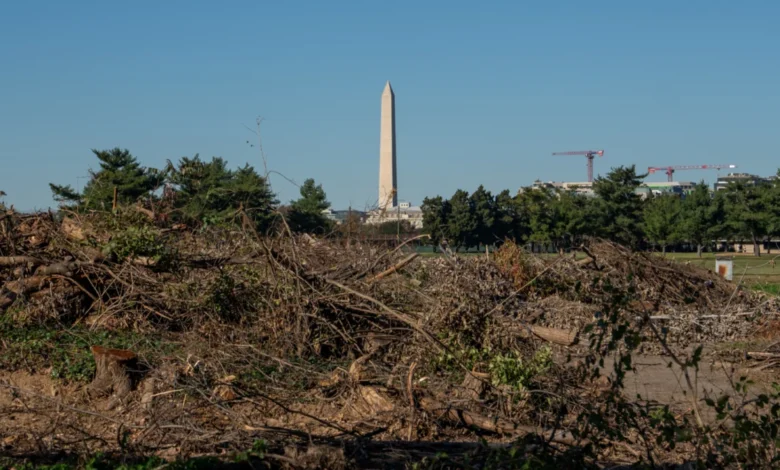
For now, East Potomac Park remains closed. The piles of debris and the damaged trees serve as a physical testament to the tension between ambitious development plans and the realities of a changing climate. Whether the site is destined to become a championship-level golf course or a protected, flood-resilient public space remains a decision that sits squarely in the hands of the judiciary.
As the legal proceedings resume in mid-December, the focus will remain on whether the government can demonstrate that the proposed transformation is in the interest of the public, or if it constitutes an unnecessary encroachment on one of the capital’s few remaining accessible, low-lying green spaces. The case serves as a microcosm of the broader national debate over public land usage, environmental responsibility, and the authority of the executive branch in managing municipal assets.
Related posts: