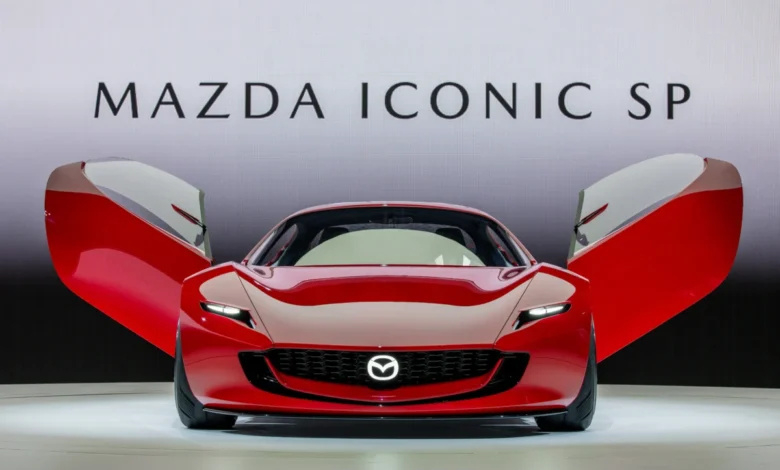
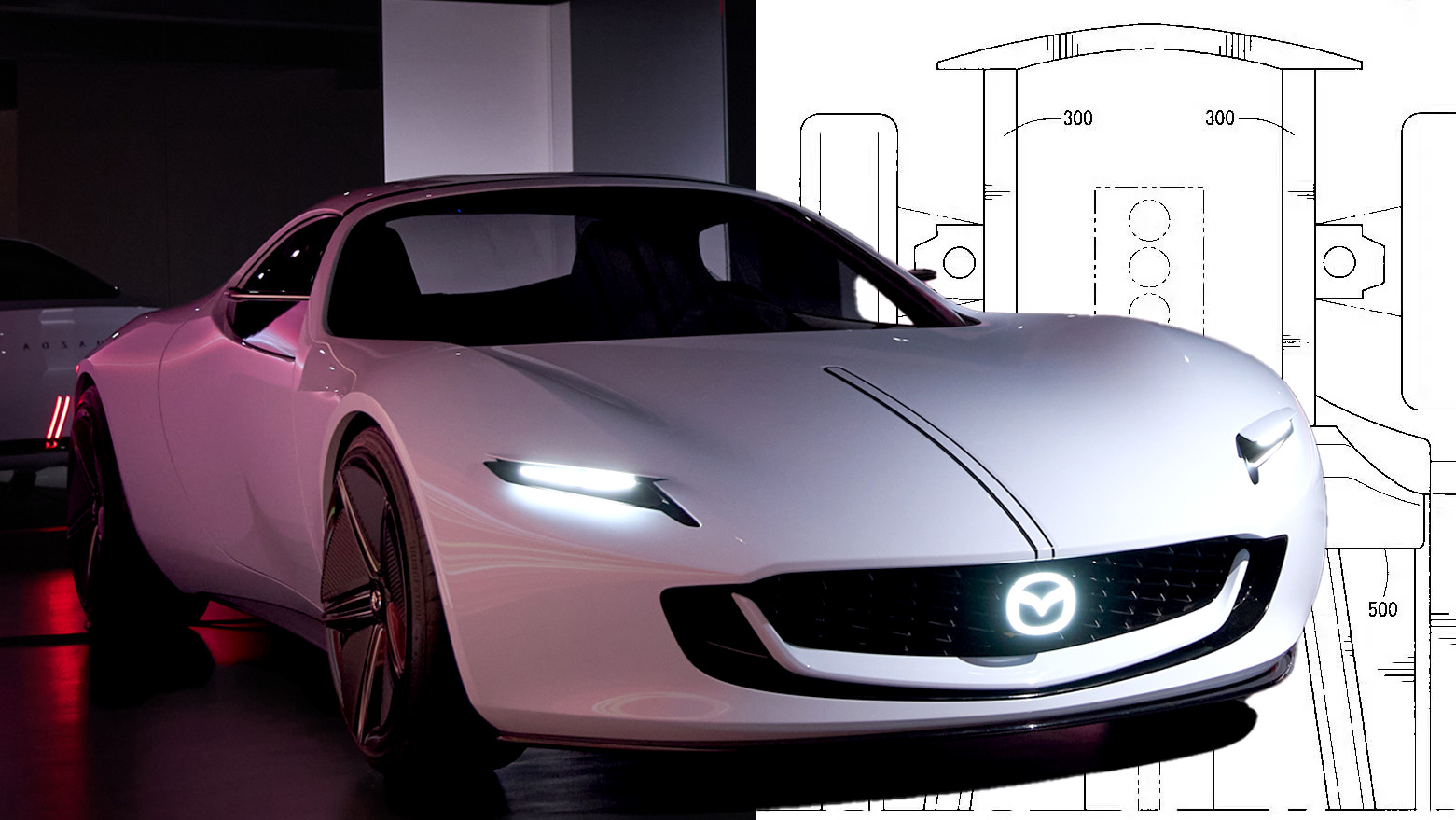
The automotive industry has been set abuzz following the discovery of two significant patent filings by Mazda Motor Corporation with the United States Patent and Trademark Office (USPTO). These documents, which surfaced via intellectual property trackers, describe a compact, front-engined, rear-wheel-drive convertible featuring a sophisticated butterfly door mechanism. While the patents do not explicitly name a specific model, the technical details provided offer a revealing glimpse into the future of Mazda’s sports car lineage, suggesting a potential successor to the iconic MX-5 Miata or a production iteration of the widely acclaimed Iconic SP concept.
The filings represent a departure from Mazda’s traditional door configurations, introducing a "flip-up side door" system that combines elements of scissor and butterfly hinges. This engineering choice, coupled with intricate chassis reinforcement sketches, signals that Mazda is actively developing a high-performance vehicle designed to balance lightweight agility with exotic-car aesthetics. Perhaps most notably, the technical drawings depict a longitudinal four-cylinder internal combustion engine, raising questions about the rotary-powered future Mazda had previously teased.
Technical Analysis of the Butterfly Door Mechanism
The first of the two patents focuses heavily on the structural integrity of the vehicle’s hinge pillars. In a traditional convertible, the absence of a fixed roof often necessitates heavy reinforcement in the lower chassis to maintain rigidity. Mazda’s engineers appear to be tackling this challenge through a unique architectural approach. The patent describes moving the A-pillars closer to the front shock towers, a move intended to maximize the chassis’s resistance to torsional forces.
The "flip-up" door mechanism is described as a system where the rear section of the door swings both outward and upward. This is not merely a stylistic choice; butterfly doors allow for easier ingress and egress in tight parking spaces while permitting a lower door sill, which can reduce the overall height and center of gravity of the vehicle. To support these doors without compromising safety, the filing details "bracing reins"—specialized structural members that transfer loads from the suspension mountings directly into the reinforced hinge pillars.
Furthermore, the patent introduces an "apron frame," a stamped-metal brace designed to link the front corners of the chassis to the firewall. This component is engineered to enhance front-end stiffness, ensuring that the steering response remains sharp and communicative, a hallmark of Mazda’s "Jinba Ittai" (horse and rider as one) philosophy.

Crash Structure and Powertrain Configuration
The second patent filing delves into the vehicle’s safety architecture and powertrain layout. The sketches illustrate a comprehensive crash structure designed to channel collision energy away from the passenger cell. According to the document, external forces acting on the front of the vehicle are redirected through the firewall and into the side sills and rear sections of the chassis. This sophisticated load-path management is critical for a small, lightweight vehicle to meet modern global safety standards.
Of significant interest to enthusiasts is the depiction of the powertrain. Unlike the Mazda Iconic SP concept, which was showcased with a dual-rotor rotary EV system acting as a range extender, these patent drawings clearly show a traditional longitudinal four-cylinder engine paired with a conventional transmission tunnel. This suggests several possibilities:
- The vehicle could be the next-generation (NE) MX-5 Miata, staying true to its naturally aspirated or turbocharged four-cylinder roots.
- Mazda may be considering a more traditional internal combustion engine (ICE) version of the Iconic SP to appeal to markets where EV infrastructure is less developed.
- The drawings are illustrative of a modular platform capable of housing both rotary-hybrid and traditional four-cylinder configurations.
A Chronology of Mazda’s Sports Car Ambitions
To understand the context of these patents, one must look at Mazda’s recent history of concept reveals and executive statements. The brand has been consistent in its messaging that sports cars remain the "soul" of the company, even as it transitions toward a more premium SUV-focused lineup.
- November 2022: Mazda releases a "Vision Study Model" in a corporate video, showing a sleek, white coupe with doors that appeared to open upward.
- October 2023: The Iconic SP concept debuts at the Japan Mobility Show. It features a rotary-EV powertrain producing roughly 365 horsepower and stunning "Viola Red" paint.
- February 2024: Mazda’s "Rotary Engine Development Group" is officially reinstated, tasking engineers with evolving the rotary engine for the electrified era.
- April 2024: Mazda executives suggest that the Iconic SP could enter production if public reception remains high, noting that the car’s size is intentionally flexible to accommodate different powertrains.
- July 2024: Discovery of the USPTO butterfly door and chassis patents, providing the first technical evidence of a production-ready sports car architecture.
The MX-5 vs. Iconic SP Dilemma
The automotive community is currently divided on which vehicle these patents represent. The MX-5 Miata has been in production since 1989 and is currently in its fourth generation (ND). While the ND has received several updates, it is nearing the end of its lifecycle. Mazda has confirmed that the next MX-5 will be electrified to some degree, but they have pledged to keep it light. The inclusion of heavy, complex butterfly doors in an MX-5 seems unlikely given the car’s historically affordable price point and "back-to-basics" ethos.
Conversely, the Iconic SP was positioned as a more premium, "halo" sports car—a spiritual successor to the RX-7. Butterfly doors are a staple of the supercar and high-end sports car segments (such as McLaren or the BMW i8), making them a natural fit for a production Iconic SP. If Mazda intends to move upmarket, a flagship coupe with exotic door hinges and a highly rigid chassis would serve as a powerful brand statement.
Industry Implications and Market Context
Mazda’s decision to patent such a specific structural design indicates that they are not merely "blue-sky" dreaming but are preparing for the realities of manufacturing. In an era where many manufacturers are abandoning small, dedicated sports car platforms in favor of shared architectures (such as the BMW Z4 and Toyota Supra partnership), Mazda’s independent development is noteworthy.

The focus on an "apron frame" and "bracing reins" suggests a car that will prioritize driving dynamics over raw power. This aligns with the current market gap left by the electrification of the Porsche 718 Cayman and Boxster. By offering a lightweight, ICE or hybrid-assisted sports car with exotic design elements, Mazda could capture enthusiasts who feel alienated by the industry’s shift toward heavy, battery-electric performance cars.
Industry analysts suggest that if these patents lead to a production vehicle, it will likely feature Mazda’s upcoming "Skyactiv-Z" engine technology. This new engine family, expected to debut around 2027, aims to use high-efficiency combustion cycles to meet stringent Euro 7 and EPA emissions standards without sacrificing the linear power delivery that sports car drivers crave.
Potential Official Responses and Corporate Strategy
While Mazda has not issued a formal statement regarding these specific patent filings, the company’s recent financial reports highlight a "multi-solution" approach to CO2 reduction. This strategy involves developing EVs while simultaneously refining internal combustion engines and exploring carbon-neutral fuels.

In recent press briefings, Mazda CEO Masahiro Moro emphasized that the company’s future depends on "delivering the joy of driving" to customers. The development of a new sports car platform, as evidenced by these patents, serves as an internal morale booster for Mazda’s engineering teams and a marketing beacon for the brand’s loyal fan base.
Conclusion: What Lies Ahead?
The filing of these patents confirms that Mazda is far from finished with the sports car segment. Whether these butterfly doors will eventually open on a showroom-ready MX-5 or a new RX-branded flagship, the technical focus on rigidity, crash safety, and driver engagement is clear.
The absence of a rotary engine in these specific drawings may be a strategic move to ensure the platform’s viability across different global markets, or it may simply be a placeholder for the mechanical layout. Regardless, the automotive world now has concrete evidence that Mazda is engineering a vehicle that aims to be as beautiful to look at as it is rewarding to drive. As the 2025 and 2026 auto show seasons approach, the industry will be watching closely for a concept-to-production transition that incorporates these innovative designs.