The Ultimate Guide to Choosing the Best Smart Speaker in 2026 for Every Ecosystem and Lifestyle

Smart speakers have evolved far beyond simple novelty items that play music or read the morning weather report. In the modern connected household, these devices act as the central nervous system of automated living. They function simultaneously as high-fidelity audio systems, voice-activated virtual assistants capable of complex contextual reasoning, and foundational smart home hubs that bridge the gap between disparate IoT protocols like Matter, Thread, and Zigbee. Selecting the right smart speaker requires a careful evaluation of hardware performance, audio fidelity, ecosystem integration, and privacy preferences.
The Evolution of the Smart Home Hub
The smart speaker market has undergone a significant transformation since voice-activated assistants first entered mainstream consumer consciousness a decade ago. Early iterations were largely reactive, relying on rigid keyword triggers and isolated commands to execute basic tasks like setting kitchen timers or checking local forecasts. Today, the landscape is defined by ambient computing, deeply integrated artificial intelligence models, and interoperability standards designed to eliminate walled gardens.
Throughout the mid-2010s, tech giants vied for market dominance by forcing consumers to choose between tightly controlled ecosystems. However, the introduction of universal connectivity standards such as Matter has begun to democratize the smart home. Modern smart speakers no longer just connect to proprietary lightbulbs or thermostats; they serve as local edge routers that help unify various devices, ensuring faster response times and enhanced local security.
As hardware capabilities have matured, consumer expectations have shifted. Buyers now demand room-filling audio quality from compact form factors, advanced microphone arrays capable of isolating voice commands from background noise, and robust privacy controls. Furthermore, the integration of generative AI and large language models into smart assistants has redefined how users interact with voice technology, enabling multi-step, contextual commands that mimic human conversation.
Amazon Echo Dot Max: The Most Versatile Choice for the General Consumer
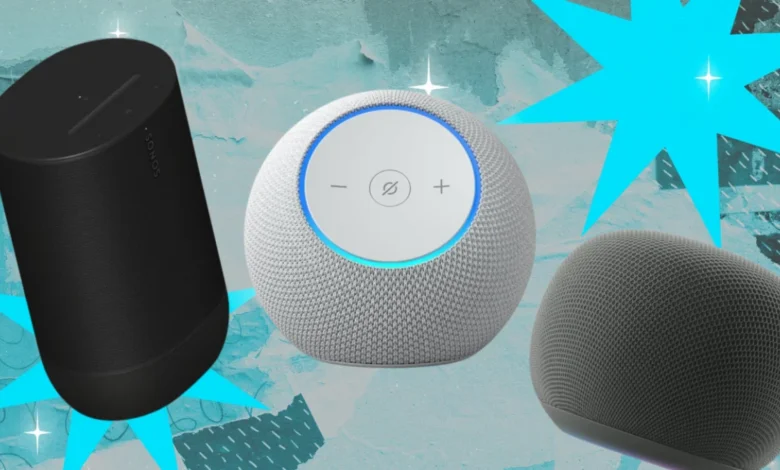
For households that do not wish to be locked into a single technology ecosystem, Amazon’s Echo lineup remains the most flexible and widely adopted option on the market. Among Amazon’s extensive catalog, the Amazon Echo Dot Max stands out as the premier mid-tier choice, balancing advanced features, robust connectivity, and cost-effectiveness.
The Echo Dot Max is engineered to occupy the sweet spot between affordability and high-end performance. According to industry hardware evaluations, the device is capable of comfortably filling a modestly sized room with balanced, clear acoustics suitable for casual music listening, podcasts, and daily announcements. While it lacks the directional audio separation found in larger, dedicated music systems, its sonic profile is remarkably well-tuned for its size class.
Beneath the fabric exterior lies a robust suite of modern connectivity standards. The Echo Dot Max features support for Wi-Fi 6E, Bluetooth 5.3, and LE Audio, ensuring stable, low-latency connections across multiple devices. Crucially for smart home enthusiasts, it supports the Matter, Thread, and Zigbee protocols, allowing it to communicate natively with a vast array of third-party hardware regardless of manufacturer. Additionally, the device is packed with environmental sensors—including temperature, ultrasonic presence detection, Wi-Fi radar, and ambient light sensors—enabling complex automation routines based on real-time room conditions.
Powered by Amazon’s Alexa ecosystem, the Echo Dot Max also integrates the company’s advanced Alexa+ AI assistant. This integration allows for more natural, conversational interactions, expanding the utility of the speaker well beyond basic smart home management. Its platform-agnostic nature makes it an ideal fit for users who mix and match operating systems, seamlessly bridging Windows PCs, iOS devices, Android hardware, and various streaming services.
Google Home: The Ultimate Hub for Google and Gemini AI Users
For consumers deeply embedded in the Google ecosystem, the reimagined Google Home speaker represents a significant leap forward in smart assistant technology. Marking Google’s first major dedicated smart speaker refresh since the Nest Mini in 2019, the new hardware marries a sleek, modern aesthetic that draws design cues from both the Nest Mini and the HomePod mini.
The defining characteristic of the 2026 Google Home speaker is its native integration with Google’s Gemini AI architecture. Unlike legacy assistants that stumble over compound requests or lose the thread of a conversation, Gemini empowers the speaker to interpret complex, contextual commands. Users can seamlessly string multiple requests together or make real-time corrections mid-sentence. For instance, an owner can ask about weather conditions tailored specifically to their favorite sports team’s upcoming itinerary, provided the assistant has been previously primed with that contextual data. Advanced features, however, often require a Google Home subscription tier to unlock their full analytical potential.

From an audio perspective, the Google Home punches well above its weight class. Equipped with a compact 58mm internal driver, the device delivers markedly improved bass response and sound clarity compared to its predecessor. Audio industry testing has praised it as one of the best-sounding speakers in the sub-$100 price bracket, making it an attractive proposition even for casual users who may not be fully committed to Google’s software ecosystem. Furthermore, deep integration with the Google Home app allows for advanced home security queries, such as asking Gemini to review captured camera footage to determine specific household events that occurred while the user was away.
Apple HomePod mini: Precision Audio and Ecosystem Cohesion for Apple Users
Apple enthusiasts utilizing iPhones, Mac computers, Apple TVs, and Apple Music will find that the HomePod mini delivers an unmatched level of ecosystem synergy. As one of the few mainstream smart speakers to natively support Siri, the HomePod mini acts as a seamless extension of the Apple user experience.
Setup and daily operation within an Apple-centric household are frictionless. The HomePod mini allows users to instantly add items to Apple Reminders, send iMessages, query the Find My network to locate misplaced devices, and manage HomeKit-enabled smart home accessories through the native Home app. Privacy is a core pillar of the device; Apple utilizes on-device processing for many Siri requests, ensuring that personal voice queries remain secure.
The speaker’s voice-recognition capabilities can distinguish up to six distinct family members, tailoring responses and media recommendations to the individual speaking. Multi-room audio management is handled effortlessly through AirPlay 2, and households with multiple units can utilize the intercom feature to broadcast voice messages between rooms. For entertainment setups, pairing a HomePod mini with an Apple TV elevates movie and music playback, while proximity-based handoff lets users transfer music playing on an iPhone simply by bringing the device close to the speaker.
Despite its diminutive physical footprint, the HomePod mini utilizes advanced computational audio algorithms to simulate the acoustic breadth of a much larger speaker. It delivers crisp high frequencies, clear mids, and a surprisingly punchy bass profile, cementing its status as the premier compact smart speaker for Apple loyalists.
Sonos Move 2: Premium Portable Audio for Flexible Environments
While the vast majority of smart speakers are engineered to remain stationary on a kitchen counter or living room shelf, the Sonos Move 2 breaks the mold by offering full battery-powered portability without compromising on audio fidelity or smart functionality.
Encased in a ruggedized housing with an IP56 rating against dust and moisture ingress, the Sonos Move 2 is designed to withstand outdoor environments, from backyard patios to beach outings. Its acoustic architecture features dual left- and right-channel tweeters designed to project expansive stereo sound, supported by a precision-tuned woofer that delivers deep, resonant bass even at moderate listening volumes.
Versatility is a hallmark of the Sonos ecosystem. The Move 2 supports Sonos Voice Control alongside Amazon Alexa, offering dual voice assistant capabilities. It also integrates seamlessly with Wi-Fi networks for home audio grouping and supports Apple AirPlay 2. While it relies on an older Bluetooth 5.0 standard for direct mobile pairing, its overall connectivity suite remains robust. The primary barrier to entry for the Sonos Move 2 is its premium price point, which significantly outpaces standard desktop smart speakers. However, for consumers who demand uncompromising audio performance that can transition effortlessly between indoor smart home duties and outdoor entertainment, the Sonos Move 2 represents the pinnacle of portable smart audio engineering.
Market Implications and the Future of Connected Living
The ongoing refinement of smart speakers highlights a broader industry shift toward ambient intelligence and hardware consolidation. As voice assistants transition from novelty command-line tools to deeply contextual AI partners, consumer expectations regarding privacy, data security, and local processing power have intensified.
Industry analysts note that the success of future smart home devices will hinge on interoperability and transparency. Standards like Matter have reduced consumer anxiety regarding platform lock-in, forcing manufacturers to compete more aggressively on hardware quality, acoustic engineering, and AI utility rather than proprietary ecosystem walls. As these technologies mature, smart speakers will continue to anchor the modern automated home, bridging the gap between human intent and digital execution with increasing sophistication.