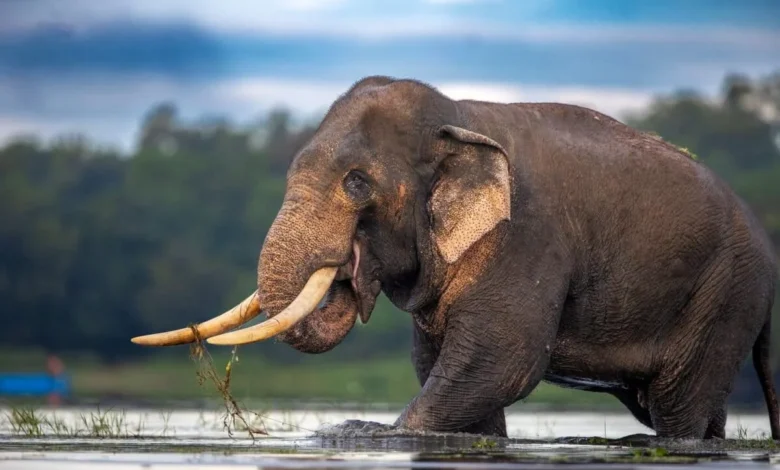
The death of Kavantissa, one of Sri Lanka’s most legendary wild tuskers, has catalyzed a profound national conversation regarding the state of wildlife conservation and the escalating volatility of the human-elephant conflict. Following a fatal encounter with a suspected trap gun, the elephant’s prolonged decline and subsequent death on October 16 ignited a fervor of public grief, political scrutiny, and intense criticism directed at the Department of Wildlife Conservation (DWC). The demise of this majestic animal, named after an ancient Sinhala king, has served as a poignant, if tragic, catalyst for reassessing the country’s approach to managing its iconic megafauna in an increasingly fragmented landscape.

A Timeline of the Final Days
The plight of Kavantissa began to garner public attention in late September 2026, when observers noted a distinct change in his gait. Known for his imposing stature and typically gentle temperament, the tusker was frequently documented by wildlife photographers in the Galgamuwa region. His movements were a testament to the precarious nature of life for elephants navigating the thin margin between protected habitats and agricultural expansion.
- September 22: Kavantissa was first observed limping, a sign that he had likely fallen victim to a "trap gun"—a crude, illegal, and indiscriminate explosive device often used by farmers to deter crop-raiding wildlife.
- September 24: The Department of Wildlife Conservation (DWC) initiated medical intervention, administering initial rounds of antibiotics via dart.
- September 25: Veterinarians sedated the animal to conduct a more thorough examination and treatment.
- October 2: After a brief period where the DWC reported signs of recovery, the tusker became elusive, failing to appear for scheduled monitoring.
- October 5: The situation took a dire turn as observers reported the onset of severe diarrhea, a clinical symptom often associated with advanced infection or systemic organ distress in elephants.
- October 15: The animal’s health reached a critical threshold, leading to a physical collapse.
- October 16: Despite a desperate, high-profile effort by a team of veterinarians to resuscitate the bull—including attempts at cardiopulmonary resuscitation (CPR)—Kavantissa succumbed to cardiac arrest at approximately 6:18 p.m.
Public Outcry and Political Mobilization
The final hours of Kavantissa’s life were marked by a surreal intersection of grief and governance. High-ranking political figures, including opposition leader Sajith Premadasa and Environment Minister Dhammika Patabendi, visited the site, their presence documented in viral imagery that underscored the cultural significance of the elephant. Buddhist monks performed traditional Pirith chants, while private sector leaders offered to subsidize the costs of specialized foreign veterinary intervention.

This mobilization, while demonstrating deep cultural empathy, also highlighted the frustration of a public that views the current wildlife management strategy as inadequate. Social media platforms became arenas for "digital trials," with users scrutinizing video footage of the rescue attempts. Allegations of negligence, including claims of potential antibiotic overdoses and the efficacy of the darting procedures, circulated rapidly. While these claims remain speculative and lack clinical substantiation, they reflect a profound loss of institutional trust.
Statistical Context: The Human-Elephant Conflict
The tragedy of Kavantissa is far from an isolated incident. Sri Lanka is currently grappling with a severe crisis in wildlife management, where the survival of the Elephas maximus maximus is constantly threatened by the encroachment of human activity into traditional migratory corridors.

According to data released by the DWC, the annual death toll for wild elephants remains alarmingly high:
- 2023: 488 total elephant deaths, with 98 attributed directly to gunshot injuries.
- 2024: 388 total elephant deaths, with 84 linked to gunfire.
- 2025: 455 total elephant deaths, with 79 recorded as gunshot-related.
These figures illustrate that while the total number of shooting-related deaths has seen a marginal decline, the practice remains a systemic threat. The reliance on trap guns and improvised firearms is a direct byproduct of the struggle between rural farming communities and elephant populations. When farmers lose their livelihoods to crop damage, the subsequent retaliatory actions—or the installation of defensive booby traps—inevitably result in the slow, agonizing death of animals like Kavantissa.

Professional Perspectives on Clinical Care
The DWC has faced significant pressure to defend its clinical procedures. Director General Ranjan Marasinghe has maintained that the agency’s response was both standard and comprehensive, involving a coordinated effort between senior veterinarians. "When an iconic tusker like Kavantissa is injured, our team of veterinarians act together as a team," Marasinghe stated. "We also welcome opinions of other senior veterinarians in the country who excel in treating elephants, so it is a planned operation."
However, experts in the field suggest that the focus on individual cases may be obscuring deeper systemic failures. Tharaka Prasad, the former director of wildlife health, emphasized the need for a forensic, evidence-based approach rather than reactionary analysis. He noted that the clinical progression—marked by feeding difficulties and gastrointestinal distress—demands a rigorous review of medical records and a comprehensive post-mortem to determine the exact cause of death, moving beyond the emotional narrative that has dominated public discourse.

Beyond the Tusker: The Need for Structural Reform
Prithiviraj Fernando, a leading scientist at the Center for Conservation and Research (CCRSL), has argued that the intense focus on "iconic" animals may actually be counterproductive to long-term conservation. Fernando posits that from an ecological standpoint, the loss of a famous tusker is no different from the loss of any other elephant, yet the media cycle around such individuals creates a false sense that the species is being protected through specialized, case-by-case attention.
"Ultimately, the only effective way to protect iconic tuskers, or any other elephant, is to protect elephants in general and address the wider threats they face," Fernando stated. He suggests that the assumption that one can provide 24-hour surveillance for individual animals is logistically impossible given the vast, dense, and fragmented nature of the elephants’ habitats.

Instead, the focus must shift to landscape-level management. This includes creating corridors that allow for natural movement, reducing the dependency of farmers on firearms by providing more effective, non-lethal deterrents, and addressing the root causes of habitat fragmentation.
The Legacy of Kavantissa
Following the confirmation of death, the DWC oversaw a formal, albeit somber, process. The tusker’s head was separated from the body to ensure that the tusks—a target for poachers—were secured in a government-monitored facility, while the remainder of the carcass was cremated at the site of death.

This decision, however, has sparked its own debate. Some conservationists, including Fernando, have questioned the wisdom of preserving the tusks. He argues that by retaining the ivory, the state inadvertently keeps alive the idea that the tusks have intrinsic, extractable value. A more powerful symbolic gesture, he suggests, would have been the total cremation of the remains, signaling that the life of the animal far outweighs the value of its ivory.
As the dust settles on the passing of Kavantissa, the challenge for Sri Lanka remains significant. The public outcry has provided a rare window of political opportunity to address the human-elephant conflict with a long-term, structural mandate. Whether the government will move beyond the reactive, high-profile mourning of "iconic" figures and toward a sustainable coexistence policy remains to be seen. For now, Kavantissa stands as a solemn symbol of a heritage that is being slowly eroded by the friction of a developing nation and its most majestic, yet vulnerable, inhabitants.
Related posts: