The Rise of the Hale End Prodigy: Max Dowman Orchestrates Arsenal’s Clinical Carabao Cup Progression

The prevailing narrative in English football currently suggests that the competitive landscape is shifting, and for the rest of the Premier League, the bad news is that Arsenal’s next generation has officially arrived. In a dominant display of tactical maturity and individual brilliance, Arsenal dismantled Ipswich Town in their Carabao Cup third-round encounter, signaling the arrival of 16-year-old playmaker Max Dowman. The teenager’s man-of-the-match performance, featuring two exquisitely taken goals, drew immediate comparisons to Lionel Messi—a parallel previously drawn by manager Mikel Arteta, who has been carefully managing the youngster’s development. Alongside Dowman, 17-year-old defender Marli Salmon delivered a performance of poise and technical superiority, marking only his second senior start and cementing the reputation of the club’s Hale End academy as a factory for elite talent.
A Historical Context of the Fixture
The fixture carried a weight of historical irony. Ipswich Town, once a formidable cup specialist, had famously defeated Arsenal in their last meeting in this competition back in 2011. That two-legged semi-final clash saw Ipswich win the first leg before Arsenal overturned the deficit at the Emirates, only to suffer a painful defeat to Birmingham City in the final—a moment that remains a scar on the club’s recent history.
Fifteen years later, the dynamics have shifted significantly. Gary O’Neil, now at the helm of a heavily invested Ipswich side, found his team unable to contend with the depth and tactical fluidity of a rejuvenated Arsenal. While Arsenal are currently riding a wave of momentum—having secured seven wins from seven matches in the opening of the new campaign—O’Neil opted to utilize the Carabao Cup to integrate recent high-profile signings and provide game time to a rotated squad. However, the gulf in class between the established title contenders and the ambitious newcomers proved insurmountable.
The Match Chronology: A Masterclass in Efficiency
From the opening whistle, the tone was set by the technical discipline of Arsenal’s youngsters. Arteta’s decision to experiment with his lineup saw Marli Salmon positioned in central defense alongside the experienced Gabriel Magalhães, while midfielder Martin Zubimendi was asked to operate in an unconventional role at right-back.
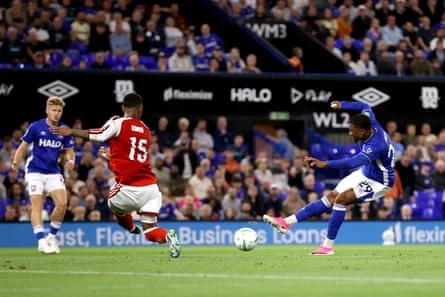
The breakthrough occurred in the seventh minute. Max Dowman, whose progression has been managed with extreme caution following his GCSE exams and a high-profile summer excursion to New York, seized his opportunity with ruthless efficiency. After muscling Santiago Núñez off the ball near the halfway line, Dowman embarked on a driving run toward the Ipswich penalty area. Facing the formidable 6ft 3in Cédric Kipré, Dowman utilized a series of rapid, deceptive feints to bypass the defender before calmly slotting the ball into the far corner. The celebration—a quintessential Thierry Henry-style knee slide—served as a symbolic passing of the torch from one generation to the next.
Arsenal doubled their lead shortly after when Noni Madueke capitalized on a clever build-up play involving Bruno Guimarães and stand-in captain Mikel Merino. By the 15th minute, the match had effectively been settled. Despite the deficit, Ipswich demonstrated resilience; Zian Flemming nearly found a route back into the game, only for a goal-line clearance from the composed Marli Salmon to preserve the clean sheet. Salmon’s defensive work, coupled with his ability to turn out of tight spaces under pressure, drew audible admiration from the Arsenal technical area.
The second half began with the same intensity. Two minutes after the restart, Dowman struck again, meeting a precise pass from Zubimendi at the edge of the six-yard box to calmly beat Christian Walton. Although Mikel Merino added a fourth with a curling effort off the post, Ipswich managed to find two late consolation goals—one through Anis Mehmeti and another in injury time from former Arsenal man Chuba Akpom—but these were mere footnotes in a night dominated by the emergence of the visitors’ teenage core.

Statistical Breakdown and Tactical Implications
The inclusion of youth in this fixture was not merely a gesture of rotation; it was a testament to the current depth of the Arsenal squad. By the final whistle, four teenagers were on the pitch for the Gunners: Max Dowman, Marli Salmon, 19-year-old Myles Lewis-Skelly, and 18-year-old Theo Julienne.
Data from the match highlights the efficiency of Arsenal’s high press, which forced significant errors from the Ipswich backline. Arsenal’s ability to transition from defense to attack was facilitated by the versatility of players like Zubimendi, who successfully executed 88% of his passes while playing in an unfamiliar defensive role. Conversely, Ipswich’s reliance on a singular defensive setup proved costly, with the team struggling to contain the pace of Arsenal’s wing-play and the clinical movement of Dowman, who maintained a 100% conversion rate on his shots on target during the 90 minutes.
Official Perspectives and Post-Match Analysis
Speaking on the development of his young squad, Mikel Arteta remained characteristically measured, yet clearly satisfied. "The environment we have created allows these players to thrive," the manager noted in his post-match briefing. "Max has had to earn his minutes through training and by showing that he understands the tactical requirements of our system. His performance tonight was a result of that process, not an accident."
While Arteta declined to lean too heavily into the comparisons between Dowman and legendary figures of the game, the reality of the teenager’s performance has already created a buzz within the league. For Gary O’Neil, the evening was a sobering lesson in the requirements of top-flight football. "We were punished for individual lapses in concentration early on," O’Neil stated. "Against a side as organized as Arsenal, you cannot afford to lose the ball in the middle of the park, especially against players with the quality of Dowman."
Broader Impact: The Arsenal Model
The broader implication of this victory is that Arsenal have moved beyond the "rebuilding" phase and into a period of sustained competitive dominance. By integrating academy products like Salmon and Dowman into a team that is already fighting for major honors, Arteta is ensuring that the club’s success is not limited to a single starting eleven.
Furthermore, the club’s recent financial strategy, which included significant investments in players like Merino and Guimarães, has provided a stable foundation that allows the youth to play without the burden of carrying the team. The synergy between experienced professionals and academy graduates creates a "meritocracy of effort," where players are rewarded based on current form rather than historical status.
As the Carabao Cup progresses, Arsenal’s ability to navigate these fixtures with such ease suggests they are serious contenders for a domestic clean sweep. The emergence of Max Dowman, in particular, provides an unpredictable element to their attacking play—a player who possesses the technical flair to break down low blocks and the physical intelligence to win the ball back in dangerous areas.
For the rest of the Premier League, the message is clear: Arsenal’s recruitment, combined with an academy that is currently producing high-ceiling prospects at an unprecedented rate, has created a blueprint for success that is proving difficult to disrupt. With the next generation already proving they can perform on the senior stage, the North London side looks well-positioned to maintain its current trajectory throughout the grueling winter schedule. The fixture against Ipswich will likely be remembered not for the result, but as the night the league was introduced to the next great hope of Hale End.