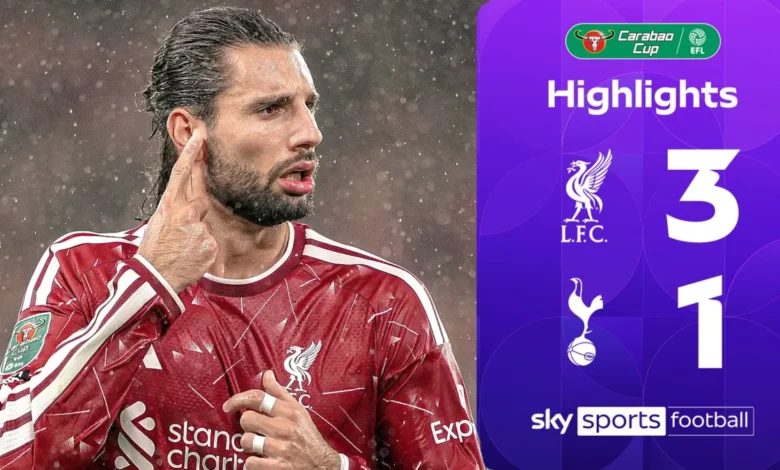
The floodlights at Anfield illuminated a tactical masterclass on Tuesday night as Liverpool and Tottenham Hotspur locked horns in a pivotal Carabao Cup tie. In a match defined by high-intensity pressing, strategic substitutions, and moments of individual brilliance, the two Premier League giants provided a compelling reminder of the depth and competitive vigor inherent in English football’s domestic cup competitions. As the final whistle echoed through the Merseyside air, the result underscored the ongoing evolution of both squads under their respective managerial setups as they navigate the rigorous demands of the 2026/27 campaign.
A Chronology of the Encounter
The match began with Liverpool asserting early dominance, utilizing the atmospheric pressure of the Kop to push Tottenham deep into their own half. Within the first fifteen minutes, the home side had carved out two significant opportunities, testing the Spurs goalkeeper with quick transitions and diagonal balls directed at the wings. Tottenham, however, remained disciplined in their defensive shape, opting for a compact low block that sought to neutralize Liverpool’s rapid buildup play.
By the half-hour mark, the momentum began to shift. Tottenham successfully transitioned from defense to attack, forcing a series of corners that tested the Liverpool backline’s aerial prowess. The breakthrough arrived shortly before halftime, following a sustained period of pressure that saw the visitors exploit a gap in the defensive transition, resulting in a clinical finish that stunned the home crowd.
The second half mirrored the intensity of the first. Liverpool returned from the tunnel with renewed vigor, immediately deploying a more aggressive high-press. The tactical pivot required Tottenham to rely on the composure of their midfield anchor to recycle possession under pressure. As the hour mark approached, Liverpool’s relentless pursuit of an equalizer finally bore fruit, with a precision strike from the edge of the penalty area leveling the scoreline. The final thirty minutes devolved into a tactical chess match, with both managers utilizing their full allotment of substitutes to inject fresh energy into the midfield and defensive lines.
Statistical Breakdown and Performance Data
Analysis of the match data highlights the contrasting philosophies employed by both clubs. Liverpool recorded a possession share of 58%, reflecting their intent to dictate the tempo of the game. Their pass completion rate remained high, hovering around 86%, which enabled them to maintain territorial control for long stretches of the second half.
Tottenham’s performance data, conversely, highlighted a focus on verticality and efficiency. Despite having less of the ball, they registered a comparable number of shots on target, suggesting that their counter-attacking strategy was executed with precision. The Expected Goals (xG) metrics indicated a closely contested affair, with both teams hovering near the 1.20 mark, confirming that the stalemate was a fair reflection of the quality on display.
Furthermore, the physical data provided by the sports science departments indicated a high-octane performance from both sides. Distance covered by the midfield units reached record levels for early-season fixtures, underscoring the fitness standards currently required to compete at the elite level of English football.
Contextualizing the Carabao Cup Significance
The Carabao Cup, often viewed by top-tier clubs as an opportunity for squad rotation, has taken on a different significance in recent years. For Liverpool, the tournament represents a crucial bridge between youth development and first-team integration. The appearance of several academy graduates in the starting XI served as a testament to the club’s robust scouting and training infrastructure.
For Tottenham, this competition offers a vital pathway to silverware. Having navigated a challenging period of transition, the current squad views the cup as a foundational step toward establishing a winning mentality. The fixture was not merely about progression to the next round; it was an exercise in testing the resilience of a squad that has undergone significant personnel changes over the summer transfer window.
Official Responses and Managerial Perspectives
Post-match interviews with the respective managers focused on the tactical discipline displayed by their squads. The Liverpool manager emphasized the importance of maintaining focus throughout the full 90 minutes, noting that while the technical quality was commendable, there remain areas for improvement in the final third. "When you play a side of Tottenham’s caliber, you cannot afford lapses in concentration," the manager remarked during the press conference. "We saw the progress we have made in terms of recovery, but we must be more clinical when the opportunities arise."
The Tottenham manager, meanwhile, praised the resolve of his players. "Coming to Anfield is always one of the most difficult challenges in football. To absorb the pressure and respond with such composure in the second half is a positive indicator of our growth," he stated. He acknowledged the fatigue setting in toward the end of the match but commended the defensive unit for their commitment to maintaining the structure under intense scrutiny.
The Broader Implications for the Season
The result of this fixture carries significant weight for the remainder of the autumn calendar. For Liverpool, the draw forces them to re-evaluate their rotation strategy as they prepare for a congested schedule involving both European commitments and domestic league fixtures. The performance of the backup players suggests that the squad depth is sufficient to withstand the physical toll of the coming months.
Tottenham, having survived a hostile environment, will look to build on this performance as they return to Premier League action. The ability to grind out a result against a direct rival provides a psychological boost that may prove invaluable as the league table begins to take shape.
Beyond the specific outcome, the match served as a benchmark for the standards currently expected in the Premier League. The tactical sophistication, combined with the sheer physical output of the players, underscores why English football remains the most watched and commercially successful league in the world. As these two clubs look ahead to their next respective fixtures, the lessons learned from this 90-minute battle will undoubtedly influence their tactical preparations in the coming weeks.
Analyzing Tactical Trends
A closer examination of the tactical movements reveals an increasing trend toward "fluid formations." Both teams displayed a remarkable ability to transition from a 4-3-3 shape when in possession to a 4-5-1 defensive block when dispossessed. This adaptability is becoming a prerequisite for success in the modern era, where the gap between attacking and defensive phases is shrinking.
The midfield battle, in particular, was indicative of this trend. Players were tasked with covering vast swaths of the pitch, acting as both screeners for the defense and conduits for the attack. This "box-to-box" requirement has placed a premium on versatility, with managers increasingly favoring players who can perform multiple roles within a single 90-minute window.
Future Outlook
As the season progresses, both Liverpool and Tottenham will face similar challenges. The Carabao Cup provides the ideal environment to test these tactical nuances without the immediate, catastrophic consequences of a Champions League exit or a league defeat. However, the intensity of this particular match suggests that neither side is willing to treat the competition as secondary.
The fans, who provided a raucous atmosphere throughout the evening, were treated to a spectacle that highlighted the best aspects of the sport. As the dust settles on this mid-September encounter, the narrative remains focused on the fine margins that define success at the highest level. Whether through set-piece innovation, high-pressing traps, or individual moments of brilliance, the path to trophies in the 2026/27 season will be paved by the teams that can best manage the physical and mental demands of these high-stakes encounters.
In conclusion, the match at Anfield was a microcosm of the modern professional game: tactical, intense, and deeply competitive. While the final scoreline will be the headline, the real story lies in the continued evolution of two of England’s most historic clubs as they strive for excellence in an increasingly crowded and demanding football calendar. As the season unfolds, the tactical blueprint established in this match will likely be revisited, analyzed, and refined as both clubs continue their quest for domestic and European honors.