Saied Abu Farchi sent off following controversial goal celebration as Nations League action delivers high-stakes drama across Europe

The UEFA Nations League returned to the spotlight this week with a series of high-intensity fixtures, headlined by a moment of significant controversy in Linz, Austria. As international squads continue to navigate a dense autumn calendar, the matches played on Thursday served as a stark reminder of the intersection between political tension, sporting discipline, and the heightened emotions inherent in elite football.
The Linz Incident: A Turning Point for Israel
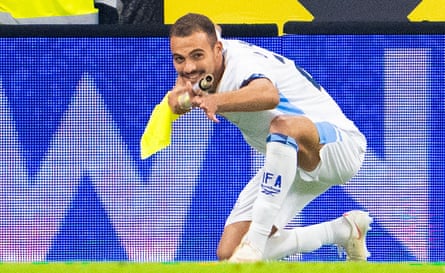
At the Raiffeisen Arena in Linz, Israel faced a formidable Austrian side in a match that promised to be a grueling tactical battle. The narrative of the evening, however, was defined by the 55th minute of play. After trailing since the first half due to a penalty converted by Austria’s Romano Schmid, Israel appeared to have found a lifeline when 20-year-old forward Saied Abu Farchi headed home an equalizer to level the score at 1-1.
What followed was a sequence that abruptly altered the trajectory of the game. In a display of misplaced exuberance, Abu Farchi sprinted toward the corner flag, uprooted it, and mimicked a firearm-firing gesture. The referee, who had issued the forward a yellow card just four minutes earlier for a previous infringement, acted immediately to present a second caution, resulting in an automatic red card.
The dismissal of Abu Farchi proved to be the decisive factor in the match. Reduced to ten men, the Israeli defense struggled to contain the sustained pressure applied by the Austrian squad. As the clock wound down, the inevitable breakthrough occurred in the 90th minute when Phillipp Mwene found the net following a precise cross from Paul Wanner. With the Israeli side demoralized and exposed, Sasa Kalajdzic added a third goal in the final moments of stoppage time, cementing a 3-1 victory for the hosts.
Ireland’s Defensive Resilience and Late Heartbreak
While the drama unfolded in Austria, the Republic of Ireland’s campaign began with a sobering 1-0 defeat in Pristina at the hands of Kosovo. The lead-up to this fixture had been characterized by an atmosphere of profound unease. Ireland manager Heimir Hallgrímsson had spoken candidly in the days preceding the match, acknowledging that several members of his squad were deeply conflicted regarding upcoming international obligations, particularly the scheduled fixture against Israel in Hungary this coming Sunday.
The match itself saw Ireland struggle to find an attacking rhythm. Chiedozie Ogbene missed a critical early opportunity, sending a shot over the crossbar, which allowed Kosovo to gain a foothold in the game. The home side displayed a physical intensity that pushed the Irish defense to its limits. By the end of the first half, the Irish goal was under siege, with two shots cleared off the line and goalkeeper Caoimhín Kelleher forced into a spectacular save to deny a header from Vedat Muriqi.

Despite an admirable defensive effort throughout the second half, the pressure eventually told. In the 83rd minute, Kosovo captain Vedat Muriqi bundled the ball into the net from close range. The result leaves Hallgrímsson with significant tactical questions to answer before his side travels to Hungary, where the geopolitical climate surrounding their next match remains a point of significant scrutiny.
Norway’s Tactical Triumph and Haaland’s Dominance
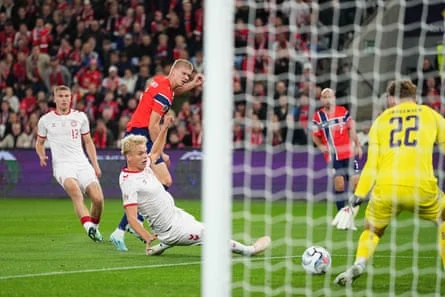
In contrast to the tensions elsewhere, Group A4 provided a display of pure attacking football in Oslo, where Norway secured a historic 3-2 victory over neighbors Denmark. Erling Haaland, continuing his prolific form on the international stage, scored twice, including a clinical 74th-minute winner.
The match was a rollercoaster of momentum. Norway surged into a 2-0 lead within the first half, courtesy of goals from Oscar Bobb and Haaland. However, Denmark demonstrated remarkable resilience, clawing back to equalize on the hour mark. The match appeared to be heading for a stalemate until Haaland intervened with his second goal of the night. The closing minutes were marred by the dismissal of Norway’s David Møller Wolfe, who received a second yellow card in stoppage time, but the hosts held on to secure their first competitive win over the Danes.
“It tasted sweet. It feels great to beat our neighbours,” said Norwegian captain Martin Ødegaard following the final whistle. “There is a lot we could have done better, but even when we were put under pressure, we found a way back and responded.”
Broad Implications: Discipline and Geopolitics
The events of the past 24 hours have underscored two distinct challenges currently facing UEFA: the maintenance of on-field conduct standards and the management of a geopolitical landscape that threatens to overshadow the sport.
The red card issued to Abu Farchi serves as a case study for modern officiating. Referees are increasingly instructed to penalize gestures that could be interpreted as provocative or inflammatory, particularly in the current global climate. The swift decision by the official in Linz reinforces the strict interpretation of the laws of the game regarding celebration conduct.
From a structural perspective, the Nations League is proving to be a high-pressure environment for younger players. Abu Farchi’s lack of composure, which left his team at a numerical disadvantage, is a costly lesson in the necessity of emotional control. His actions did not only impact the scoreline but also invited intense scrutiny toward his national federation at a time when they are already under the microscope.
Statistical Snapshot of the Night’s Action
The breadth of the Nations League schedule saw several other notable results:
- Serbia vs. Greece: In a match of high intensity, Greece staged a late comeback in Belgrade. After trailing for much of the game, they secured a 2-1 victory, with Tasos Douvikas providing the winner deep into stoppage time.
- League D Results: Malta successfully overcame a deficit to defeat Andorra 2-1, while Lithuania secured a professional 2-0 victory over Liechtenstein, highlighting the competitive parity currently being observed in the lower tiers of the competition.
Analysis: The Road Ahead
As the group stages progress, the focus for managers like Heimir Hallgrímsson will shift from pure tactical preparation to the psychological management of their squads. The controversy surrounding Ireland’s upcoming fixture with Israel is not merely a logistical hurdle but a central narrative that could dictate the team’s performance.
For Israel, the fallout from the Linz match will likely extend beyond the defeat. The disciplinary committee is expected to review the incident, and there is a possibility of further sanctions or internal disciplinary actions, which could hinder their squad depth for upcoming rounds.
Furthermore, the performance of Norway suggests they are becoming a formidable force in Group A4. With Haaland in such clinical form, they have positioned themselves as the team to beat. However, their defensive fragility, exemplified by the late red card to Wolfe, suggests that coach Ståle Solbakken must find a way to maintain discipline when the game is in the balance.
The Nations League continues to act as a crucible for European football. While the primary focus remains on the pursuit of promotion and the avoidance of relegation, the tournament is increasingly becoming a reflection of the pressures—both internal and external—that modern professional footballers must navigate. As the international break continues, the governing bodies and participating nations will be hoping that the focus shifts back toward the tactical nuances of the game and away from the controversies that defined Thursday’s headlines. The coming fixtures are set to be defining moments, not just for the standings, but for the collective composure of the teams involved.
Related posts: