Apple Inc. has officially released its flagship smartphone for the autumn cycle, the iPhone 18 Pro, introducing a suite of incremental updates anchored by improved thermal management, a more efficient 2nm processor, and enhanced battery longevity. As the tenure of Chief Executive Officer Tim Cook approaches its twilight, Apple’s hardware strategy for its Pro lineup has increasingly solidified around function-over-form pragmatism, reserving radical aesthetic experiments for alternative product tiers like the iPhone Air and iPhone Duo. While the iPhone 18 Pro resists the temptation of sweeping design overhauls, it delivers tangible mechanical refinements that address historical criticisms regarding device heat dissipation and sustained processing loads.
Evolution of the Pro Lineup and Market Context
The launch of the iPhone 18 Pro arrives at a transitional juncture for the world’s leading smartphone vendor. Over the past several hardware generations, Apple has bifurcated its flagship strategy. Devices designated with the "Pro" moniker function as heavy-duty workhorses engineered to satisfy power users, content creators, and enterprise consumers demanding maximum feature density. Meanwhile, flashier, design-forward concepts—such as ultra-slim chassis variations—are deployed in separate product categories.
This pragmatic approach reflects a mature smartphone market where consumers upgrade less frequently. Industry analysts note that the typical replacement cycle for high-end mobile devices has stretched beyond three years, driven by plateauing hardware breakthroughs and consumer preference for longevity. Consequently, manufacturers like Apple are focusing their engineering investments on internal efficiencies, thermal sustainability, and local artificial intelligence capabilities rather than disruptive exterior redesigns.
Design Modifications and the Shrinking Dynamic Island
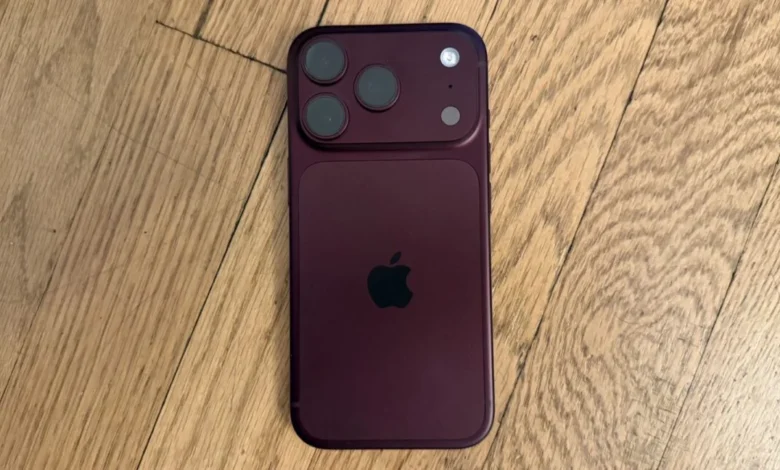
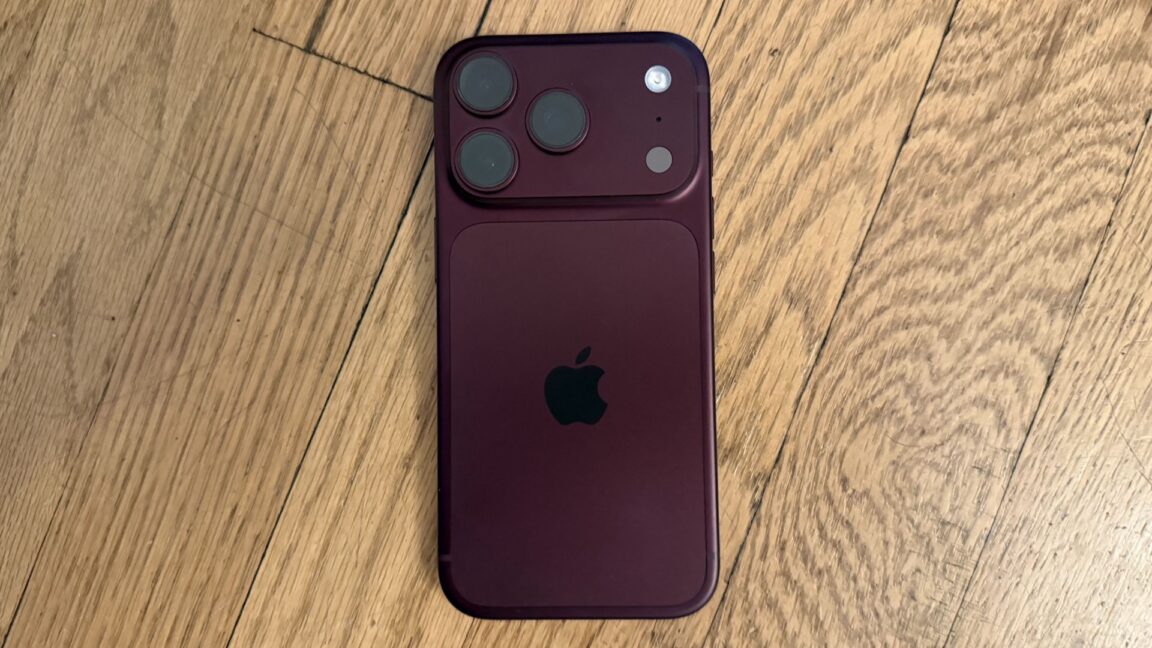
At first glance, the iPhone 18 Pro bears a striking resemblance to its predecessor, the iPhone 17 Pro. The device maintains a rugged, utilitarian chassis crafted from premium materials. Review units feature a newly introduced burgundy colorway, which, true to traditional glass-backed smartphone finishes, proves to be a notable magnet for fingerprints.
The most prominent physical modification on the exterior is a visibly reduced Dynamic Island. Apple achieved this reduction by relocating the infrared (IR) camera beneath the OLED panel into the upper-left corner of the screen. By implementing a novel pixel arrangement, the manufacturer permits infrared light to pass through the display matrix while driving the surrounding pixels at double the standard brightness to offset lower pixel density.
This hardware shift has practical software implications. Because the sensor cutout occupies less physical space on the display, the interface now accommodates up to three simultaneous Live Activities, compared to two on previous generations. The central activity displays expanded contextual data, while the flanking widgets utilize minimal indicators. Despite these adjustments, the fundamental design language remains conservative, prioritizing ergonomic familiarity and structural durability.
Silicon Advancements: The A20 Pro and Thermal Architecture
Under the hood, the iPhone 18 Pro introduces the A20 Pro system-on-a-chip (SoC), fabricated on an advanced 2-nanometer process node, representing a significant step down from the 3nm architecture of the preceding A19 Pro. The CPU configuration maintains a standard six-core layout consisting of two performance cores and four efficiency cores. However, the graphics processing unit has been upgraded to a seven-core architecture, with each core featuring dedicated Neural Accelerators designed to handle GPU-intensive machine learning workloads and hardware-accelerated ray tracing.
A central narrative of the iPhone 18 Pro launch is the aggressive overhaul of the device’s thermal management systems. Historically, high-performance tasks—such as extended 3D gaming, high-bitrate video recording, or utilizing navigation applications under direct sunlight—have caused iPhones to throttle performance and trigger thermal protection warnings. To counteract this, Apple has re-architected the internal layout by placing the system-on-a-chip adjacently to the memory modules rather than utilizing a stacked configuration.
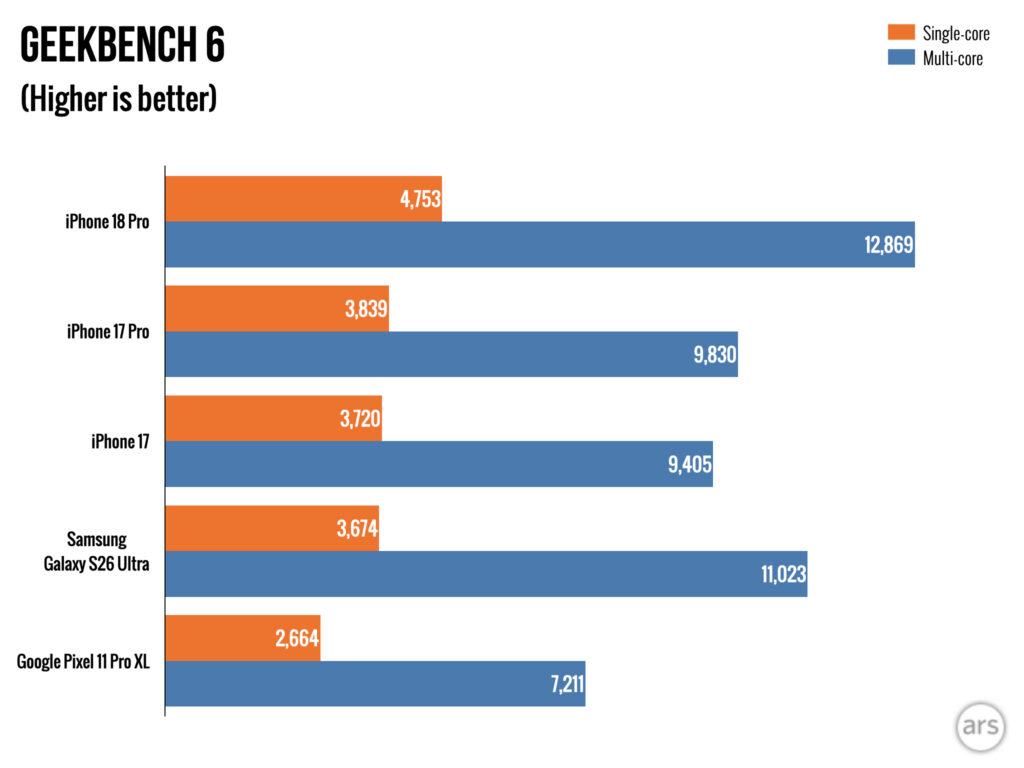
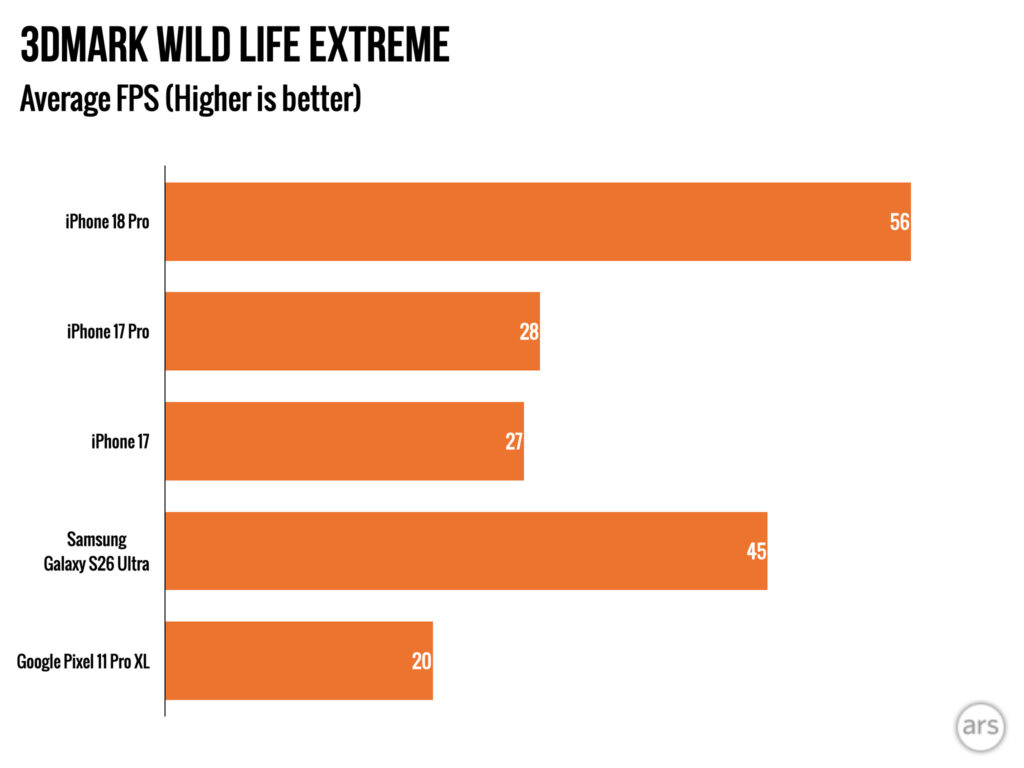
Complementing this layout change is a significantly expanded vapor chamber, building upon the baseline cooling structures introduced in the iPhone 17 Pro. Additionally, a copper-infused backing plate assists in dissipating heat away from the display panel. Apple claims these structural upgrades yield up to a 40 percent improvement in sustained processing performance compared to the previous generation, and up to a 100 percent improvement relative to the iPhone 16 Pro. Independent benchmark testing confirms substantial gains in graphical stability under heavy, prolonged loads.
Power Efficiency and Battery Longevity
Energy management on the iPhone 18 Pro benefits from both silicon efficiency and proprietary component engineering. The device incorporates Apple’s custom C2 cellular modem, which exhibits lower power consumption than the Qualcomm hardware utilized in older models. Furthermore, wireless charging capabilities have been expanded to support speeds of up to 25W using compatible accessories.
Official specifications cite up to 36 hours of offline video playback on a single charge for the Pro model, outpacing the 33-hour benchmark set by the iPhone 17 Pro. Real-world evaluations indicate that power efficiency has noticeably improved, with the device retaining a higher battery percentage under standard mixed-usage scenarios compared to older iterations.
Photographic Capabilities and User Control
In the realm of mobile photography, Apple continues to refine both its hardware optics and computational pipelines. The rear camera system retains the triple 48-megapixel configuration established in the previous generation, paired with an 18-megapixel front-facing sensor.
The primary hardware advancement is the inclusion of a variable aperture mechanism. While manual aperture adjustment caters primarily to niche photography enthusiasts, the system operates dynamically by default, automatically optimizing light intake based on environmental conditions to elevate everyday point-and-shoot image quality.
Concurrently, Apple introduced Photographic Styles 3, an expansion of its non-destructive image grading presets. Unlike earlier iterations that focused strictly on color balance adjustments, the third-generation software introduces granular texture controls. Users can now apply presets categorized as film, glow, soft skin, and standard directly within the native Camera App. These adjustments provide an alternative to third-party aesthetic applications, signaling a broader industry push toward customizable, less opinionated computational photography.
Broader Industry Implications and Market Outlook
The release of the iPhone 18 Pro underscores a broader stabilization phase within the global consumer electronics industry. By prioritizing incremental refinements—such as superior thermal dissipation, expanded memory bandwidth for future artificial intelligence applications, and improved battery endurance—Apple is catering directly to users seeking long-term reliability over novel form factors.

Market analysts observe that while year-over-year upgrades may offer diminishing returns for owners of very recent devices—such as the iPhone 17 Pro or iPhone 16 Pro—the cumulative technological delta remains highly compelling for consumers transitioning from older, legacy hardware. As the smartphone market continues to mature, the success of flagship lines increasingly hinges on sustained operational excellence, energy efficiency, and practical utility rather than disruptive industrial design changes.