Moon Man Phenomenon Returns: 2026 MTV Video Music Awards Smash Ratings Records With Best Viewership in Over a Decade

The 2026 MTV Video Music Awards experienced a massive resurgence in traditional television viewership, cementing a triumphant night for both CBS and MTV through a combined cross-platform simulcast that drew massive audiences on a Sunday evening. According to official Nielsen Live+Same Day fast national metrics, the combined broadcast coverage averaged an impressive 8.43 million total viewers. This substantial figure marks the most-watched presentation of the VMAs in eleven years—surpassing every ceremony since 2015, when the event broadcast exclusively on MTV—and represents a remarkable 51% surge compared to the total audience numbers recorded during the previous year’s telecast.
This year’s ceremony, broadcast live from the Peacock Theater at L.A. Live in downtown Los Angeles, benefited from a high-profile lead-in courtesy of the National Football League. A dramatic NFL game overrun, featuring a late-game surge where the Baltimore Ravens narrowly defeated the Dallas Cowboys, pushed the scheduled start time of the awards show back by several critical minutes. As a result, the live broadcast officially commenced on the East Coast at 7:51 p.m. ET. Although the event began promptly at its intended 4:30 p.m. PT local time inside the Los Angeles venue, the late-running sports coverage necessitated a brief tape-delay implementation for viewers tuning in across the CBS television network.
Detailed Viewership Breakdown and Comparative Metrics
The cumulative audience figure of 8.43 million incorporates simultaneous broadcasts across the CBS television network and MTV, alongside a scheduled late-night encore presentation on MTV. To ensure an accurate year-over-year evaluation, industry analysts point out an identical multi-platform strategy was deployed for the 2025 ceremony, which aired on September 7 across CBS and MTV with a corresponding MTV encore. That specific 2025 telecast brought in 5.60 million total viewers, highlighting the staggering 2.83 million viewer increase achieved by the 2026 production.
Examining the performance of individual networks reveals widespread growth across all participating channels. The primary CBS network telecast anchored the evening by averaging 7.61 million viewers, representing a robust 52% increase over the 5.00 million viewers who watched the network broadcast the previous year. Meanwhile, the simultaneous MTV simulcast captured an average audience of 686,000 viewers, marking a 40% improvement compared to the 481,000 viewers recorded in 2025. Furthermore, the late-night MTV encore presentation contributed an additional 142,000 viewers to the overall tally, reflecting a 31% bump from the 108,000 viewers who tuned into the replay last year.
Network executives noted that these figures represent the highest same-day linear audience for the VMAs since the watershed year of 2015, during which the awards show achieved a towering 12.73 million viewers when cable television commanded a larger share of the overall media landscape. The ability of the 2026 broadcast to approach those historical benchmarks in an era defined by media fragmentation has surprised and encouraged television executives.
Key Demographic Growth and Engagement
Beyond total viewership, the 2026 VMAs recorded extraordinary gains across all core advertising demographics, proving that the event successfully mobilized younger generational cohorts alongside older, nostalgic viewers. Within the heavily coveted adults aged 25 to 54 demographic, the broadcast drew 3.11 million viewers. This performance represents the highest mark for this specific age group since 2019, when the category reached 3.55 million viewers, and translates to a 34% increase over the 2.32 million demographic viewers recorded in 2025.
For the broader adults 18 to 49 demographic, the awards program brought in 2.66 million viewers, securing the highest audience volume in this bracket since 2018, when the show pulled in 3.02 million viewers. This figure demonstrates a 32% year-over-year improvement from the 2.02 million viewers registered during the 2025 ceremony. Similarly, within the younger adults 18 to 34 demographic, the telecast averaged 1.09 million viewers. This milestone marks the best performance for the category since 2020—when it hit 1.14 million viewers—and represents a substantial 46% surge compared to the 751,000 viewers recorded last year.
Digital and social media metrics released by CBS further underscored the pervasive cultural footprint of the evening. The network reported an astounding 31.1 million total social interactions across major digital platforms, accompanied by 159 million video views globally. This digital engagement reflects an 8% increase over the social metrics achieved by the previous year’s ceremony, proving that the linear television success was mirrored and amplified by real-time online discourse.
Star-Studded Chronology and Memorable Performances
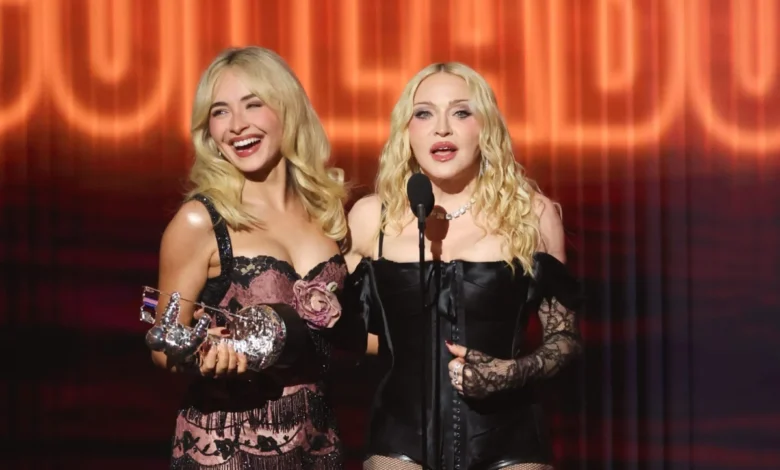
The timeline of the evening was packed with high-profile moments, legendary comebacks, and industry milestones that kept audiences glued to their screens throughout the multi-hour broadcast. Setting a historic tone for the night, the ceremony opened with a landmark performance by pop icon Madonna, marking her first appearance on the VMA stage in 23 years. Joined by contemporary hitmakers Sabrina Carpenter and Charli XCX, Madonna delivered a high-energy medley that instantly dominated social media feeds and set a high artistic bar for the remainder of the evening.
As the night progressed, the ceremony delivered a series of expected triumphs and emotional tributes. Pop superstar Taylor Swift added to her historic collection of accolades by capturing the coveted Video of the Year award, alongside securing the MTV VMA Artist Director award. Adding to the excitement, Swift used the global platform to premiere her highly anticipated new music video for the single Patient Zero, generating immediate internet frenzy and driving significant spikes in live viewership as fans tuned in for the exclusive reveal.
In recognition of enduring contributions to the medium, legendary rock band Nirvana received the prestigious Video Vanguard Award, prompting a celebratory retrospective of their groundbreaking music videos. The evening also featured poignant musical tributes dedicated to the enduring legacies of Dolly Parton and George Michael, celebrating their profound influence on generations of artists.
The performance lineup offered a diverse cross-section of musical genres and styles, showcasing a balance of veteran icons and rising stars. Alongside the opening collaboration, the stage played host to dynamic sets by GENER8ION, Gunna, Kacey Musgraves, Lisa, Raye, Shaboozey, Sienna Spiro, Sombr, Teddy Swims, and Yung Lean. Guiding the sprawling production as master of ceremonies was iconic entertainment figure Snoop Dogg, whose comedic timing and steady stage presence anchored the fast-paced proceedings.
Production and Industry Implications
The logistical triumph of the 2026 VMAs was the result of a massive collaborative effort among a seasoned team of television producers and network executives. The special was produced by Gunpowder & Sky, with industry veteran Van Toffler serving as a principal producer. Executive production duties were shared by Jesse Ignjatovic of Den of Thieves, Barb Bialkowski, and Bruce Gillmer, working alongside Barry Barclay and Floris Bauer.
Further supporting the elaborate production were co-executive producer Melanie Block and co-producer Gary Lanvy. Snoop Dogg extended his involvement beyond hosting duties to serve as an executive producer, working in tandem with producers Sara Ramaker and Jasmin Ratansi. Jen Proctor rounded out the core leadership team as the executive talent producer, successfully securing the star-studded roster that ultimately drove the record-breaking ratings.
Media analysts reviewing the data point out that the success of the 2026 VMAs underscores the continued viability of major live entertainment events when paired with smart cross-platform distribution strategies. By combining the broad household reach of the CBS broadcast network with the targeted youth appeal of MTV and strategic digital integrations, the organizers managed to reverse years of declining linear viewership trends.
Furthermore, the fortuitous lead-in provided by the NFL game overrun demonstrated the enduring power of live sports television to funnel massive audiences directly into subsequent entertainment broadcasts. As media networks increasingly search for formulas to combat audience fragmentation in the streaming era, the unprecedented performance of the 2026 Video Music Awards serves as a compelling case study in the power of live event television, nostalgic reunions, and cross-generational star power.
Related posts: