The landscape of digital content creation has undergone a seismic shift, with artificial intelligence emerging as the primary catalyst for democratizing artistic production. Among the most notable pivots in recent technology history is the transformation of LimeWire, a platform once synonymous with the decentralized file-sharing era of the early 2000s, into a modern, blockchain-integrated generative AI publishing hub. Today, LimeWire serves as a multi-faceted ecosystem where creators can generate, mint, and monetize high-fidelity AI-driven media, effectively bridging the gap between cutting-edge machine learning and decentralized finance.
Historical Context and the Rebirth of a Brand
To understand the current iteration of LimeWire, one must first recognize its origins. Founded in 2000 as a peer-to-peer file-sharing client, the original LimeWire became a cultural phenomenon, boasting millions of users globally before shutting down in 2010 following extensive litigation regarding copyright infringement. The brand lay dormant for over a decade until 2022, when it was acquired and relaunched as an NFT marketplace. This second act focused on digital collectibles for music fans and artists. However, the company’s trajectory changed again as generative AI exploded into the mainstream. By pivoting to an AI-first model, LimeWire rebranded itself as a creative studio, positioning the platform as an all-in-one suite for the next generation of digital artists.
The Mechanics of the LimeWire AI Studio
At the core of the current platform is the LimeWire AI Studio, an intuitive, browser-based interface designed to lower the barrier to entry for complex generative art. Unlike standalone AI tools that exist in isolation, LimeWire integrates a suite of state-of-the-art models—including Stable Diffusion 2.1, Stable Diffusion XL, and DALL-E 2—directly into a social publishing framework.
This integration allows users to move seamlessly from text-based prompts to high-resolution visual outputs. The platform’s architecture is built to support various aesthetic styles, ranging from photorealistic and cinematic renderings to stylized anime and pixel art. By providing users with advanced parameters such as samplers and prompt guidance, the studio caters to a broad demographic, from hobbyists experimenting with AI for the first time to professional digital artists looking to integrate machine-assisted workflows into their existing portfolios.
The Role of Blockchain and NFT Integration
What distinguishes LimeWire from other AI generation tools is its aggressive integration of Web3 technologies. Once a user generates an image, the platform offers the capability to mint that content as a Non-Fungible Token (NFT) on the Polygon or Algorand blockchains. This process is automated, removing the technical hurdles that often prevent casual users from participating in the blockchain ecosystem.
By turning generative art into digital assets, LimeWire provides a tangible mechanism for ownership. When a creator publishes a piece of content, they have the autonomy to decide whether that asset is publicly viewable or restricted to a premium subscriber tier. This creates a dual-layered economy: a public gallery for discovery and a private, gated community for monetization. Furthermore, the platform incentivizes the secondary market; whenever an NFT is traded, the original creator is entitled to a 2.5% royalty, providing a passive income stream that is increasingly rare in traditional digital media distribution.
Monetization and the LMWR Token Economy
LimeWire has built its financial model around the LMWR token, a utility token that serves as the lifeblood of the platform’s internal economy. This tokenized approach is designed to foster a sustainable creator economy, moving away from the traditional advertisement-reliant models of social media platforms.
Creators can earn revenue through multiple channels. First, they receive a share of the ad revenue generated by their content. Depending on the user’s subscription tier, this share ranges from 50% to 70%. Second, they can earn through the sale and trade of their NFTs. Finally, the LMWR token provides a standardized currency for internal transactions, such as purchasing additional AI credits or supporting other creators. These earnings are paid out monthly, and the tokens can be traded on major global exchanges, including Kraken, ByBit, and Uniswap, providing liquidity to creators who would otherwise struggle to monetize their digital presence.
Tiered Access and Platform Scalability
The platform operates on a freemium model, ensuring that the technology remains accessible to the public while providing power-user features for those who require higher output capacities.
- Free Tier: Provides 10 credits daily, allowing for up to 20 image generations, with a 50% ad revenue share.
- Basic/Pro Tiers: Ranging from $9.99 to $99 per month, these plans offer significantly higher credit limits—up to 22,500 images—along with advanced features such as priority image generation, ad-free viewing, and exclusive access to upcoming AI models.
This tiered structure is designed to scale with the creator. A novice can begin their journey without any financial commitment, while a professional artist or a brand can leverage the higher-tier plans to sustain a high-volume, professional content output.
Strategic Roadmap: Music and Video
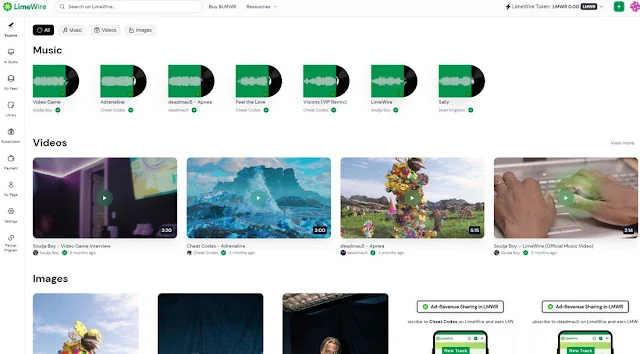
While LimeWire’s current primary focus remains on static image generation, the company has made its roadmap clear: the integration of generative music and video tools is the next frontier. Given the platform’s roots in the music industry—and the early adoption of the studio by high-profile figures like Deadmau5, Soulja Boy, and Sean Kingston—the introduction of AI music synthesis is expected to be a major differentiator.
The ability to generate unique, copyright-cleared audio tracks and video clips would position LimeWire as a direct competitor to professional-grade creative suites. By combining these capabilities with the existing NFT and monetization framework, LimeWire aims to become the definitive platform for creators who want to own their output entirely while operating within a decentralized, fair-pay environment.
Implications for the AI and Creative Industries
The emergence of platforms like LimeWire signifies a fundamental change in the relationship between content creators and their audience. By collapsing the distance between creation and monetization, LimeWire is addressing some of the most significant pain points for independent artists in the digital age.
However, this shift also brings implications regarding copyright and the ethical use of AI. As the industry grapples with the legality of training datasets, LimeWire’s commitment to developing its own proprietary AI models suggests a move toward greater transparency and intellectual property security. The platform’s ability to navigate these legal waters while providing a robust, user-friendly interface will likely determine its long-term success.
Furthermore, the integration of blockchain technology into everyday creative tools represents a wider trend of "owning the internet." By allowing creators to retain a percentage of every secondary sale, LimeWire is challenging the traditional platform-heavy model where the host, rather than the creator, retains the majority of the value generated by user content.
Conclusion
LimeWire has successfully reinvented itself, evolving from a relic of the early internet into a sophisticated hub for the AI-driven creative economy. By combining accessible generative tools with the financial utility of blockchain technology, the platform offers a unique value proposition for artists, musicians, and designers.
As the platform continues to refine its image generation capabilities and expands into the realms of music and video, its influence on the digital content landscape is likely to grow. For creators seeking to explore the intersection of art and technology, LimeWire provides a structured, incentivized environment to experiment, build a following, and ultimately participate in a decentralized financial system. Whether it will achieve the ubiquity of its namesake predecessor remains to be seen, but its current path suggests that it is well-positioned to become a cornerstone of the next generation of digital creativity.