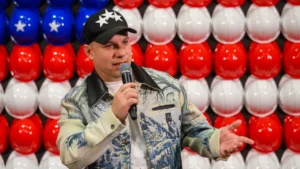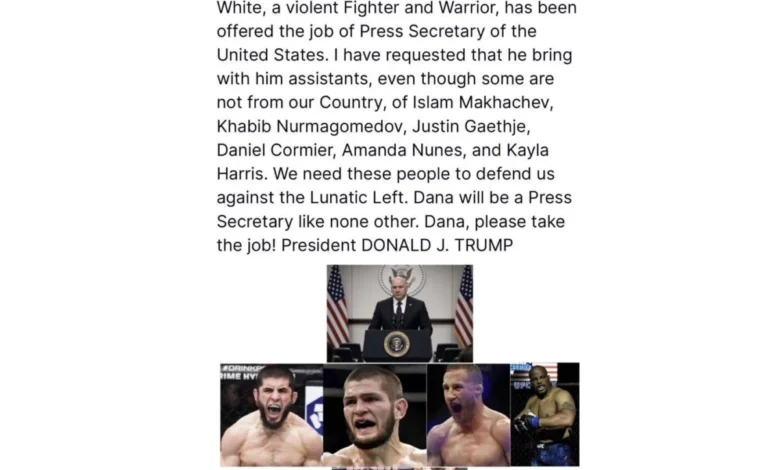
The announcement, delivered via the Truth Social platform on Saturday, marks the latest unconventional staffing decision in an administration that has prioritized loyalty and high-profile alliances over traditional political experience. In his post, President Trump described White as a "violent Fighter and Warrior," framing the potential appointment as a strategic necessity in his ongoing efforts to counter what he terms the "Lunatic Left."
A Departure from Conventional Diplomacy
The offer to White is not merely an attempt to fill a vacancy; it represents a fundamental change in the role of the White House press secretary. Historically, the position has been held by career communications professionals or political strategists tasked with articulating complex policy and maintaining a conduit between the executive branch and the press corps.
Trump’s public request that White bring a roster of high-profile mixed martial arts (MMA) athletes to the White House as "assistants" suggests a shift toward a more combative media relations strategy. The President explicitly mentioned several international figures, including Islam Makhachev, Khabib Nurmagomedov, and Justin Gaethje, alongside established stars like Daniel Cormier, Amanda Nunes, and Kayla Harrison—the latter of whom was misspelled as "Kayla Harris" in the President’s original correspondence.
The underlying implication of this request—that the physical presence of elite combat athletes might serve as a deterrent to aggressive questioning—has sparked debate among political analysts regarding the administration’s disregard for traditional democratic norms regarding the free press.
The Chronology of a High-Stakes Partnership
The relationship between Donald Trump and Dana White spans over two decades, evolving from a mutual interest in combat sports to a powerful political alignment.
- 2001: Dana White becomes the president of the Ultimate Fighting Championship (UFC) after facilitating its acquisition by Zuffa, LLC.
- 2016–2020: Throughout the 2016 and 2020 election cycles, White remained a vocal supporter of Trump, frequently appearing at rallies and utilizing the UFC platform to provide the President with exposure to the "manosphere" and podcast-driven media landscapes.
- June 2026: In a move that signaled the normalization of the Trump-UFC alliance, the administration hosted a birthday cage fight on the White House lawn. The event, which featured a temporary stage construction, drew widespread scrutiny regarding the use of executive grounds for commercial entertainment purposes.
- October 2026: The administration experiences significant turnover in its communications department. Katie Zacharia, the then-press secretary, was dismissed on October 19, marking the end of a tenure that lasted less than a week.
- November 2026: President Trump issues the formal invitation to Dana White via Truth Social, following weeks of instability within the White House press office.
The Role of Media and the Podcast Ecosystem
Sociologists and media analysts have long noted the strategic importance of the UFC in President Trump’s electoral success. Kyle Green, a sociologist at SUNY Brockport, has extensively documented how the UFC served as a gateway for the Trump campaign to reach the coveted "podcast bro" demographic. By appearing on high-traffic programs hosted by figures like Joe Rogan, whose platform is deeply intertwined with the UFC, Trump was able to bypass traditional gatekeepers of the news media.
This strategy effectively neutralized the impact of traditional media cycles. By leveraging White’s influence, the administration successfully tapped into a base of voters who prioritize authenticity, strength, and anti-establishment rhetoric over the nuanced policy debates typical of standard political discourse. The potential appointment of White as press secretary would effectively formalize this bridge, bringing the operational style of the UFC’s promotional engine into the executive branch.

Operational and Ethical Implications
If Dana White were to accept the position, he would face immediate questions regarding his ongoing private business interests. White currently serves as the co-leader of Zuffa Boxing, a high-stakes joint venture with the General Entertainment Authority of Saudi Arabia.
Federal ethics laws generally require appointees to divest from business interests that present a conflict of interest or to recuse themselves from matters that could impact those interests. The intersection of his potential role as the voice of the U.S. government and his ties to foreign state-owned entertainment entities creates a complex web of potential conflicts. The administration has yet to release details on how White would navigate these statutory requirements or whether he would step down from his executive duties at the UFC.
Furthermore, the stability of the White House press office remains a critical point of concern. With the firing of Katie Zacharia after just seven days, the role has become one of the most precarious positions in Washington. Critics argue that the rapid turnover suggests a workplace environment where the press secretary is viewed as an extension of the President’s personal brand rather than an objective institutional voice.
Reaction and Public Sentiment
The announcement has elicited a wide range of responses. Supporters of the President view the offer as a bold, "outside-the-box" move designed to invigorate a stagnant communications strategy. They argue that White’s experience in building a global brand from the ground up makes him uniquely qualified to navigate the current media climate.
Conversely, members of the White House Correspondents’ Association and various political watchdog groups have expressed alarm. The suggestion that professional fighters should act as press aides is being characterized as an intimidation tactic that threatens the integrity of the daily press briefing. While White has not publicly confirmed his intent to accept the role, the administration is reportedly moving forward with the assumption that he is their preferred candidate.
Looking Toward the Future
As the White House awaits a formal response from White, the implications of this potential appointment continue to ripple through the political landscape. If White accepts, he would be the seventh person to hold the title of press secretary under the current administration, underscoring the volatility that has defined the President’s second term.
Regardless of the outcome, the invitation itself serves as a case study in the modern era of American politics, where the boundaries between pop culture, sports entertainment, and federal governance have become increasingly porous. Whether this appointment would lead to a more effective communications strategy or further polarization remains the subject of intense speculation. For now, the administration continues to emphasize the need for "warriors" in a political climate they define as inherently adversarial, signaling that the traditional norms of the West Wing may be permanently altered.