The Fetishization of Black Women in American Political Discourse: Nicki Minaj and the Trump Michigan Rally

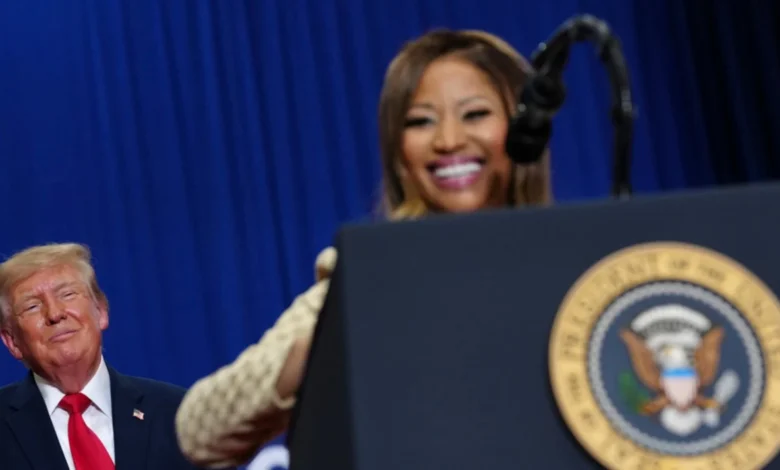
During a campaign rally in Port Huron, Michigan, on October 25, 2026, President Donald Trump’s interaction with rapper Nicki Minaj reignited national conversations regarding the intersection of race, gender, and political performance. The event, which occurred just days before the midterm elections, saw the president publicly comment on the physical appearance of the Grammy-nominated artist. This moment, while presented as a casual exchange within a high-energy campaign environment, has drawn sharp criticism from civil rights advocates and political analysts who argue that the rhetoric utilized by the president reflects a historical pattern of dehumanizing Black women.
The rally in Port Huron was intended to solidify voter enthusiasm in a key swing state. However, the media focus shifted significantly when the president, while addressing the crowd, diverted his attention to Minaj, who was positioned near the podium. Trump remarked, "I looked at one hell of a beautiful ass before, Nicki Minaj. That’s hard to miss," before motioning for the artist to stand and acknowledge the audience. This interaction occurred against the backdrop of a heightened political climate, where the Trump administration has been actively engaged in legal and administrative challenges against several prominent Black female political figures.
A Chronology of Public Alignment
The relationship between Nicki Minaj and the Trump administration has evolved over the past two years, marked by several high-profile public appearances that have signaled a departure from typical celebrity-politician dynamics.
- December 2025: Minaj accepts an invitation to speak at a United Nations forum, an event that drew significant public scrutiny and served as the catalyst for initial reports regarding her alignment with the administration’s platform.
- Summer 2026: Speculation begins to mount regarding a potential shift in the White House press office, with internal sources suggesting that the administration is seeking a non-traditional communicator to lead briefings.
- October 2026: Following a series of administrative actions—including the investigation of political opponents and the controversial detention of legislative figures—the campaign intensifies its outreach efforts.
- October 25, 2026: The Port Huron rally serves as the most visible platform for the partnership, with the president explicitly referencing the rapper’s physical features in front of a live audience.
These events have occurred amidst broader concerns regarding the administration’s treatment of political dissenters. As of late October 2026, the Department of Justice has been involved in several high-profile investigations targeting Democratic lawmakers, many of whom are women of color. The juxtaposition of these legal maneuvers with the celebratory inclusion of Minaj at campaign events has created a polarized narrative regarding the administration’s demographic strategy.
Data-Driven Analysis of Rhetorical Patterns
The rhetoric used by President Trump in Michigan is not viewed by researchers as an isolated incident, but rather as part of a statistically measurable trend. A study conducted in 2025 by a non-partisan research organization analyzed the president’s social media communications on the platform Truth Social over a four-year period ending in April 2026. The findings indicate a distinct linguistic pattern regarding how the president describes political adversaries.
The research found that of the at least 50 instances in which the president used the descriptor "low IQ" to characterize individuals or groups, 60 percent of those targets were Black public figures or legislators. Among those specifically identified were Vice President Kamala Harris, Representatives Jasmine Crockett, Maxine Waters, Ilhan Omar, and Rashida Tlaib, as well as Attorney General Letitia James.
Political scientists suggest that this reliance on tropes—specifically those suggesting a lack of intellectual capacity or emotional stability—functions as a mechanism for delegitimizing political opponents. When applied to Black women, this language is often categorized by sociologists as "misogynoir," a term coined to describe the unique confluence of anti-Black racism and misogyny. By focusing on physical characteristics rather than political substance, observers argue that the administration reinforces a historical legacy of objectification.
Historical Parallels and Academic Context
The public reaction to the Port Huron event has frequently invoked the historical treatment of Sarah Baartman, a South African woman of Khoisan descent who was brought to Europe in the early 19th century. Baartman, often referred to as the "Hottentot Venus," was subjected to public displays that fetishized her body, reducing her identity to a series of physical traits for the amusement of colonial audiences.
Historians highlight that the legacy of Baartman serves as a cautionary study in how societal structures exploit the bodies of Black women for political or entertainment gain. The academic consensus, frequently cited in discussions of contemporary political rhetoric, is that such objectification is intended to strip the subject of their individual agency. When public figures participate in environments where their bodies are the primary focus of the discussion, critics argue it risks normalizing the dehumanization that has historically plagued the demographic.
Official Responses and Political Implications
The White House has maintained a formal silence regarding the specific criticism of the president’s comments at the Michigan rally. However, White House Communications Director Steven Cheung alluded to the potential for administrative changes on social media, further fueling rumors that Minaj may be considered for a role within the executive branch.
Supporters of the administration suggest that these interactions demonstrate a "populist outreach" strategy, arguing that the inclusion of high-profile entertainment figures allows the president to reach segments of the electorate that are otherwise disconnected from traditional political discourse. From this perspective, the rally was a successful engagement exercise.
Conversely, civil rights organizations have issued statements expressing concern over the tone of the campaign. The National Partnership for Women & Families and other advocacy groups have pointed to the disparate impact of current administration policies on Black maternal health, voting rights, and the equitable application of the law. They argue that the focus on celebrity appearances acts as a distraction from the substantive policy issues that disproportionately affect the lives of Black women in the United States.
The Broader Impact on Political Discourse
The incident in Port Huron serves as a microcosm of the current American political environment. It highlights the tension between the use of celebrity culture to drive voter turnout and the ethical responsibilities of political leadership to maintain a discourse that respects the dignity of all citizens.
The long-term implications of this rhetoric are significant. If the pattern of targeting Black women—both through legal investigations and through the use of derogatory or fetishizing language—continues, political analysts predict a further hardening of existing demographic divides. The strategy appears to prioritize the mobilization of the base through provocative messaging, even at the cost of alienating moderate voters or exacerbating racial tensions.
Furthermore, the participation of Black women like Nicki Minaj in these rallies presents a complex challenge for political commentators. While Minaj holds the agency to choose her political affiliations, her presence alongside an administration that has been widely criticized for its policies toward Black communities has invited questions about the responsibility of public figures in shaping political narratives.
As the 2026 midterms conclude, the events in Michigan are likely to remain a focal point for researchers studying the intersection of media, race, and governance. Whether this strategy will yield the intended political results—or whether it will deepen the divide within the electorate—remains a subject of intense debate. What is clear, however, is that the rhetoric utilized by the president has once again brought the treatment of Black women in the public square to the forefront of the national conversation, ensuring that the legacy of such language will continue to be evaluated long after the campaign season concludes.