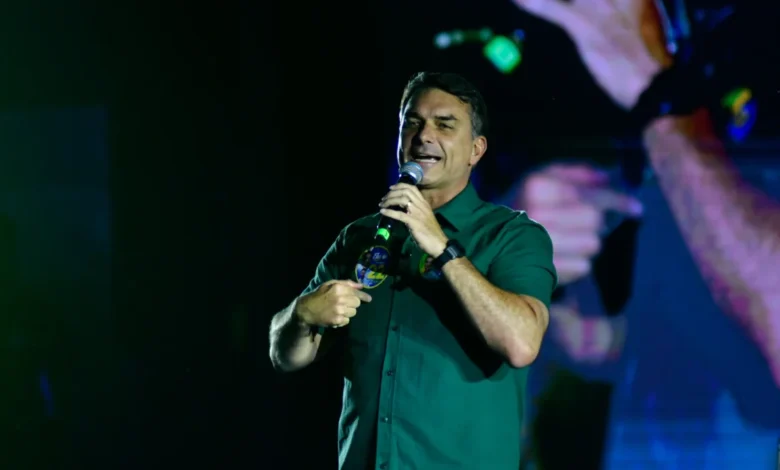
The arrival of Flávio Bolsonaro in Miami this week marks a significant escalation in the ongoing diplomatic and legal friction between the United States and Brazil. Despite facing severe judicial restrictions in his home country, the defeated right-wing presidential candidate successfully bypassed Brazilian authorities to secure sanctuary in the United States. His transit, which involved a calculated departure through Argentina, underscores the complex intersection of international law, partisan political alliances, and the shifting landscape of U.S. immigration policy under the current administration.
A Calculated Departure: The Path to Miami
The logistics of the Bolsonaro family’s exit from Brazil highlight a deliberate effort to evade a mounting legal net. As of late October 2026, Flávio Bolsonaro was subject to a stringent order from Brazil’s Supreme Court, which mandated the surrender of his passports and explicitly prohibited him from leaving the country. These restrictions were imposed as part of a series of expansive investigations into alleged money-laundering operations and systemic tax evasion linked to his political activities.
Ignoring these judicial mandates, the former candidate initiated a clandestine exit strategy. On the night of October 27, 2026, Argentine federal migration officials confirmed that Bolsonaro and his family crossed the border from Brazil. From there, the group traveled to Ecuador before boarding a flight bound for the United States. Upon landing in Miami on the morning of October 28, the family was observed exiting the airport terminal in an SUV, shielded from public view by umbrellas—a maneuver that reflects the high-stakes nature of his flight from domestic prosecution.
The Role of International Alliances
The ease with which Flávio Bolsonaro navigated his way into the United States stands in stark contrast to the stringent visa restrictions currently being enforced against other foreign nationals. The U.S. State Department’s decision to grant entry to a figure under active criminal investigation in a democratic partner nation suggests that political alignment with the Trump administration remains a potent factor in navigating American immigration hurdles.
This pattern of "political asylum" for figures aligned with the Brazilian right is not unprecedented. The United States has increasingly become a preferred destination for individuals seeking to avoid the reach of Brazilian law enforcement. Notable examples include the self-imposed exile of Eduardo Bolsonaro, Flávio’s brother, who has remained in the U.S. since early 2025, and various far-right influencers who have leveraged American territory to continue their operations while evading charges related to the dissemination of misinformation and anti-democratic activities.
Domestic Immigration Policy: A System in Flux
The granting of entry to the Bolsonaro family occurs against a backdrop of aggressive restrictive measures within the U.S. immigration system. Since 2025, the Trump administration has implemented a series of travel bans and policy shifts ostensibly grounded in national security and counterterrorism. These measures have included the suspension of immigrant visa processing for citizens of 75 countries, predominantly in the Global South, based on the administration’s stated concerns regarding potential "public benefits reliance."
The legal legitimacy of these measures has been frequently challenged. In August 2026, a federal judge in New York struck down the administration’s 75-country visa ban, ruling that it violated the Immigration and Nationality Act of 1965 by enforcing nationality-based discrimination. Legal experts, including representatives from the Center for Constitutional Rights, have characterized these policies as attempts to codify a restrictive nationalist agenda, noting that the inconsistent application of these rules—favoring political allies while barring others—exposes a deep-seated ideological bias in the current execution of foreign policy.
Diplomatic Retaliation and the Lula Factor
The arrival of the Bolsonaro family is likely to further strain the already fragile relationship between the United States and the administration of Brazilian President Luiz Inácio Lula da Silva. Relations between the two nations have deteriorated significantly since Lula’s reelection, which the Trump administration has repeatedly challenged, mirroring the rhetoric used by the Bolsonaro campaign itself.
The diplomatic fallout has manifested in tangible economic and administrative sanctions. In recent months, the White House has imposed 50 percent tariffs on a range of Brazilian goods, citing a need to address the "political persecution" of the Bolsonaro family. Furthermore, the administration took the rare step of revoking the visa of Brazil’s ambassador to the United States, Maria Luiza Ribeiro Viotti, as a retaliatory measure for delays in the confirmation process of a U.S. nominee. These actions represent a departure from traditional diplomatic norms and suggest a policy of active intervention in Brazilian domestic affairs.
Implications for International Jurisprudence
The presence of Flávio Bolsonaro on U.S. soil poses a difficult question for international legal cooperation. Brazil’s judiciary is currently attempting to hold high-level political figures accountable for alleged systemic corruption and anti-democratic maneuvers. When a key figure in such investigations finds refuge in the United States, it creates a "safe haven" dynamic that complicates the extradition process and undermines the sovereignty of the Brazilian legal system.
Analysts monitoring the situation suggest that the U.S. government’s stance may force a broader debate on the limits of diplomatic hospitality. If the U.S. continues to serve as a base for political actors fleeing judicial accountability in Latin America, it risks long-term damage to its credibility as a promoter of the rule of law. The current administration’s willingness to prioritize ideological allies over consistent legal standards could lead to prolonged instability in the hemisphere, as the "Bolsonaro-adjacent" network continues to use the U.S. as a platform for political maneuvering against the legitimate, democratically elected government of Brazil.
Summary of Key Events (2025–2026)
- Early 2025: Eduardo Bolsonaro establishes residence in the United States, citing political persecution in Brazil.
- June 2025: The Trump administration implements a new series of travel bans targeting Global South nations.
- January 2026: The State Department formally halts visa applications for 75 countries, citing "public benefits risk."
- August 2026: A federal court in New York invalidates the 75-country visa ban, citing the Immigration and Nationality Act.
- October 21, 2026: Flávio Bolsonaro holds final campaign rallies, continuing to contest the legitimacy of Brazilian election results.
- October 26, 2026: Brazil’s Supreme Court issues an order demanding the surrender of Flávio Bolsonaro’s passports and barring him from leaving the country.
- October 27, 2026: Bolsonaro flees Brazil, transiting through Argentina to Ecuador.
- October 28, 2026: Bolsonaro arrives in Miami, Florida, and is whisked away under heavy security.
As the international community watches these developments, the focus remains on whether the U.S. Department of Justice will cooperate with formal requests for information or extradition from Brazilian authorities, or if the current political climate in Washington will continue to shield the former candidate from the reach of the law. The precedent set by this episode will likely influence how the United States engages with its regional partners for the remainder of the decade.