Trump Announces Plan to Convert Controversial Washington DC Triumphal Arch into Militarized Drone and Sniper Outpost

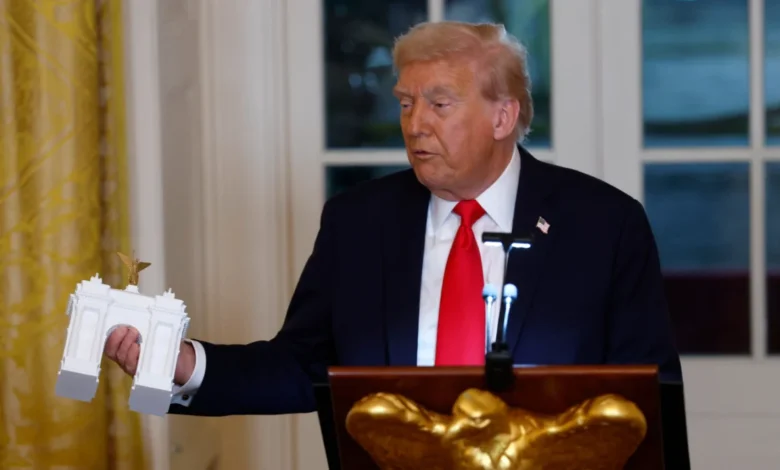
President Donald Trump has unveiled a significant pivot in the design and purpose of his proposed 250-foot Triumphal Arch in Washington, D.C., announcing that the structure will now serve as a high-security military complex. In a statement posted to Truth Social on Sunday, the President characterized the planned monument not merely as a commemorative structure for the nation’s 250th anniversary, but as a strategic facility equipped to house substantial weapons caches, drone deployment capabilities, and elevated tactical positions for snipers.
This latest development marks a departure from the project’s original conceptualization, which was presented in October 2025 as a decorative, patriotic landmark featuring a gilded statue of Lady Liberty and the inscription "One Nation Under God." The shift toward a militarized facility has intensified the scrutiny surrounding the project, which has already been mired in litigation and administrative controversy for nearly a year.
A Chronology of the Project
The saga of the "Triumphal Arch" began in earnest in the fall of 2025, when the administration first floated the concept of a massive monument to be placed near the National Mall. From the outset, the project encountered resistance from urban planners, historians, and local residents concerned about the structural impact on the aesthetic integrity of the nation’s capital.
- October 2025: President Trump announces plans for a 250-foot Triumphal Arch to commemorate the United States’ 250th anniversary.
- December 2025 – Early 2026: Public discourse intensifies as critics point out that the proposed height and placement would obstruct significant viewsheds, most notably the sightline between the Lincoln Memorial and Arlington National Cemetery.
- June 2026: Veterans groups and historical preservationists formally voice opposition, citing the emotional and symbolic disruption of the sacred vista toward Arlington.
- September 2026: A federal judge intervenes, ordering the administration to provide 48 hours of advance notice before any excavation or construction activities occur, following a lawsuit filed by a coalition of Vietnam War veterans.
- September 20, 2026: President Trump updates the project scope to include drone launch capabilities and sniper positions, citing "national security" requirements.
The National Security Justification
In his recent communication, the President invoked the authority of the United States military, claiming that the design change was a "strong request" from defense officials. By framing the structure as a military necessity, the administration appears to be attempting to bypass traditional zoning and environmental oversight that has stalled the project.
This strategic reclassification of public works as national security assets is a recurring theme in the current administration. Earlier this year, the President justified the construction of a controversial ballroom at the White House by asserting that the military required a "big complex" beneath the foundation. Critics argue that this pattern of rhetoric is designed to circumvent Congressional appropriations and the oversight of the National Capital Planning Commission.
Strategic and Logistical Concerns
The inclusion of drone launching capabilities and sniper nests in a monument located near the National Mall has drawn sharp rebuke from aviation and security experts. Representative Don Beyer (D-Va.), whose district includes parts of the area affected by the proposed construction, has been a vocal critic of the plan.
"Putting a drone launching site directly in the landing path for Reagan National Airport (DCA) is a stupid, dangerous, and unworkable idea," Beyer stated on social media. The proximity of the proposed site to the primary flight path for the capital’s busiest airport presents a significant conflict with Federal Aviation Administration (FAA) safety regulations. The integration of high-frequency drone activity within a dense, civilian-heavy urban corridor is viewed by aviation authorities as a high-risk operational environment.
Furthermore, the structural integration of a weapons depot into an open-access monument raises significant questions regarding perimeter security and public safety. Unlike a traditional military installation, which is typically secured by controlled entry points and remote locations, a monument on the National Mall is by definition a destination for tourism and public assembly. Reconciling these two functions remains a central point of contention for security planners who argue that the dual-purpose nature of the site could create unnecessary vulnerabilities.
Legal and Constitutional Implications
The litigation brought by Vietnam War veterans highlights a fundamental constitutional dispute regarding the separation of powers. The plaintiffs contend that the Executive Branch does not possess the unilateral authority to construct permanent, massive structures on federal land without specific authorization and funding from Congress.
The federal judge’s recent ruling, which mandates 48 hours’ notice for any work, serves as a temporary injunction intended to prevent the "fait accompli" strategy often used by developers to force projects through before legal challenges can be fully adjudicated. Should the administration move forward with construction under the guise of "national security," the courts will be forced to weigh the President’s Commander-in-Chief powers against the established legislative processes governing the use of public space in Washington, D.C.
Analysis of Administrative Strategy
Political analysts observe that the President’s pivot is likely a calculated effort to insulate the project from further legal setbacks. By embedding military utility into the core design of the arch, the administration creates a pretext for arguing that any delay or cessation of the project constitutes an obstruction of national defense initiatives.
This strategy is consistent with a broader administration trend of expanding the definition of national security to encompass infrastructure projects, environmental deregulation, and the management of civil society. As noted by scholars of executive power, the constant invocation of national security as an omnibus justification risks diluting the term’s constitutional significance. When virtually any project—from data centers to decorative arches—is designated as a national security priority, the standard checks and balances designed to monitor government spending and land use are effectively neutralized.
Broader Impact on the National Mall
The Washington Monument, standing at 555 feet, is the tallest structure in the District, protected by height limitations that have defined the city’s skyline for over a century. The proposed 250-foot arch, while shorter than the monument, would significantly alter the horizon and the carefully curated sightlines of the L’Enfant Plan.
Urban planners have expressed concern that the introduction of a militarized structure into the heart of the capital’s memorial core would set a dangerous precedent. The National Mall has historically functioned as a space for civic expression, mourning, and national celebration, rather than a site for active tactical deployment. The conversion of a commemorative monument into a weaponized facility could fundamentally shift the character of the city from a democratic hub to an overtly fortified seat of government.
As the legal battle continues, the administration faces mounting pressure from both the legislative branch and the public to provide transparency regarding the military requirements for the site. To date, no classified briefing has been provided to the relevant Congressional committees to verify the specific defense necessity of the arch’s drone and sniper capabilities. Until such evidence is provided, the project remains at a standstill, caught between the President’s vision for a redefined, militarized capital and the established legal and planning frameworks that have governed Washington for generations.