The Unlikely Tale of The Edge’s Lost Elf 2 Script And Why Will Ferrell’s Christmas Classic Remains Untouched

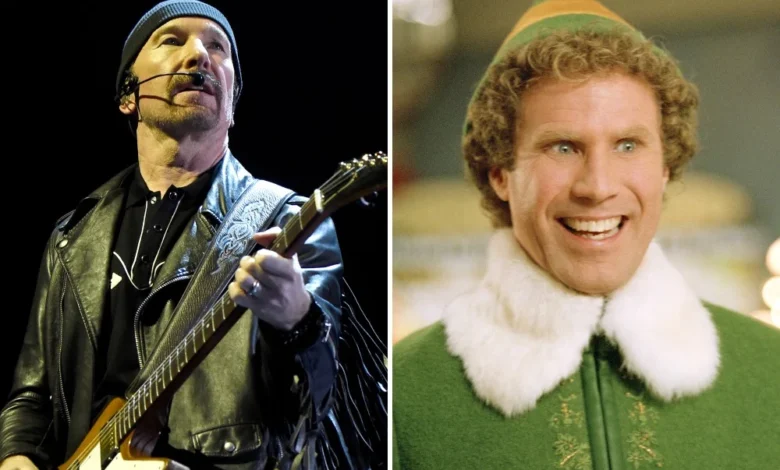
For over two decades, Jon Favreau’s 2003 holiday classic Elf has held a treasured, nearly untouchable status in the pantheon of modern cinematic comedies. Starring Will Ferrell as Buddy the Elf—a human raised by Santa’s elves who journeys to New York City to find his biological father—the film grossed over $223 million worldwide against a modest budget and quickly evolved into a seasonal fixture. Yet, despite its massive commercial and cultural footprint, attempts to develop a sequel have perpetually stalled, remaining confined to the realm of Hollywood lore.
New light has now been shed on these aborted follow-up attempts. According to actor and comedian Andy Richter, who appeared in the original film and co-wrote the newly released behind-the-scenes book Elf Unwrapped: Behind the Scenes of a Modern Christmas Classic, a completely written script for Elf 2 was once penned by an entirely unexpected source: David Howell Evans, better known as The Edge, legendary guitarist of the rock band U2.
The Revelation on Obsessed: The Podcast
The bizarre piece of cinematic trivia emerged during a recent guest appearance by Richter on the podcast Obsessed: The Podcast. During the interview, Richter detailed how Shauna Robertson, a producer on the original 2003 film, was once approached with a proposition that seemed almost too surreal to be true.
According to Richter, an intermediary reached out to Robertson with a startling message: The Edge had quietly written a complete, feature-length screenplay for an Elf sequel and was eager to discuss bringing it to the screen.
"Somebody reached out to her and said, ‘The Edge from U2 has written a sequel to Elf, and he wants to talk to you about it,’" Richter recalled during the podcast episode. "It’s the weirdest story, but apparently it was fully written. Somewhere in the world there is an Edge-penned Elf 2 out there… I would love for that to make the light of day."
Despite the rock icon’s interest, the project never gathered operational momentum. Richter noted that while Robertson entertained the idea out of professional courtesy, agreeing to a preliminary meeting, the concept ultimately dissolved into Hollywood’s vast graveyard of unproduced scripts. "It never happened," Richter said. "It’s one of those things where she’s like, ‘All right, sure, I’ll meet him,’ and then it just petered out and never happened."
The Secret Script by Scot Armstrong
The Edge’s lost manuscript was not the only attempt made to capture lightning in a bottle a second time. Richter also disclosed that screenwriter Scot Armstrong, renowned for his work on comedies such as Old School and The Hangover Part II, took a stab at writing a separate sequel script for the franchise.
Armstrong, who Richter noted had actually contributed uncredited writing to the original Elf due to guild and procedural regulations, envisioned a markedly different narrative direction for a potential follow-up. According to Richter, Armstrong’s script centered around a high-stakes premise involving "the evil South Pole elves kidnapping Santa or something like that."
Despite having established comedy writing talent attached to the project, studio executives and producers ultimately chose to leave the narrative untouched, preventing Armstrong’s script from moving into active pre-production.
The Cultural Legacy and Anatomy of a Modern Holiday Classic
To understand why multiple attempts at an Elf sequel failed to gain traction, industry analysts point to the unique lightning-in-a-bottle nature of the original production. Released on November 7, 2003, by New Line Cinema, Elf was directed by Jon Favreau from a screenplay by David Berenbaum.
The film featured a powerhouse ensemble cast, including Will Ferrell at the height of his comedic powers, the late James Caan as cynical book publisher Walter Hobbs, Zooey Deschanel as love interest Jovie, Mary Steenburgen as Emily Hobbs, and Ed Asner as Santa Claus. The narrative relied heavily on Ferrell’s earnest, physical commitment to playing an oversized man-child with unwavering holiday cheer, juxtaposed against the gritty, indifferent backdrop of Manhattan.
The movie’s enduring appeal is reflected in its financial and cultural metrics. Beyond its initial $223 million box office return, Elf regularly ranks near the top of critics’ lists of the greatest Christmas movies of all time. It spawned a successful Broadway musical adaptation, Elf: The Musical, which debuted in 2010, and a 2014 animated television special, Elf: Buddy’s Musical Christmas.
However, a live-action cinematic sequel has notoriously faced resistance from its principal creative team, most notably Will Ferrell himself. Over the years, Ferrell has repeatedly turned down lucrative offers to reprise his role as Buddy the Elf, reportedly declining a staggering $29 million payday for a potential sequel in the late 2010s.
Why Hollywood Should "Let It Stand"
For his part, Andy Richter is firmly in the camp that believes a sequel would do more harm than good to the franchise’s legacy. Reflecting on the passage of time and the film’s untouchable status 23 years after its premiere, Richter argued that continuing the story is entirely unnecessary.
"I’m on the side of ‘Let it stand,’" Richter said. "Just let Elf be Elf. You don’t have to use every part of the animal."
He elaborated on the risks inherent in legacy sequels, noting that modern audiences have witnessed numerous beloved properties tarnished by belated follow-ups that failed to capture the magic of the originals.
"Now that time has passed, the movie has become so special that I think that people, rightfully so, are loath to mess with it because we all can think of movies that have been tarnished by their sequels," Richter explained. "And this is so special and so perfect and so beloved… Why risk it?"
The Broader Implications of Unproduced Scripts
The revelation of The Edge and Scot Armstrong’s abandoned scripts offers a fascinating glimpse into the mechanics of Hollywood development, where high-profile names and experienced writers routinely generate speculative material for established intellectual property. Often, these passion projects—whether conceived by a rock star looking to break into screenwriting or a seasoned comedy scribe—serve as interesting footnotes rather than viable commercial products.
In the case of Elf, the decision to protect the integrity of the original film appears to have been the correct strategic choice, preserving the movie’s immaculate holiday reputation. As fans continue to unwrap merchandise, watch annual television broadcasts, and now explore Andy Richter’s comprehensive retrospective book, Elf Unwrapped: Behind the Scenes of a Modern Christmas Classic (released on Tuesday), the legend of Buddy the Elf remains safely isolated in the North Pole of cinematic history—untouched by the perils of Hollywood sequel culture.
Related posts: