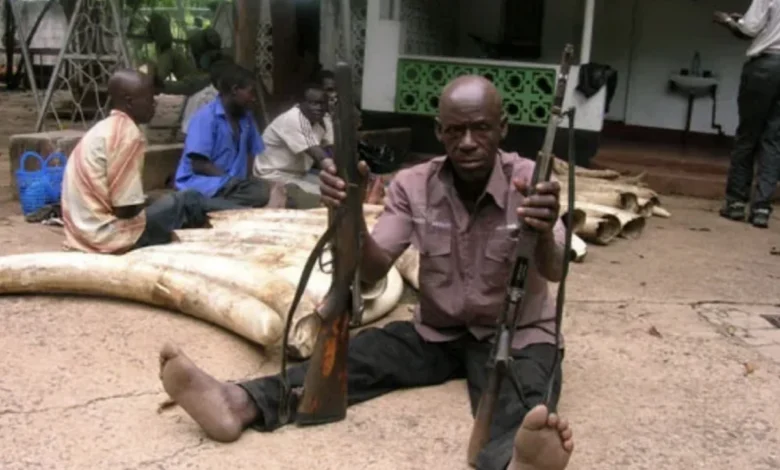
In the stark, confined reality of a Zambian correctional facility, one inmate recounts a narrative that has become a recurring motif in the fight against global wildlife trafficking. He describes a chance encounter with an intermediary—a man claiming to have connections to lucrative buyers of ivory and pangolin scales in Lusaka. Lured by the prospect of financial stability, the inmate was provided with a burner phone and a direct line to his new contact. He was promised enough capital to build a home and secure his children’s education. Today, that man sits behind bars, a small cog in a massive, multifaceted criminal machine, serving time for an elephant-related offense.
His story is far from an anomaly; it is a primary case study for a groundbreaking investigation conducted by Wildlife Crime Prevention (WCP) Zambia in partnership with Copperbelt University. The study, which surveyed 302 inmates across 32 correctional facilities, offers a rare, unflinching look at the grassroots drivers of wildlife crime. By moving beyond the headlines of international syndicates and high-level kingpins, researchers have begun to map the desperate economic conditions and opportunistic voids that pull local populations into the illicit trade.
The Anatomy of a Criminal Chain
Wildlife crime is often portrayed as a monolithic structure dominated by heavily armed militias and shadowy transnational cartels. While such entities do exist and operate with high levels of sophistication, the reality on the ground is far more fragmented. The supply chain for illegal wildlife products is a pyramid, and the base is composed of individuals who are often socio-economically marginalized.

In Zambia, a nation uniquely positioned with borders touching eight different countries, the illicit trade routes are porous. The research findings indicate that wildlife offenders represent approximately 7% of the total prison population in the country. This significant percentage reflects not only the severity of the crackdown on poaching but also the frequency with which local community members are recruited into the trade.
The legal repercussions in Zambia are severe. Depending on the species involved and the nature of the infraction, convictions for hunting in protected areas without a license can range from three to ten years. For more serious offenses, such as the possession of ivory or rhino horn, sentences can extend well beyond two decades. Despite these harsh deterrents, the cycle of crime continues, driven by a lack of alternative economic opportunities and a fundamental misunderstanding of the long-term risk-reward ratio.
Chronology and Methodology of the Study
The research initiative, led by wildlife criminologist Emma Richards, was designed to fill a critical knowledge gap. While governments and NGOs have long focused on the "enforcement" side of the equation—increasing ranger patrols, deploying drone technology, and strengthening border security—there has been a lack of focus on the "demand for participation" at the community level.
Between 2025 and 2026, the research team received authorization from the Zambia Correctional Service to conduct interviews. The team utilized open-ended, qualitative questions to encourage inmates to speak candidly about their paths to incarceration. The demographic data collected was telling: the majority of respondents were middle-aged men, with roughly half over the age of 41. Perhaps most importantly, an overwhelming majority were first-time offenders, though one-third of the respondents admitted to being involved in wildlife crimes in the past without having been caught.

The crimes themselves were diverse, spanning bushmeat hunting—often categorized as a survivalist activity—to the high-stakes trafficking of pangolin scales and elephant ivory. By categorizing these offenses, the study highlighted that "opportunity" was the primary driver for 40% of the participants. A further 16% explicitly cited existential necessity—the urgent need for medical care or food—as their catalyst for involvement.
Socio-Economic Drivers: A Lack of Safety Nets
The study paints a bleak picture of the economic environment in which these individuals operate. For many, the decision to engage in poaching is not born of a criminal mindset, but of a lack of institutional support.
"There’s no social safety net here," noted one anonymous researcher involved in the study. "You can’t go to the bank and get a loan. People generally aren’t saving up. Unless you’ve got a wealthy relative in town, there’s really not many other opportunities."
This reality explains why many of the participants were subsistence farmers whose livelihoods were at the mercy of unpredictable harvests and environmental volatility. When an unexpected expense arose—a family medical emergency or the need to pay school fees—the illicit wildlife market appeared not as a moral failing, but as a viable, albeit dangerous, financial instrument. The narrative of one inmate, who stumbled upon a pangolin while on his way to sell tomatoes in Mozambique, serves as a poignant reminder of how easily the opportunistic nature of the trade can ensnare a vulnerable individual.

Official Responses and the Challenge of Reintegration
The Zambia Correctional Service, while facilitating the study, has yet to issue a formal statement regarding the long-term policy implications of the findings. However, the data has already spurred action from organizations like WCP Zambia. Recognizing that incarceration does little to address the underlying causes of poaching, the NGO launched a six-month pilot program focused on post-release economic stability.
The program aims to bridge the gap between prison and the community. Rather than releasing individuals back into the same environment with the same lack of resources, the program facilitates contact with families and provides vocational support. "You can have somebody doing a carpentry project in prison, but if they get out and they’ve got no access to carpentry tools, what have you really achieved?" Richards asked, highlighting the futility of current rehabilitation models.
The pilot project offers equipment for agricultural pursuits and start-up assistance for small retail businesses, attempting to provide the "alternative" that was absent when the offenders first entered the trade.
Broader Implications and Future Research
The findings from the Zambia study have broader implications for how the international community approaches wildlife conservation. Meredith Gore, an environmental crime researcher at the University of Maryland, suggests that the current model for understanding wildlife crime may be fundamentally flawed. By applying standard recidivism models—often designed for urban, street-level crime—to wildlife offenses, policymakers may be missing the nuance of rural economic survival.

One of the most striking findings of the study was the lack of perceived social stigma among male offenders. For many, being convicted of a wildlife crime did not result in the same level of community ostracization as other crimes might. This suggests that in some rural Zambian communities, the line between "poacher" and "provider" is blurred, particularly when the law is viewed as distant or illegitimate.
As the authors of the study, published in the International Journal of Law, Crime and Justice, note, the research has raised more questions than it has answered. The gender dimension, for instance, remains an under-tapped field. While the study included female participants, the small sample size makes it difficult to draw broad conclusions about how women are recruited into or impacted by the wildlife trade.
Furthermore, the data suggests that relying on traditional deterrence—long prison sentences—may be ineffective if the state cannot provide a path to economic security upon release. If an offender leaves prison with no assets and no employment prospects, the risk of reoffending is not just a statistical likelihood; it is a logical response to their environment.
A Call for Humanizing Conservation
The overarching takeaway from the study is the necessity of viewing wildlife offenders with a degree of humanity, without compromising the goal of conservation. By recognizing that these individuals are often victims of systemic economic exclusion, conservationists can begin to design strategies that target the "push" factors of poaching.

As the global community continues to grapple with the extinction crisis and the decline of keystone species, the Zambian case study serves as a critical reminder that conservation is not merely a biological or ecological challenge; it is a socioeconomic one. The path to protecting Africa’s biodiversity may well run through the development of rural economies, the establishment of micro-credit systems, and the creation of vocational pathways that render the illicit wildlife trade unnecessary.
Moving forward, the researchers hope that this study will serve as a foundational document for future policy discussions. By shifting the narrative from a simplistic "good versus evil" framework to a complex, data-driven analysis of human motivation, there is a genuine opportunity to move the needle on wildlife crime in Zambia and beyond. As one researcher succinctly put it, "They’re not just a group of evil people who kill elephants." They are, in many cases, people who have reached a point where the risks of poaching are outweighed by the certainty of poverty. Addressing that balance is the true challenge for the future of conservation.