nova Imposter AT 2016blu
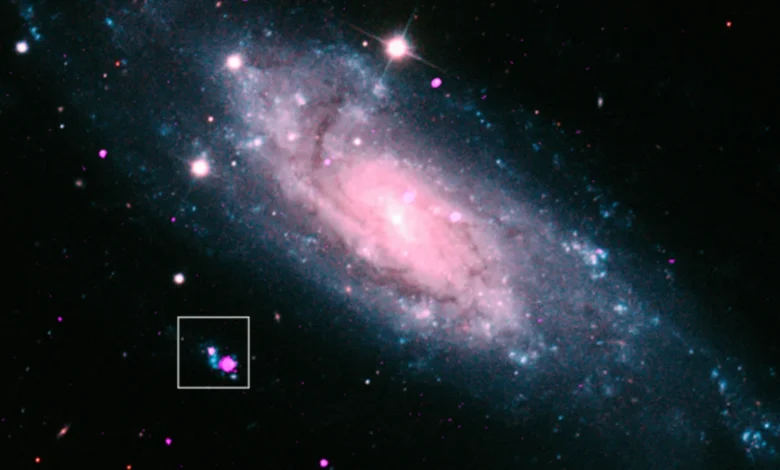
Deep in the outer boundaries of the spiral galaxy NGC 4559, located some 25 million light-years away in the constellation Coma Berenices, a stellar ghost has baffled the astronomical community for over a decade. On January 11, 2012, automated sky surveys registered a sudden, brilliant flash of light. To all outward appearances, the event possessed every hallmark of a terminal stellar cataclysm—a supernova marking the violent death of a massive star that had finally exhausted its nuclear fuel. Yet, unlike a true supernova, which obliterates its progenitor star entirely, this phantom transient refused to stay dead. Once the initial glare subsided, the star stubbornly remained, returning to life with clockwork regularity every 113 days, staging an optical repeat performance 27 times and counting.
For years, this cosmic imposter—cataloged as AT 2016blu—remained an impenetrable astrophysical enigma. It belonged to a rare and volatile classification known as luminous blue variables (LBVs), the heaviest and most brilliant stars in the universe. Because of their extreme masses and radiation pressures, LBVs are notoriously unstable, prone to coughing up massive shells of gas and dust into the surrounding interstellar medium. However, standard stellar physics could not account for how an LBV could pull off a convincing supernova impression nearly thirty times on a strict, periodic schedule.
The mystery was finally unraveled thanks to targeted observations by NASA’s Chandra X-ray Observatory. Led by a team of researchers from the University of Virginia, astronomers successfully captured the system mid-outburst, revealing that AT 2016blu is not acting alone. Instead, the hyper-luminous blue star is locked in a deadly gravitational tango with an invisible, vampiric companion: a compact stellar-mass black hole or a neutron star. This discovery not only demystifies a long-standing astronomical puzzle but also provides vital clues linking erratic stellar eruptions to ultra-luminous X-ray sources across the cosmos.
A Chronology of Confusion: From False Alarms to Targeted Breakthroughs
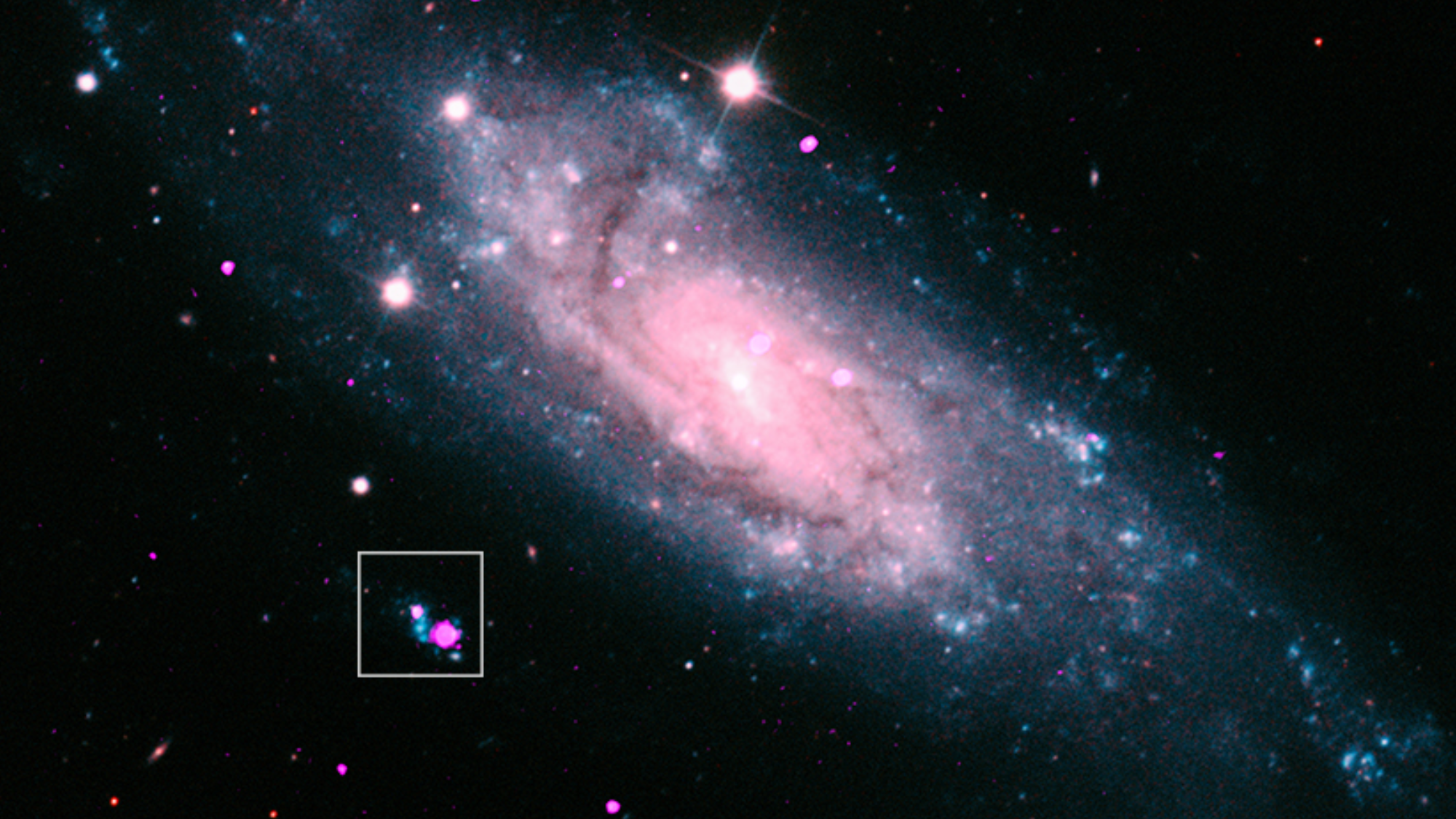
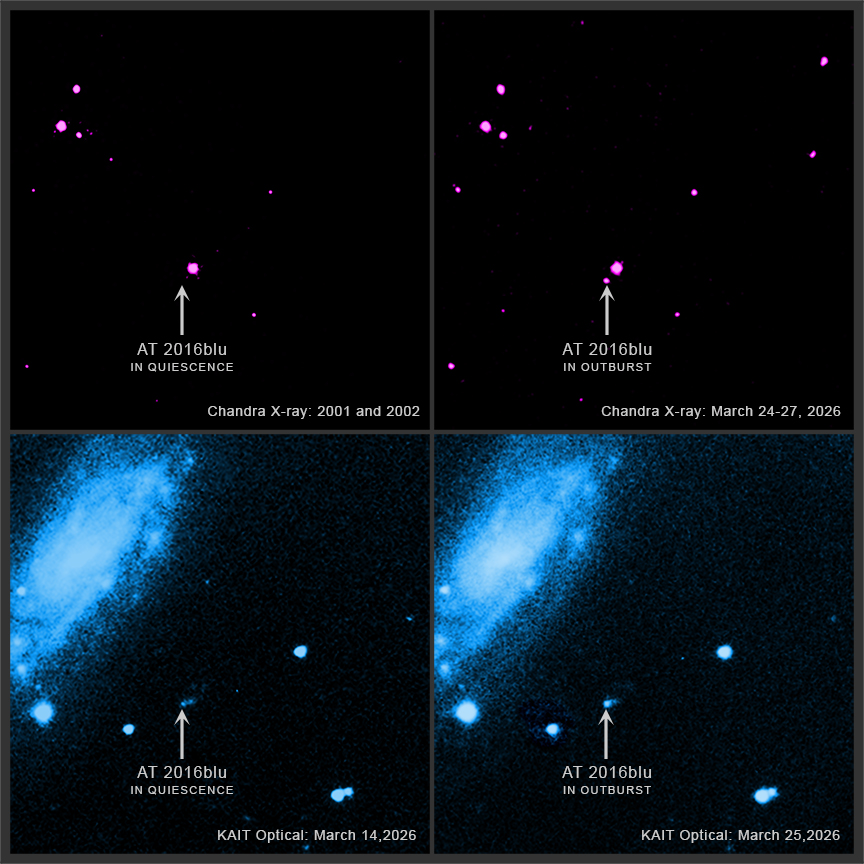
The timeline of AT 2016blu stretches back decades, though its true nature was obscured by the limitations of historical observational campaigns. Astronomers retrospectively realized that archival data from NASA’s Chandra X-ray Observatory had inadvertently captured the region containing NGC 4559 back in 2001 and 2002. During those early scans, Chandra recorded nothing out of the ordinary, registering standard background X-ray emissions without any dramatic flares.
The turning point occurred on January 11, 2012, when ground-based optical telescopes detected the sharp brightening at the outskirts of NGC 4559. Astronomers classified the transient as a supernova candidate, expecting the light curve to peak and fade into oblivion over several months. Instead, the source exhibited recurring optical outbursts on an 113-day cadence. For nearly fifteen years, researchers watched the star brighten and dim with mechanical precision, recognizing it as a "supernova imposter"—a term reserved for rare, non-terminal eruptions that mimic the luminosity of exploding stars.
Recognizing that optical monitoring alone could not pierce the dense cocoons of gas surrounding the system, lead researcher Mojgan Aghakhanloo and her team at the University of Virginia petitioned for coordinated observation time. They needed to deploy Chandra’s high-resolution X-ray optics precisely when the star entered its outburst phase. That narrow window of opportunity finally arrived in March 2026.
Unlike the quiet X-ray background of 2001 and 2002, the March 2026 observation captured an intense, highly energetic burst of X-rays that coincided perfectly with the optical brightening. This synchronized multi-wavelength detection provided the missing puzzle piece, allowing the research team to reconstruct the complex physics driving the 113-day cycle.
Anatomy of a Cosmic Vampire: Mechanics of the 113-Day Cycle
The data gathered by Chandra point to a compelling binary system architecture. AT 2016blu is composed of a primary luminous blue variable star—possessing at least 33 times the mass of our sun—and a compact, high-gravity secondary object. This companion is the dense remnant of an ancient supernova: either a neutron star or a stellar-mass black hole.
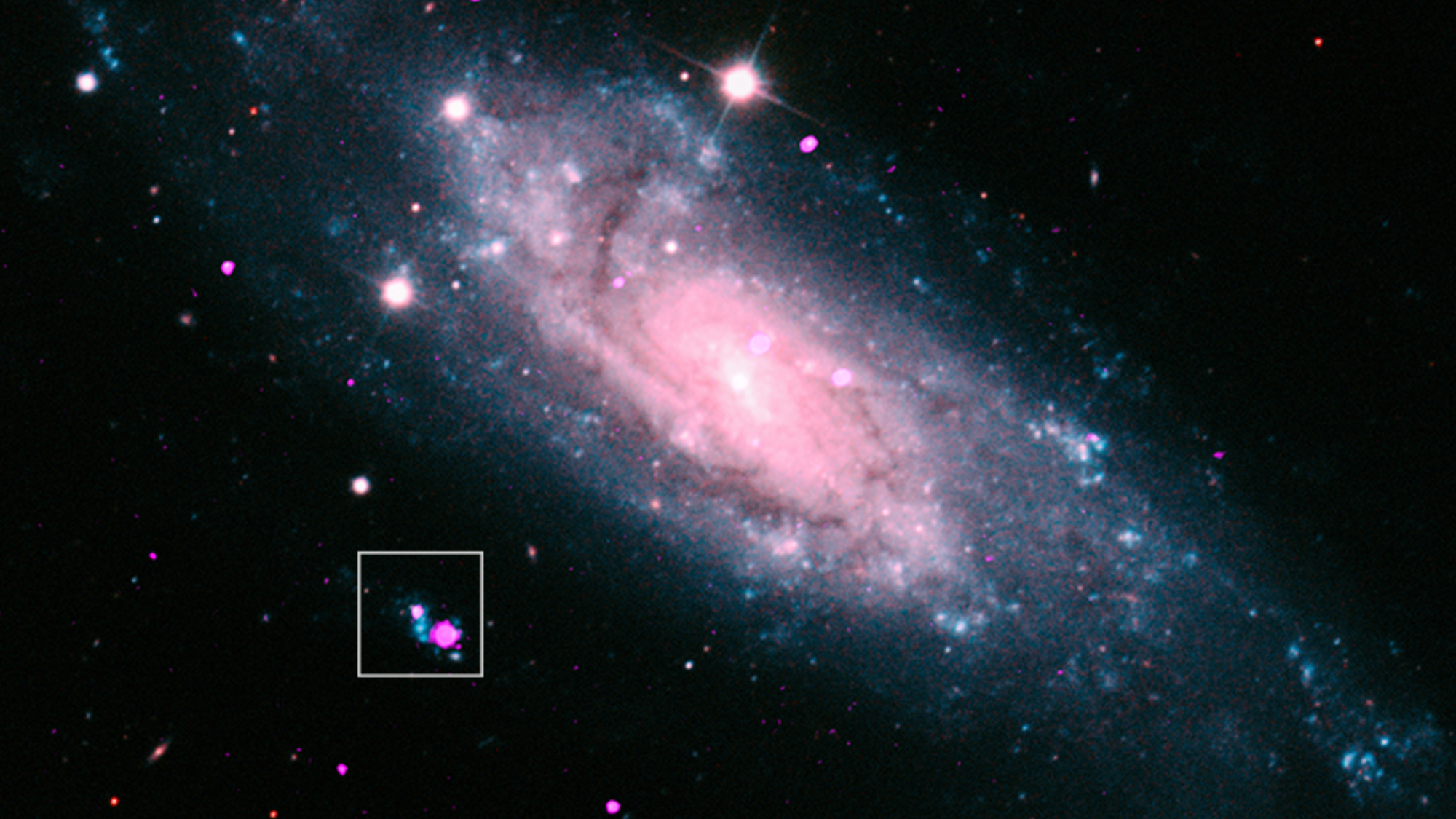
These two bodies are locked in an eccentric, elliptical orbit that brings them into close approach every 113 days. As the compact object swings past the volatile luminous blue variable at periastron, its intense gravitational field exerts immense tidal forces on the massive star. The gravity of the black hole or neutron star successfully strips away a portion of the outer stellar atmosphere, dragging the stolen material into a swirling vortex known as an accretion disk.
This captured gas spirals inward toward the compact object at phenomenal speeds, generating extreme friction and heating up to millions of degrees. The result is a powerful pulse of high-energy X-rays. This sudden flood of X-rays then slams outward into the dense, expanding shell of gas that the primary star had previously ejected into space during earlier epochs of mass loss. The surrounding cloud absorbs the X-ray energy, heats up, and fluoresces brilliantly across optical wavelengths. To observers millions of light-years away on Earth, this secondary illumination mimics the catastrophic flash of a true supernova explosion.
Astrophysical Data and the Limits of Accretion
To understand the sheer scale of the mechanics at play in AT 2016blu, astrophysicists have calculated the mass transfer rates between the two stellar bodies. Estimates indicate that during each closest approach, the compact companion steals a minimum of 440 billion trillion pounds of material from the blue variable star, with potential maximums reaching up to two orders of magnitude higher.
While this constitutes a staggering quantity of matter—translating to roughly 800 millionths of a solar mass per year—it represents only a fraction of the primary star’s total mass. Nevertheless, the rate at which gas falls onto the neutron star or black hole pushes against fundamental astrophysical boundaries. It exceeds the Eddington limit, which dictates the maximum luminosity a body can achieve when balancing inward gravitational force against outward radiation pressure. Because the compact object attempts to devour more matter than it can comfortably process, the excess energy is violently vented, driving the high-energy outbursts that characterize the system.
Implications for Ultra-Luminous X-ray Sources and Future Research
The implications of the findings on AT 2016blu extend well beyond a single bizarre star system in the Coma Berenices constellation. Researchers have noted structural similarities between AT 2016blu and ultra-luminous X-ray (ULX) sources—point-like celestial bodies that emit more X-rays than any known stellar process should comfortably allow, shining hundreds of thousands of times brighter than our sun.
For decades, the exact nature of ULXs has been a subject of intense debate among astrophysicists, with theories ranging from intermediate-mass black holes to hyper-accreting stellar-mass compact objects. Because AT 2016blu reaches luminosities high enough to qualify as a ULX during its active phases, it may serve as an observational Rosetta Stone. It bridges the gap between known supernova imposters and mysterious ULX populations, offering a rare laboratory to study super-Eddington accretion in real time.
However, caution remains warranted within the scientific community. To date, only one other supernova imposter—designated SN 2010da—has demonstrated similar X-ray emission characteristics indicative of mass transfer onto a compact body. In the case of SN 2010da, subsequent analysis revealed that the compact object’s companion is a red supergiant rather than a luminous blue variable, demonstrating that nature employs diverse pathways to produce these cosmic masquerades.
The detailed analysis of AT 2016blu, formally documented by Aghakhanloo and her colleagues, was published in The Astrophysical Journal, marking a significant milestone in stellar astrophysics. As automated sky surveys and space-based observatories continue to monitor transient phenomena with unprecedented sensitivity, astronomers expect to uncover more of these cosmic imposters, shedding further light on the violent, collaborative deaths and interactions of massive binary star systems across the universe.