Raphinha sends a message to Ballon d’Or selectors as Barcelona and PSG dominate opening Champions League fixtures

The European football landscape witnessed a seismic shift in intensity this week as the UEFA Champions League returned with a flurry of high-scoring encounters and statement performances. Among the most compelling narratives was the resurgence of Raphinha, who responded to his controversial omission from the 30-man Ballon d’Or shortlist with a blistering display in Barcelona’s 5-1 dismantling of Feyenoord at a rain-swept Camp Nou.
While the Brazilian forward’s individual brilliance commanded the headlines, the night was defined by collective tactical superiority across the continent, with Paris Saint-Germain and Stuttgart also asserting their authority in the early stages of the competition’s revamped league phase.
Raphinha’s Statement of Intent at Camp Nou
The decision to exclude Raphinha from the 2026 Ballon d’Or nominees had drawn criticism from pundits and fans alike, given his instrumental role in Barcelona’s tactical evolution under head coach Hansi Flick. On a night when the pressure was expected to be high against a disciplined Feyenoord outfit, the Brazilian international showcased the exact qualities that the selection panel seemingly overlooked.
Raphinha opened the scoring in the third minute, capitalising on a defensive lapse to finish with clinical precision. As the rain battered the pitch, Barcelona’s fluid movement overwhelmed the Eredivisie visitors. The forward added his second goal just before the hour mark, effectively ending any hopes of a Dutch comeback. With this brace, Raphinha has now tallied an astonishing eight goals in six competitive appearances this season, cementing his status as the primary catalyst in Flick’s high-pressing system.
Beyond Raphinha, the depth of Barcelona’s attacking talent was on full display. Summer signing Karim Adeyemi contributed a goal of rare quality, while academy sensation Lamine Yamal demonstrated his burgeoning maturity by expertly threading a free-kick through the Feyenoord wall. Gabriel Jesus, a recent arrival intended to add tactical versatility to the front line, needed only two minutes to find the back of the net after coming off the bench, underlining the formidable competition for places in the Catalan squad.
Hansi Flick’s Philosophy Takes Root
Hansi Flick, whose tenure at Barcelona has been marked by a return to intense, vertical football, expressed his satisfaction with the squad’s cohesion. "The most important thing is we are playing like a team, like one unit," Flick noted in the post-match press conference. "We controlled the game, we are dominant, and this is fantastic to see. This is our style and how we want to play."

The statistics support Flick’s assessment. Barcelona’s control in possession, combined with a relentless defensive transition, suggests a side that has fully internalized the German manager’s methodology. For Giovanni van Bronckhorst, the former Barcelona player now managing the Dutch side, it was a harsh homecoming. While Sem Steijn provided a consolation goal for the travelling Feyenoord contingent with a late far-post effort, the gulf in class between the two sides was evident throughout the ninety minutes.
PSG’s Clinical Efficiency in Paris
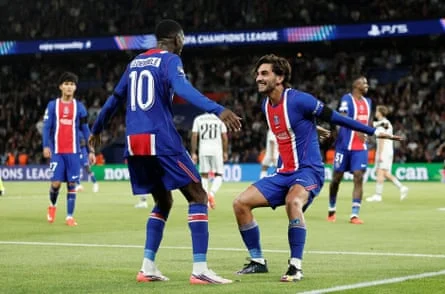
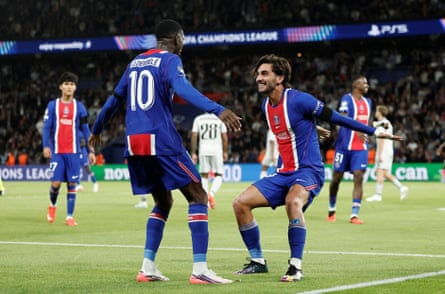
In the French capital, Paris Saint-Germain sent an emphatic warning to the rest of Europe regarding their intentions to secure a third successive Champions League crown. The Parc des Princes played host to a 6-1 thrashing of Slovan Bratislava, a match that served as a showcase for the sheer offensive firepower currently at Luis Enrique’s disposal.
The tone was set by the reigning Ballon d’Or holder, Ousmane Dembélé, who netted two goals before the midway point of the first half. His movement, combined with a devastating turn of pace, left the Slovakian champions’ backline in disarray. Dembélé then turned provider, setting up Ferran Torres for the third goal just before the interval.
Torres, who completed a high-profile switch from Barcelona to Paris this summer, was the protagonist of the second half. He added two more goals in quick succession to complete a clinical hat-trick, demonstrating his seamless transition into the PSG starting eleven. Although Suleiman Camara managed to pull a goal back for the visitors, the result was never in doubt, with Fabián Ruiz adding a sixth to round off a dominant display.
Stuttgart’s Thrilling Encounter
In Germany, Stuttgart marked their return to the top table of European football with a 3-1 victory over Viking Stavanger, a team making their maiden appearance in the competition’s league phase. The star of the evening was Ermedin Demirovic, who produced a sensational 12-minute first-half hat-trick.
Demirovic opened the scoring in the 20th minute with a clever touch at the near post. While Viking responded almost immediately through Zlatko Tripic, who finished a swift counter-attack with an impressive left-footed strike, their parity was short-lived. Demirovic restored Stuttgart’s lead just four minutes later before completing his hat-trick with a spectacular hooked volley in the 32nd minute. "For me personally, it was the perfect start, and also for the team as a whole," Demirovic remarked to DAZN, reflecting on what was a dream debut in the tournament.
Sporting CP’s Resilience in Lisbon
In Portugal, Sporting CP showcased the mental fortitude required for a deep Champions League run. Despite suffering an early setback through an own goal by Gonçalo Inácio against Galatasaray, the Lisbon outfit remained composed.
Geny Catamo capitalized on defensive hesitation to level the score in the 27th minute, providing the momentum Sporting needed to shift gears. In the second half, the experience of Luis Suárez came to the fore; the striker converted a crucial 57th-minute penalty to put Sporting in the lead. Rodrigo Zalazar ensured the points remained in Portugal with a blistering free-kick six minutes later, sealing a 3-1 victory that builds on their quarter-final run from the previous season.
Tactical Implications and Tournament Outlook
The opening round of fixtures has underscored a clear trend in modern European football: the dominance of teams with high-intensity, high-pressing structures. Barcelona, PSG, and Stuttgart all displayed a willingness to take risks in the final third, a philosophy that is becoming the hallmark of the current era of the Champions League.
The absence of Raphinha from the Ballon d’Or shortlist appears to be an outlier in a season where individual performances are being driven by a desire for continental validation. As the league phase progresses, the tactical maturity shown by teams like Barcelona and PSG—who are successfully integrating new arrivals into established systems—suggests that the tournament will be defined by squads that can maintain these levels of intensity over the coming months.
Contextual Analysis: The Road Ahead
As the competition enters its second week, the pressure on clubs to secure early points in the league phase is palpable. The revamped structure, which places a higher premium on aggregate results, means that defensive lapses, such as those seen by Feyenoord and Slovan Bratislava, will be punished far more severely than in previous iterations of the tournament.
For Barcelona, the focus now shifts to maintaining their domestic momentum alongside their European aspirations. The integration of Gabriel Jesus and the form of Raphinha provide Flick with tactical options that few other managers in Europe possess. Meanwhile, PSG’s reliance on the individual brilliance of Dembélé and Torres will be tested as they face more formidable defensive units in the coming weeks.
The performances this week provide a blueprint for what is expected to be a highly competitive campaign. With top-tier clubs like Arsenal also making strong starts—as seen in their victory over Napoli—the race to secure a top-eight finish in the league table, which guarantees automatic qualification for the knockout stages, is already intensifying. The tactical discipline exhibited by the winners of this round, combined with the offensive output of players like Demirovic and Raphinha, sets a high bar for the remainder of the tournament.
In summary, while the headlines will be dominated by the hat-tricks and the high-scoring victories, the true story of this opening week is the efficiency of the continent’s elite. Whether through Raphinha’s defiant response to his snub or PSG’s relentless pursuit of a third consecutive title, the message is clear: the Champions League remains the ultimate arena for individual and collective brilliance. As the competition progresses, the tactical flexibility of these squads will likely be the deciding factor in who eventually lifts the trophy in the final.
Related posts: