Nearly a year after the implementation of the October 2025 Israel-Hamas ceasefire agreement, the humanitarian crisis in the Gaza Strip has entered a grim new phase marked by the relentless constriction of the enclave’s internal boundaries. At the center of this unfolding tragedy is the "yellow line"—a heavily monitored partition established in the wake of the cessation of hostilities to divide Gaza into two distinct operational territories. While the western zone theoretically serves as a sanctuary for the majority of the Palestinian civilian population, the eastern zone remains under strict Israeli military control.
Initially, this demarcation granted Palestinians access to roughly 47 percent of the total land area of the Gaza Strip. However, according to recent assessments from the United Nations Office for the Coordination of Humanitarian Affairs (OCHA), a continuous and unyielding inward push by Israeli forces has drastically reduced this figure. Today, displaced Palestinians are crammed into less than 40 percent of Gaza’s territory. This spatial suffocation has triggered repeated waves of forced displacement, compounding the devastation of a population that has already endured years of intensive warfare, structural collapse, and acute shortages of basic necessities.
The Chronology of Confinement: From Ceasefire to Shrinking Borders
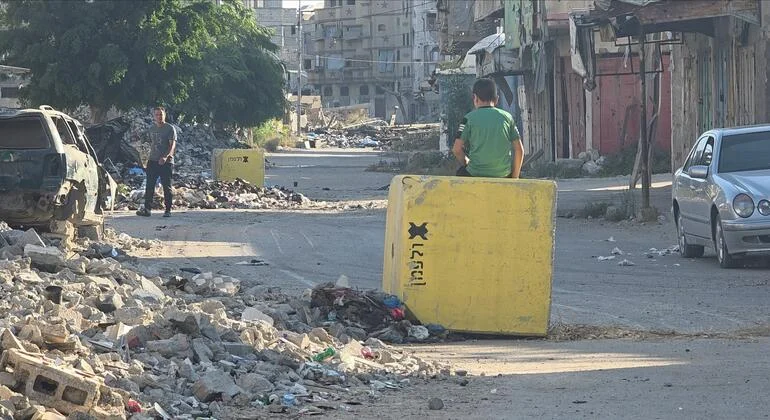
The genesis of the yellow line dates back to the diplomatic breakthroughs of October 2025, when international mediators brokered a fragile ceasefire agreement intended to halt large-scale combat operations and facilitate the entry of critical humanitarian aid. As part of the security arrangements tied to the truce, military demarcation zones were painted onto the landscape using bright yellow blocks, cutting through neighborhoods, roads, and agricultural lands in eastern Gaza City and surrounding areas.
While the ceasefire was initially hailed as a potential turning point that would allow civilians to begin the arduous process of recovery, the reality on the ground quickly deviated from diplomatic expectations. Throughout late 2025 and into 2026, OCHA reports documented a systematic shifting of these tactical boundaries. Rather than stabilizing, the yellow line has steadily drifted westward, consuming buffer zones, residential blocks, and vital infrastructure.
For families residing in frontline districts such as Al-Tuffah and Al-Zaytoun, this incremental land grab has translated into a nightmarish cycle of instability. As Israeli forces adjust their positions or conduct localized military operations near the perimeter, residents living adjacent to the yellow markers find themselves abruptly ordered to evacuate or caught in the crossfire of ongoing skirmishes, rendering long-term recovery or the establishment of stable temporary settlements virtually impossible.
A Cycle of Endless Displacement
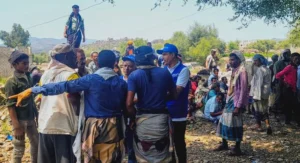
The human cost of this shrinking geographic footprint is borne overwhelmingly by civilians, nearly all of whom have been uprooted multiple times since the conflict began. According to UN estimates, approximately 2.1 million people—virtually the entire population of the Gaza Strip—remain internally displaced. Many of these individuals have gravitated toward the margins of the yellow line not out of strategic choice, but out of sheer desperation, as safe havens elsewhere in the enclave have been exhausted.
Ibtisam Malika, a resident of the heavily impacted Zeitoun neighborhood situated directly alongside the boundary markers, encapsulates the profound exhaustion of the civilian populace. "Every two to three months, we are forced to move and leave our belongings behind," she said, describing a relentless cadence of flight and abandonment. "We can’t take it anymore. We lost half of our children in the war, and only remnants of us remain."
For families living in these contested frontier zones, daily existence is defined by hyper-vigilance. The fear of an unannounced expansion of the military zone or an escalation in localized hostilities means that residents maintain a perpetual readiness to pack whatever meager belongings they possess and flee on a moment’s notice. Safaa Mushtaha, a resident of the Al-Tuffah neighborhood, noted that the existential query of where to seek refuge has become an agonizing daily ritual. "’Where do we go?’ This is a question we’ve been asking ourselves for three years," she stated. "We accepted living near the yellow line, but it’s become unbearable."
Collapsing Humanitarian Space and Infrastructure
The progressive constriction of the yellow line has severely crippled the operational capacity of international aid organizations attempting to deliver life-saving support. Finding suitable, secure land to establish planned encampments or robust humanitarian hubs has grown increasingly difficult. Much of the terrain that might otherwise accommodate such facilities lies within prohibited, restricted, or actively contested zones situated to the east, south, and north of the current military perimeter.
A comprehensive shelter assessment published by OCHA underscores the staggering scale of deprivation across the enclave. The data reveals that approximately 1.98 million people—constituting an alarming 94 percent of Gaza’s total population—are in urgent need of shelter assistance and non-food items. Furthermore, 84 percent of families are currently surviving in catastrophic conditions, relying on makeshift shelters, damaged structures, or flimsy tents that offer virtually no defense against inclement weather, extreme temperatures, or environmental hazards.
The psychological toll of this environment is particularly acute among children. Ahmed Arhim, another displaced resident from the Zeitoun neighborhood, described an atmosphere of constant tension where sleep is elusive. "We don’t sleep every night," Arhim said. "The children can’t sleep. They are scared and they wet themselves. Many residents have already left. We are displaced every day, always displaced. This is not life."
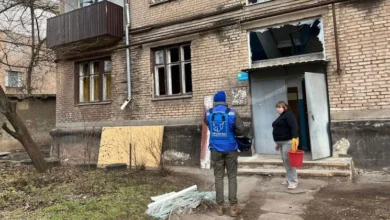
Echoing these sentiments, Ola Ishtiwi, who was interviewed by UN News while sheltering outside the skeletal remains of a bombed-out building, emphasized the absolute lack of agency and resources available to families trapped near the demarcation line. "We don’t know what to do or where to go," Ishtiwi said. "We don’t have a tent, and we don’t have money."
Persistent Violence and Official UN Condemnations
The tightening of the yellow line occurs against a backdrop of ongoing military operations that continue to claim civilian lives, despite the nominal framework of the October 2025 ceasefire. While large-scale ground invasions have largely given way to localized maneuvers and targeted air raids, the human toll remains severe.
Local health authorities in Gaza have documented 1,334 fatalities and 4,429 injuries since the ceasefire was officially announced, illustrating that the cessation of hostilities has offered little respite from daily violence. In a recent operational update, OCHA highlighted that military strikes and exchanges of fire continue to routinely pierce the relative calm of the enclave.
International human rights bodies have increasingly raised alarms regarding the legality and humanitarian consequences of these ongoing operations and the enforcement of restrictive boundaries. In a strongly worded recent statement, the UN Human Rights Office demanded an immediate halt to the ongoing violence, emphasizing that civilian populations cannot be subjected to perpetual displacement and structural neglect. The office pointed to a documented five-day spike in late August during which 24 Palestinians, including four children and a woman, were killed in Israeli military actions, with the vast majority resulting from aerial bombardment.
Implications for the Future of Gaza
The relentless contraction of the yellow line carries profound implications for any future political settlement, reconstruction efforts, and the long-term viability of the Gaza Strip as a cohesive geographic entity. As more land is effectively cordoned off under military control and the available living space for Palestinians shrinks to historic lows, the prospects for sustainable economic recovery, agricultural production, and urban planning recede further out of reach.
Humanitarian analysts warn that without a reversal of this spatial containment policy and strict adherence to international humanitarian law regarding the protection of civilians and displaced persons, the humanitarian catastrophe in Gaza will only deepen. For the millions of Palestinians currently existing in the shadow of the yellow markers, the immediate imperative remains basic survival—waiting in crowded, vulnerable encampments for an end to a cycle of displacement that shows no sign of abating.