John Malkovich Reflects on His Career-Defining Role in Martin McDonagh’s Wild Horse Nine and the Weight of Historical Trauma

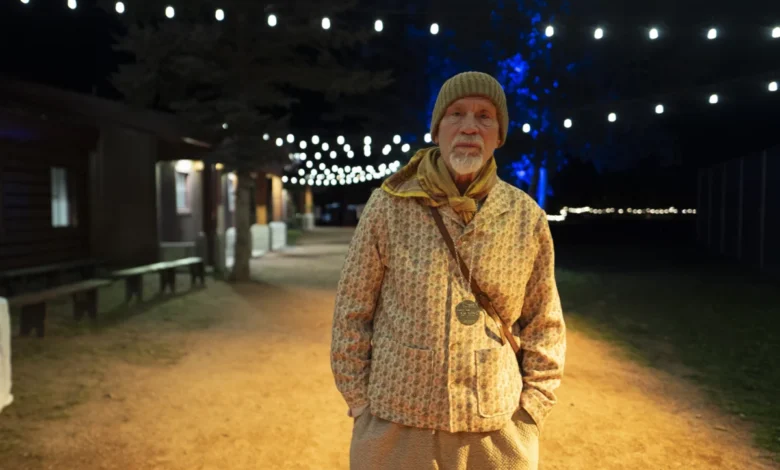
The autumn film festival circuit of 2026 has brought forward a formidable contender in the upcoming Academy Awards race with Searchlight Pictures’ Wild Horse Nine. Directed by the idiosyncratic and critically acclaimed auteur Martin McDonagh, the film has swiftly transitioned from early, private industry press screenings in Los Angeles and New York to triumphant, high-profile public debuts across international stages. Following an enthusiastic, sustained ovation at the 83rd Venice International Film Festival at the Palazzo del Casino, the production traveled west to the crisp altitudes of the Colorado Rockies for the Telluride Film Festival. There, the public response propelled veteran actor John Malkovich directly into the conversation for Best Actor at the 2027 Oscars—a prospective milestone that would mark his third career Academy Award nomination and his first in a leading category.
Malkovich’s previous Academy recognition came exclusively in the Best Supporting Actor bracket: first in 1985 for his role in Robert Benton’s rural drama Places in the Heart, and again in 1993 for Wolfgang Petersen’s presidential thriller In the Line of Fire. Following its stops in Venice and Telluride, Wild Horse Nine secured a coveted slot at the Toronto International Film Festival, building substantial momentum ahead of its commercial theatrical release scheduled for November 6, 2026.
A Collaboration Rooted in Mutual Respect
Speaking candidly from the back of a chauffeured vehicle outside the Herzog Theatre prior to receiving his Telluride career tribute, Malkovich discussed the genesis of his involvement with McDonagh. Despite having crossed paths professionally and socially within elite cinematic circles for decades, Malkovich and McDonagh had never officially collaborated.

"I was offered a couple of things of Martin’s over the years," Malkovich recalled, citing earlier opportunities that ultimately slipped away due to scheduling conflicts, including the feature film Seven Psychopaths and the Broadway play A Behanding in Spokane. "I couldn’t do it. I was busy. I love the scripts, but I couldn’t do it, and so then this came. I thought the thing was great. Beautiful piece of writing, just a perfect screenplay, and I couldn’t believe I got sent it. I couldn’t believe he asked me to do it."
With a script boasting a rich, multifaceted protagonist, Malkovich accepted the role without hesitation. The production required relocation to London for a rigorous five-to-six-day rehearsal period alongside co-star Sam Rockwell—an actor Malkovich previously crossed paths with during the production of The Hitchhiker’s Guide to the Galaxy, as well as socially. The cast also reunites Malkovich with character actor Steve Buscemi, with whom Malkovich shares screen history from the 1997 action vehicle Con Air and the 2001 dark comedy Ghost World.
The dynamic between Malkovich and Rockwell forms the emotional core of Wild Horse Nine. Rockwell portrays Lee, a character who serves as a crucial, understated anchor to Malkovich’s explosive performance as Chris, a legendary and unrestrained CIA operative with a shadowy past.
"I think he played his part," Malkovich noted regarding Rockwell’s contribution. "And the part of Lee is slightly recessive in that sense. Chris is the older one. He’s the wild card. He’s killed whatever, 168 people, but apparently none while they were eating. And he’s a legend in the CIA. Sam is an exceptionally generous actor, as generous as you could ever find, you couldn’t ask for a better partner in every way."

Unpacking Historical Trauma and American Intervention
Set against the geopolitical turbulence of 1973—with the ominous shadow of Augusto Pinochet’s impending coup in Chile looming large—Wild Horse Nine delves into the psychological toll of mid-20th-century American foreign policy. For Malkovich, whose career spans decades of cultural and political shifts, the historical setting is not merely a backdrop, but an open wound.
"November 22, 1963 is a trauma, as is September 11, 2001, and 1973 in Chile," Malkovich said, drawing parallels between domestic tragedies and international interventions. "For those of us who were alive at that time, it’s immutable. Doesn’t matter your politics then or now, or if you had any. Doesn’t matter anything."
Malkovich reflected on his theatrical adaptation of Don DeLillo’s seminal novel Libra, which he worked on directly with the author. He recalled DeLillo’s description of the era as "the seven seconds that broke the back of the American century in Chile," noting that the geopolitical fractures extended across South America, touching Argentina, Brazil, Peru, and Ecuador.
"We were bad," Malkovich acknowledged, addressing the historical reality of covert intelligence operations. "And various actors have been bad along with us, and possibly not worse, but the birthday party was spoiled. What’s left, and it caused generations of pain, of nihilism, of loss of innocence, of loss of faith in a political system. People everywhere can understand that, and Martin mines that beautifully. It’s beautifully structured in the writing and modulated in the filmmaking. So the wave is there."

Navigating Modern Discourse and the Art of Resilience
In Wild Horse Nine, Malkovich’s character Chris operates without a filter, speaking his mind with absolute impunity. It is a trait that mirrors, to some degree, Malkovich’s own philosophy on public discourse, cultural sensitivity, and the pervasive nature of modern social media.
"People appreciate that because in this culture, it’s very odd," Malkovich said, critiquing the swift backlash often mobilized by online platforms. "You say this word or that word, and the anti-social media mob goes berserk. I don’t have social media. I don’t want it designated to me in the slightest. I don’t care what they say. They can say whatever they want, and so can people who offend you. They can say whatever they want, and voila, who cares?"
Malkovich expressed open skepticism toward contemporary restrictions on language and artistic expression, viewing the climate of hypersensitivity as counterproductive to genuine human engagement. "This idea that you can’t say that because it’s offensive to this or that, and covers everything and every topic and every subject and every blah blah blah seems incredibly dumb. It’s a dumb world."
This uncompromising perspective informs much of Malkovich’s recent artistic output outside of traditional Hollywood filmmaking. He frequently tours with The Music Critic, a unique stage and short-film hybrid project that compiles the most vicious, historically inaccurate contemporary reviews leveled against the world’s most celebrated classical music compositions. By highlighting how masterworks by Bach, Beethoven, and Brahms were initially trashed by critics, Malkovich champions artistic resilience.

"So what? Get used to it," Malkovich advised. "Grow a thick skin, go on with your life, do what you think is good."
Implications for the 2027 Awards Season
As Searchlight Pictures prepares Wild Horse Nine for its wide theatrical rollout on November 6, 2026, industry analysts are positioning the film as a major player across multiple Academy categories. Beyond John Malkovich’s surging momentum in the Best Actor race, McDonagh’s screenplay and the interplay between Malkovich and Sam Rockwell are anticipated to draw heavy consideration from voting bodies.
By marrying high-stakes geopolitical history with character-driven dark comedy and dramatic tragedy, Wild Horse Nine taps into a contemporary appetite for complex, morally ambiguous storytelling. For Malkovich, whose legendary filmography includes iconic turns in Dangerous Liaisons, Being John Malkovich, and In the Line of Fire, this latest collaboration represents a masterclass in utilizing age, experience, and artistic fearlessness to anchor a cinematic landscape in transition.