President Trump Delivers Lengthy, Uneven Speech at Rescheduled White House Correspondents’ Association Dinner

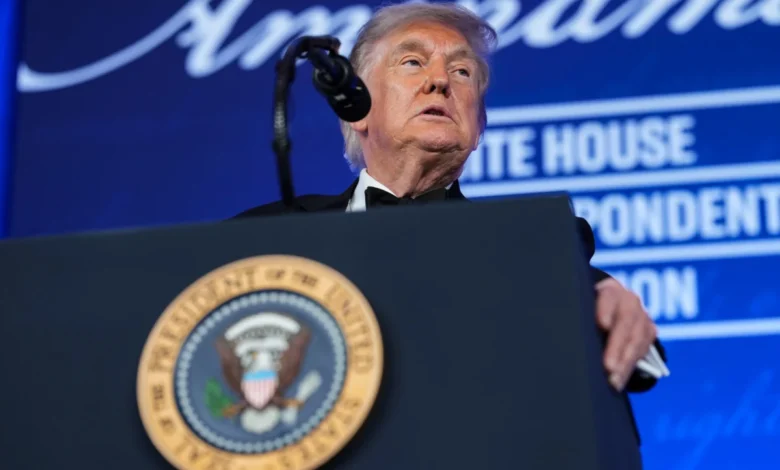
President Donald Trump addressed the White House Correspondents’ Association Dinner Friday evening, marking his first appearance at the event as president. The speech, which stretched for an hour, was characterized by a blend of familiar campaign rhetoric and a series of jokes that, according to observers, largely failed to elicit a strong audience response. The dinner itself had been rescheduled from its original April date following a security incident where an individual attempted to breach the ballroom and was apprehended by the Secret Service.
Historically, the keynote address at the White House Correspondents’ Dinner has provided a platform for presidents to engage in lighthearted, albeit sometimes pointed, banter with members of the press. However, President Trump’s address deviated significantly from this tradition, leaning heavily into what many described as "rally mode." While he did deliver some personal remarks directed at members of the media, these were often interspersed with references to their appearance and delivered with a tone that seemed to resonate more with his base than the assembled journalists and dignitaries.
One particular anecdote involving a joke about an elderly U.S. senator’s personal life was met with silence, prompting Trump to comment on the lack of reaction. "Does anybody get that? I thought that was actually great. That was actually the only thing I thought was good in this whole frickin’ stupid speech," he remarked, expressing surprise at the muted response. This moment appeared to underscore a broader challenge the president faced in connecting with the audience through his humor throughout the evening.
The speech, described by attendees as meandering, saw President Trump frequently deviating from prepared remarks, often to engage in extended monologues on various topics. The lack of laughter and discernible reactions from the audience, beyond what was described as fidgeting and squirming, suggested that many of his intended punchlines were not landing. This observation was further highlighted when the President himself seemed to acknowledge the subdued atmosphere, humorously suggesting that CBS News CEO David Ellison had informed him that the event would be renamed the "Trump White House Correspondents’ Dinner" next year, implying this would be the only way to ensure his return.
The hour-long address tested the endurance of many in attendance, with significant periods of near-silence punctuated by sporadic applause. The energy in the room appeared to shift noticeably once President Trump concluded his remarks and mentalist Oz Pearlman took the stage. A number of guests were observed departing the venue shortly after Trump’s speech, signaling a collective desire for a change in tone and content.
A Rescheduled Event Amidst Security Concerns and Political Tensions
The White House Correspondents’ Dinner has long been a fixture in Washington D.C.’s social and political calendar, serving as an annual event where the president, the press, and various public figures gather to celebrate the role of a free press. This year’s iteration, however, was overshadowed by the security incident that led to its postponement. On April 15th, an individual attempted to force entry into the ballroom of the Washington Hilton, prompting a swift response from the Secret Service. The audible sounds of the confrontation from within the ballroom led to the immediate evacuation of President Trump and Vice President Mike Pence from the dais, creating a chaotic and unsettling atmosphere that ultimately led to the early conclusion of the event.
Following the incident, President Trump encouraged the White House Correspondents’ Association (WHCA) to reschedule. The new arrangements were made for a different venue, the Waldorf-Astoria, a hotel with a history of Trump ownership and operation. The change in location also necessitated enhanced security measures.
The rescheduled dinner took place in a ballroom noted to be smaller than the original venue at the Hilton. Within the gathering, a notable presence of Trump administration officials mingled with members of the press. Among those present were Chief Legal Officer Makan Delrahim, who attended just hours after a significant development in corporate mergers; Pete Hegseth; presidential advisor Stephen Miller and his wife, Katie Miller; Secretary of Health and Human Services Robert Kennedy Jr. and his wife, Cheryl Himes; Commerce Secretary Howard Lutnick; Department of Homeland Security Secretary Markwayne Mullin; and Acting Attorney General Todd Blanche. The presence of these figures underscored the intersection of political power and media scrutiny that the event represents.
Awards and Accolades: A Moment of Tension
Prior to President Trump’s address, the evening featured the presentation of annual awards to journalists, recognizing their investigative work. The juxtaposition of these accolades with President Trump’s known adversarial relationship with many media outlets created a palpable tension. Notably, reporters from The Wall Street Journal received an award for their reporting on a letter allegedly sent by Trump to Jeffrey Epstein. Upon presenting the award, Wolf Blitzer, who was emceeing, highlighted that Trump had previously sued The Wall Street Journal for $20 billion over the story. President Trump, in turn, shook the hands of the award recipients with a gesture that appeared to convey a mix of acknowledgement and perhaps wry resignation.
Personal Attacks and Unresponsive Audiences
Once at the podium, President Trump directed personal barbs at specific journalists, including Josh Dawsey of The Wall Street Journal and CNN host Kaitlan Collins. These attacks, however, were met with what was described as a near-complete silence from the audience, indicating a lack of resonance with the intended humor. Weijia Jiang, the outgoing president of the White House Correspondents’ Association, maintained a stoic demeanor as the president’s remarks veered into what were perceived as personal digs. In response to the criticisms leveled at its journalists, CNN issued a statement during the speech, offering a defense of its reporting staff.
President Trump’s speech, while seemingly structured with prepared jokes, frequently saw him depart from the script. These digressions often led to extended discussions on familiar political themes, such as criticisms of Congressman Adam Schiff’s appearance, and elaborate descriptions of his plans for a White House ballroom. He even pointed out details on the chandeliers at the Waldorf-Astoria, referencing his own role in the building’s history. The sheer length of the speech and the breadth of topics covered may have, in some instances, diluted the impact of his more pointed criticisms of the press.
A Pattern of Estrangement and Confrontation
President Trump’s attendance at this year’s dinner marked a departure from his previous stance. During his first term and last year, he had opted to skip the WHCA dinners, sometimes holding alternative events. His agreement to attend this year placed him in the spotlight at an event that, by its nature, celebrates the very institutions and individuals he has frequently criticized. This includes reporters whose work has investigated sensitive matters, such as the aforementioned Epstein letter, which Trump has denied sending and for which he initiated legal action against The Wall Street Journal, its publisher, and Rupert Murdoch.
The relationship between President Trump and the news media has been marked by a consistent pattern of estrangement and confrontation. Beyond his public rhetoric, his administration has taken actions that have raised concerns among press freedom advocates. These include threats to revoke broadcast licenses for news networks and instances where the Justice Department has sought to subpoena reporters for their sources. Most recently, the Department of Justice announced it would withdraw subpoenas issued to New York Times reporters concerning articles about security features on the new Air Force One. This decision followed a judicial hearing where a federal judge had expressed criticism of the government’s handling of the subpoenas.
The Broader Implications for Press-Government Relations
The President’s speech and his overall engagement with the White House Correspondents’ Association Dinner carry significant implications for the ongoing dialogue between the executive branch and the press. While the WHCA aims to foster a spirit of collegiality and recognize the vital role of journalism, President Trump’s approach has consistently challenged these norms. His decision to attend and deliver a lengthy, often critical address, coupled with his administration’s actions regarding reporter subpoenas and licensing threats, paints a complex picture of the current state of press-government relations in the United States. The event, therefore, served not only as a social gathering but also as a microcosm of the broader tensions and dynamics shaping the landscape of American journalism and political discourse.
The remarks by mentalist Oz Pearlman at the conclusion of the dinner, noting President Trump’s announcement of his intention to attend next year’s event, further underscored the unusual nature of the evening. His lighthearted jest, "I thought he was going to be speaking until next year, actually," captured the sentiment of many who experienced the extended duration of the President’s address. The evening, marked by its rescheduled date, its venue’s historical ties to the President, and the President’s unique approach to the traditional keynote, offered a memorable, if largely unamusing, chapter in the long history of the White House Correspondents’ Association Dinner.