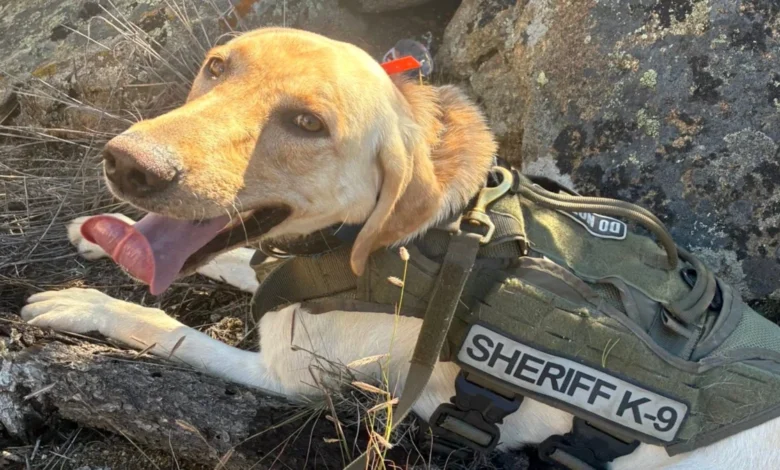
The rugged expanse of the Rocky Mountains, while breathtaking, often presents a perilous landscape for those who wander off the beaten path, particularly for children. On September 26, 2026, a routine family camping trip near the Midland Bike Trail in Buena Vista, Colorado, turned into a high-stakes search-and-rescue operation after three young children—two six-year-olds and a nine-year-old—vanished into the wilderness. While modern search efforts typically rely on the rapid deployment of aerial assets such as drones and helicopters, the resolution of this incident underscored the enduring necessity of canine olfactory capabilities. The successful recovery of the missing trio was credited to the keen instincts of a two-year-old yellow Labrador named Archie, a relatively new addition to the Chaffee County Sheriff’s Office (CCSO) canine unit.
Chronology of a Disappearance and Search
The incident began on a Saturday morning when the group of children was reported missing from their campsite. According to the official timeline provided by the Chaffee County Sheriff’s Office, the alarm was raised at approximately 9:00 A.M. after family members realized the children were no longer within the perimeter of the camp. The family initially attempted to locate the children independently, a common reaction that often complicates official search parameters by introducing a multitude of human scents into the area.
After two hours of fruitless searching, the family contacted local authorities at 11:00 A.M. The Chaffee County Sheriff’s Office immediately mobilized a multi-agency response team. The Midland Bike Trail, a popular singletrack route known for its challenging terrain and dense, mountainous vegetation, was prioritized as the primary search zone. Recognizing the urgency—especially given the children’s ages and the potential for rapid temperature fluctuations in the high-altitude environment—rescuers deployed advanced technology, including drones equipped with thermal imaging and aerial support via helicopter.
Despite the high-tech equipment, the dense canopy and rocky outcrops of the Colorado backcountry created significant "blind spots." By mid-afternoon, the search had reached a critical threshold. Deputy Kendra Hoffman, who coordinated the response, identified the need for a ground-level solution. She recalled the specific tactical decision to bring in the department’s canine unit, noting that the children’s smaller stature made them difficult to spot from the air, particularly if they had sought shelter beneath rock formations or heavy brush.
The K-9 Advantage: The Role of Archie
Archie, a two-year-old yellow Labrador, was dispatched to the command post as the search transitioned into its most critical phase. In search-and-rescue operations, the effectiveness of a K-9 unit is contingent upon the "scent article"—an item, such as a piece of clothing or a toy, that carries the specific odor of the missing individual. Handlers provided Archie with a stuffed animal belonging to one of the children to establish a scent profile.
The integration of K-9 units into search-and-rescue (SAR) is governed by strict protocols. Experts generally suggest that the success rate of scent-tracking dogs diminishes as time passes and environmental conditions—such as wind, humidity, and human contamination—degrade the scent trail. However, because Archie was deployed within a relatively short window of the disappearance, the olfactory trail remained viable.
Archie demonstrated immediate proficiency, leading his handler and a team of three deputies on a demanding trek downhill from the campsite. The terrain, characterized by sandy washes and steep inclines, tested the physical endurance of the human searchers. After traversing approximately 1.5 miles of challenging wilderness, the team discovered footprints in a sandy wash, a positive indicator that confirmed they were on the correct path. Archie successfully led the deputies directly to the location of the three children, who were found safe, roughly five hours after they were initially reported missing.
Search and Rescue Protocols in the Backcountry
The successful deployment of Archie serves as a case study for the integration of specialized K-9 units into rural law enforcement operations. Deputy Hoffman noted that this was the canine’s first on-duty search, a milestone that has significantly bolstered the department’s confidence in his capabilities. "I wanted to personally see how he could work," Hoffman explained, noting that the department now intends to utilize the canine team as a primary resource in future missing person incidents.
The implications of this rescue extend beyond the specific success of the canine unit; it highlights a broader challenge in wilderness management. When individuals—particularly children—go missing in remote areas, the initial response period is the most critical factor in survival. The presence of other searchers in the area often creates "scent contamination," which can confuse even highly trained dogs. By coordinating the search effort to keep human searchers away from the scent path until the dog has an opportunity to work, the Chaffee County Sheriff’s Office demonstrated an adherence to best practices in SAR operations.
Educational Implications and Parental Guidance
In the aftermath of the successful rescue, the Chaffee County Sheriff’s Office took the opportunity to reinforce backcountry safety protocols for families. The "hug a tree" mantra is a foundational tenet of wilderness survival training for children. It teaches youngsters that when they realize they are lost, their best chance of survival is to stop moving, stay in one place, and make themselves as visible as possible.
Sheriff’s officials emphasized that the psychological distress of being lost often leads children to hide, especially if they encounter unfamiliar individuals or loud, unfamiliar noises. Deputy Hoffman noted that children must be explicitly taught that if they see a searcher—especially those wearing high-visibility colors or uniforms—they should not remain hidden. Instead, they should actively seek assistance and clearly state that they are missing.
Furthermore, the National Park Service (NPS) and other wilderness safety organizations advocate for the "buddy system" and rigorous pre-trip planning. Parents are advised to:
- Maintain Constant Supervision: In areas with natural hazards, children should never be left to explore unmonitored.
- Pre-trip Briefings: Before heading into the backcountry, parents should discuss a "what-if" plan with their children, including identifying potential meeting points if the group becomes separated.
- Equip for the Environment: Children should carry a basic survival kit, including a whistle, which is often more effective at signaling searchers than a human voice, especially in wind-swept mountainous terrain.
- Visibility: Dressing children in bright, non-natural colors (such as neon orange or yellow) significantly increases their detectability from both ground and aerial search perspectives.
Future Outlook for SAR Operations
The rapid expansion of drone technology in the search-and-rescue sector has led some to believe that traditional methods might be phased out. However, the Chaffee County incident provides a clear counter-narrative: technology and biology must work in tandem. While drones provide a macroscopic view of the landscape and can cover large swaths of terrain in a short time, they lack the ability to penetrate dense cover or identify signs that are only detectable at the ground level.
The success of Archie underscores the necessity of maintaining a diverse toolkit for search-and-rescue teams. As the Chaffee County Sheriff’s Office looks toward future operations, the commitment to training and deploying K-9 units appears to be a permanent fixture in their tactical planning. For Archie, the two-year-old Labrador, the operation was more than just a successful training exercise; it was a testament to the specialized skills that can make the difference between a tragedy and a triumphant return.
By prioritizing the use of scent-tracking dogs alongside aerial surveillance, law enforcement agencies are better positioned to mitigate the inherent risks of the backcountry. As the popularity of wilderness recreation continues to climb, these combined methods will remain essential to ensuring the safety of those who seek to enjoy the natural beauty of the Rocky Mountains. The children involved in this incident were returned to their families unharmed, a result that highlights the value of preparedness, effective inter-agency coordination, and the quiet, specialized expertise of a four-legged K-9 officer.