Navigating airline baggage policies can often feel like deciphering a complex puzzle, with rules and costs shifting dramatically based on your destination, fare class, elite status, and credit card portfolio. For passengers flying with United Airlines, understanding these nuances is essential to avoiding unexpected expenses at the airport. Whether you are packing light for a quick weekend getaway or preparing for an extended international journey, knowing what you can bring on board—and what it will cost to check—can save you both time and money.
United Airlines operates one of the largest route networks in the world, connecting millions of passengers annually across domestic and international corridors. Over the years, legacy carriers like United have refined their ancillary fee structures to segment their passenger base, introducing ultra-restrictive basic economy fares while offering premium perks to high-value frequent flyers and co-branded credit cardholders. To master United’s baggage framework, travelers must look closely at carry-on regulations, checked bag pricing, weight thresholds, and the numerous exemptions that allow savvy flyers to bypass fees entirely.
Deconstructing United Airlines Carry-On Guidelines and Basic Economy Restrictions
Understanding what you can bring into the aircraft cabin is the first step in preparing for any flight. United Airlines permits all ticket-holders to bring one personal item on board free of charge. According to official carrier guidelines, this personal item must fit securely under the seat directly in front of you and should not exceed maximum dimensions of 9 inches by 17 inches by 10 inches. Acceptable items under this category include standard backpacks, purses, briefcases, laptop bags, and airline-approved pet carriers.
Beyond the personal item, the vast majority of passengers are also entitled to bring one full-size carry-on bag into the cabin at no additional cost. These overhead bin items must measure no more than 22 inches by 14 inches by 9 inches, dimensions that include any handles and wheels. Ensuring your suitcase complies with these measurements is critical, as gate agents frequently check oversized bags before boarding commences.
However, a major exception applies to travelers flying on United basic economy tickets. Basic economy is designed as the carrier’s lowest-cost fare option, and it comes with strict limitations. Passengers who purchase a basic economy ticket are generally restricted to bringing only a personal item into the cabin. Bringing a full-size carry-on bag to the gate on a basic economy ticket results in a penalty: travelers are forced to check the bag, pay the standard checked baggage fee for their route, and absorb an additional $25 gate handling charge.
There are limited exceptions to this basic economy restriction, primarily for active-duty military personnel, select elite MileagePlus members, and holders of specific eligible co-branded credit cards. For everyone else, attempting to sneak a full-size roller bag onto a basic economy boarding pass is a costly mistake. Furthermore, regardless of fare class, if a passenger’s carry-on bag exceeds United’s strict size limits at the gate, they will be required to check it and pay any applicable fees.
Analyzing Checked Baggage Fees Across Domestic and International Routes
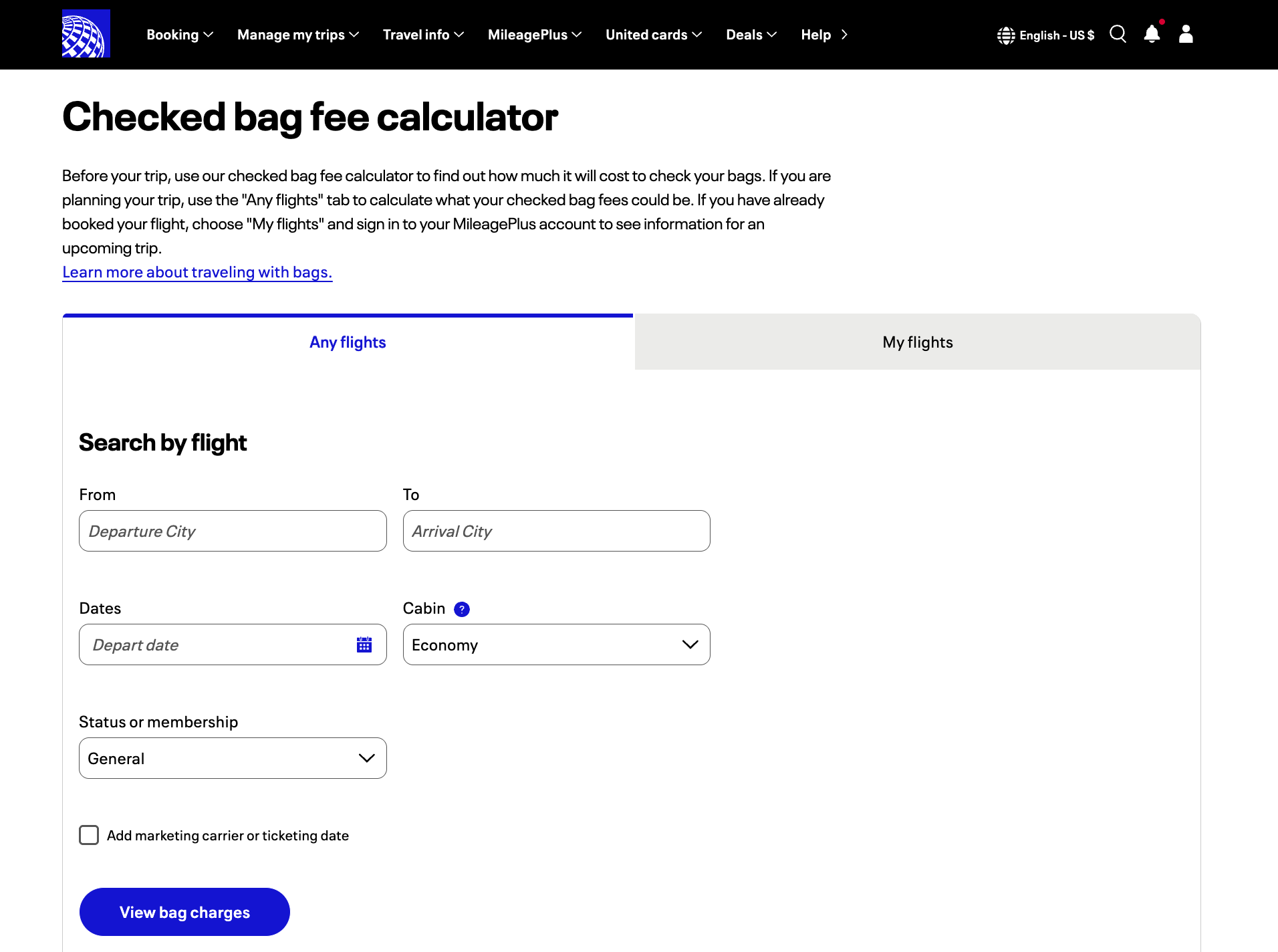
When it comes to checking bags, United Airlines determines pricing through a multi-variable matrix. Your total out-of-pocket expense depends heavily on your destination, the specific fare type you purchased, the physical weight and size of your luggage, your elite status tier within the MileagePlus loyalty program, and whether you possess an eligible co-branded credit card. Because these variables change frequently, United maintains an online baggage fee calculator on its official website, allowing travelers to plug in their specific itinerary details to receive an exact price quote before heading to the airport.
For flights operating within North America, Central America, and the Caribbean, United’s fee structure for standard economy tickets without complimentary baggage benefits is relatively transparent. To incentivize early compliance and streamline airport operations, United offers a financial incentive for prepaying baggage fees. Passengers who prepay for their checked bags online at least 24 hours before their scheduled flight departure receive a $5 discount on each of the first two checked bags.
Under this North American schedule, the cost for a first checked bag is $45 if prepaid at least 24 hours in advance, rising to $50 if paid within 24 hours of departure. The second checked bag costs $55 when prepaid and $60 closer to departure. Should a passenger require a third checked bag on a domestic or regional itinerary, the fee escalates sharply to a flat $200.
For long-haul international destinations, the pricing model grows more complex. Baggage fees for transatlantic and transpacific flights vary widely depending on the country of origin, the destination country, and the specific fare class booked. While some international economy fares include one or two checked bags in the base ticket price—particularly on routes to and from regions like Europe, Asia, and South America—other discounted international basic economy or economy saver tickets may require a fee for the first checked bag. Passengers embarking on international itineraries are strongly advised to consult the airline’s bag calculator well in advance to avoid surprises at the ticket counter.
Weight Limits, Overweight Penalties, and Oversized Baggage Policies

Packing efficiently requires careful attention to the scales. For standard economy and premium economy passengers on United Airlines, the weight limit for any checked bag is 50 pounds (or 23 kilograms). This threshold also applies to travelers holding Star Alliance Gold status or eligible co-branded credit cards unless their specific fare class dictates a higher allowance. In contrast, MileagePlus Premier members and passengers ticketed in business or first class enjoy a more generous allowance, permitted to check bags weighing up to 70 pounds (32 kilograms) without incurring overweight penalties.
When a bag exceeds these standard weight limits, hefty fees come into play. Overweight bags weighing between 51 and 70 pounds on itineraries where the 50-pound limit applies will trigger an additional fee, which varies by route. For bags weighing between 71 and 100 pounds, the fees increase substantially. United Airlines maintains a strict safety threshold: as a general rule, the carrier will not accept any checked bag weighing more than 100 pounds, with very few exceptions made for specialized assistive devices or specific musical equipment.
In addition to weight, physical dimensions matter. Oversized baggage—defined as bags with linear dimensions (length plus width plus height) exceeding standard limits—is subject to separate handling fees. Furthermore, passengers checking excess baggage beyond the standard allotment face steep penalties; for instance, a third checked bag on a domestic U.S. flight incurs a flat $200 fee, while excess baggage on international routes can cost significantly more and is frequently accepted only on a space-available basis during peak travel seasons.
Specialized Items: Traveling with Sporting Equipment and Musical Instruments
Recognizing the diverse needs of its passenger base, United Airlines maintains accommodating policies for travelers transporting specialized gear, such as sporting equipment and musical instruments. Items like skis, snowboards, hang-gliding equipment, parachutes, and golf clubs are generally accepted as checked luggage—or in some cases, as carry-ons—provided they meet specific packaging and size requirements.
For most sports equipment, United does not levy extra surcharges beyond the standard checked bag fee or applicable overweight charges, with notable exceptions such as scuba tanks, which require special handling. However, travelers should note that certain items, such as kayaks and canoes, are strictly prohibited and will not be accepted under any circumstances. Detailed guidelines for niche items can be found directly on United’s sports equipment portal, ensuring athletes and hobbyists can plan their transit without logistical failure.
Strategic Methods to Completely Avoid United Airlines Baggage Fees
Given the steep cost of checking multiple bags, frequent flyers have developed several proven strategies to bypass United’s baggage fees entirely. Understanding these loopholes and benefits can result in significant financial savings over multiple trips.
The most direct route to free checked baggage is through elite status within United’s MileagePlus loyalty program. All tiers of United elite status provide enhanced checked bag allowances for travel within the U.S. and between the U.S., Canada, Mexico, the Caribbean, and Central America. Furthermore, elite status often elevates the weight limit to 70 pounds per bag, offering a double benefit for heavy packers. Additionally, Star Alliance Gold members receive at least one complimentary first checked bag on all United-operated flights, regardless of their frequent flyer tier in a partner airline program.
For travelers who do not fly frequently enough to earn elite status, co-branded United credit cards offer an accessible shortcut. Several credit cards issued in partnership with Chase waive the first standard checked bag fee for the primary cardholder and, in some cases, a companion traveling on the same reservation. Premium cards, such as the United Club Infinite Card, extend this courtesy to cover both the first and second standard checked bags on United-operated flights.
Booking a premium cabin is another foolproof method for securing complimentary luggage allowance. Passengers ticketed in United Polaris business class, United Business, or United First are universally granted two free checked bags, each with a generous 70-pound weight limit. Similarly, travelers in United Premium Plus receive two free checked bags, though their standard weight limit remains at 50 pounds unless elevated by MileagePlus Premier status.
Finally, everyday travel rewards credit cards offer flexible workarounds through annual statement credits. Premium cards like the Chase Sapphire Reserve provide a $300 annual travel credit that can be applied directly to airline incidental purchases, including baggage fees. Similarly, the American Express Platinum Card offers up to $200 in annual airline fee credits for eligible incidental charges on a pre-selected qualifying airline, which can be designated as United Airlines. By leveraging these card perks, elite tiers, and strategic fare selections, travelers can navigate United’s baggage policies efficiently, ensuring their journeys remain as cost-effective as possible.