Consumer technology has long been characterized by escalating price tags, driven in part by ongoing global supply chain constraints, inflationary pressures, and a prolonged memory component crisis. For budget-conscious consumers looking to upgrade their digital ecosystems or simplify their daily routines, the search for affordable hardware can often feel daunting. While premium categories such as flagship smartphones, high-performance laptops, and next-generation gaming consoles inherently demand a substantial financial investment, the sub-$50 market continues to harbor a wealth of high-utility, reliable, and expertly engineered devices.
According to retail analytics and market research from late 2026, manufacturers have increasingly focused on delivering high-end features—such as active noise cancellation, fast charging protocols, and smart home automation compatibility—to entry-level price brackets. This strategic shift allows consumers to optimize their daily workflow and entertainment setups without straining their personal finances. Below is a comprehensive overview of the top-performing technological hardware available for under $50, categorized by utility, ecosystem compatibility, and overall market value.
Portable Audio Solutions
Portable Bluetooth speakers have evolved to offer impressive acoustic performance and rugged durability at a fraction of their historical cost.
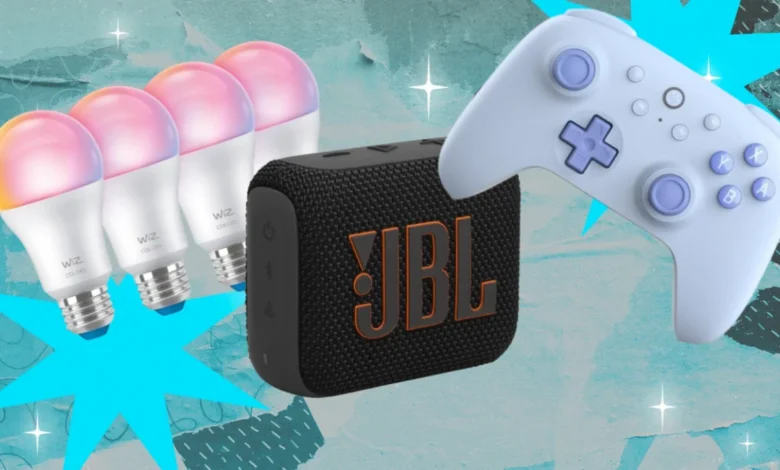
The JBL Go 4 remains a benchmark in the ultra-portable category. Retailing comfortably under the $50 threshold, it provides an IP67 dust- and water-resistant chassis, making it resilient against harsh environmental conditions. With an operational battery life reaching up to seven hours per charge, the device bridges the gap between portability and performance. Furthermore, JBL’s proprietary multi-speaker pairing technology allows users to daisy-chain compatible units via a single physical button, facilitating an expanded soundstage when multiple units are present. While newer iterations such as the Go series successors occasionally dip into this price range during promotional events, the Go 4 maintains a reliable baseline for individual acoustic needs.
For consumers prioritizing battery longevity over rugged dust resistance, the Anker Soundcore 2 presents a compelling alternative. While lacking the formal dust-ingress rating of its JBL competitor, the Soundcore 2 delivers up to 24 hours of continuous playback on a single charge and maintains robust water-resistance standards suitable for poolside environments. Its audio fidelity punches well above its weight class, establishing Anker as a dominant force in the value-driven audio sector.
Device Trackers and Ecosystem Integration
The market for Bluetooth tracking hardware has expanded rapidly, offering consumers peace of mind regarding the location of their personal belongings, luggage, and keys.
For users deeply integrated into the Apple ecosystem, the Apple AirTag remains the gold standard. Retailing at approximately $30 individually—and significantly less when purchased in multi-pack configurations—the AirTag leverages Apple’s expansive Find My network, utilizing millions of active iOS devices to anonymously relay location data. Supported by compatible iPhones and Apple Watches, features like Precision Finding utilize ultra-wideband technology to guide users step-by-step toward a misplaced item. With an easily replaceable coin-cell battery offering a one-year lifespan, the AirTag represents a low-maintenance, high-utility security investment.
Conversely, non-Apple users or households operating within mixed-platform environments can look to Life360’s Tile tracking ecosystem. The Tile lineup—encompassing the standard Tile tracker, the rugged Tile Pro, and the ultra-thin Tile Slim designed for wallets—operates independently of Apple’s network, serving Android and iOS users alike. These devices integrate seamlessly with Tile’s proprietary tracking infrastructure, offering flexible usage options with or without supplementary subscription services, all while maintaining retail price points strictly below $50.
Personal Listening Devices: Wireless and Wired Earbuds
Audio consumption on the move has diversified significantly, balancing the convenience of wireless transmission against the uncompressed fidelity and reliability of wired connections.
In the wireless sector, the Anker Soundcore P31i offers a feature set typically reserved for mid-tier devices costing twice as much. Equipped with Active Noise Cancellation (ANC), high-resolution audio drivers, and an IP55 dust and water resistance rating, these earbuds cater to commuters and fitness enthusiasts alike. They provide up to 10 hours of continuous playback, extending to a total of 50 hours when utilizing the charging case, alongside a rapid-charge feature that yields 3.5 hours of listening time from a mere 10-minute charge. Notably, the P31i also incorporates live translation capabilities across up to 100 languages, a software integration rarely found in sub-$50 hardware.
Apple-oriented consumers have traditionally gravitated toward the Beats Flex wireless earphones, which integrate Apple’s custom W1 chip for seamless device pairing and audio sharing capabilities. While standard retail pricing sits slightly above the $50 mark, persistent market discounting over recent quarters has regularly positioned the Beats Flex at or below $49, making them an accessible entry point into Apple-adjacent audio hardware with a 12-hour battery life.
For purists rejecting battery degradation and Bluetooth compression, wired solutions have experienced a resurgence. The Sennheiser CX 80U USB-C earbuds offer direct, zero-latency digital audio transmission. By eliminating internal batteries and wireless transmitters, these earbuds deliver uncompressed sound quality capable of fully realizing high-resolution, lossless streaming tracks. Available in both USB-C and traditional 3.5mm configurations, they bypass the need for digital-to-analog adapters on modern smartphones.

Similarly, Apple’s classic wired EarPods remain a staple of cost-effective audio engineering. Priced under $20, they offer reliable integrated microphone functionality, an ergonomic open-air design, and zero charging downtime, retaining steady demand among consumers seeking straightforward, no-fuss connectivity.
Home Entertainment and Gaming Hardware
Enhancing a home media center or gaming rig no longer requires a prohibitive capital expenditure, as entry-level streaming and control peripherals reach new performance plateaus.
In the streaming media sector, Amazon’s Fire TV Stick 4K Plus delivers comprehensive video and audio processing capabilities below the $50 threshold. Supporting 4K Ultra HD resolution alongside advanced high dynamic range formats including Dolby Vision, HDR10, HDR10+, and HLG, the device ensures optimal visual fidelity on modern displays. It further incorporates Wi-Fi 6 connectivity, picture-in-picture functionality, and access to cloud gaming services such as Amazon Luna, Xbox Cloud Gaming, and NVIDIA GeForce NOW, outpacing several competing platforms in raw feature density per dollar.
For interactive entertainment, the 8BitDo Ultimate 2C controller provides an ergonomic, high-performance alternative to first-party console gamepads. Designed for compatibility with Nintendo Switch systems, personal computers, and mobile devices via Bluetooth and USB connectivity, the controller integrates modern hall-effect sensor technologies and additional programmable macro triggers, mitigating the stick drift common in lower-tier third-party hardware without demanding a premium price.
Power Management and Mobile Charging Accessories
With mobile devices demanding increasingly rapid power delivery, efficient charging infrastructure has transitioned from a luxury to an essential utility.
The INIU 10,000mAh portable charger addresses mobile power anxiety by combining a high-capacity lithium-ion cell with a compact, lightweight footprint. Supporting up to 45W fast-charging protocols, it is capable of rapidly replenishing modern flagship smartphones such as the Apple iPhone 17 Pro and Samsung Galaxy S26 Ultra. Its inclusion of a durable, detachable braided USB-C cable resolves a common industry failure point seen in power banks with integrated, non-replaceable cords.
For stationary mobile charging, Anker’s 622 Magnetic Charging Stand offers MagSafe-compatible wireless power delivery for supported iPhone models. Acting simultaneously as a desktop stand and a 5,000mAh portable power bank, it allows users to maintain device visibility and operational status while charging on a desk or nightstand.
When wall outlets are accessible, the Anker 65W Max 3-Port USB-C charger block exemplifies modern gallium nitride (GaN) semiconductor efficiency. Capable of delivering a full 65W of power over a single USB-C connection—sufficient to power lightweight laptops like the MacBook Air—the block can simultaneously distribute power across three independent ports (two USB-C and one USB-A), consolidating multi-device charging into a single, pocket-sized wall brick.
Smart Home Automation and Over-the-Air Broadcasting
Expanding smart home infrastructure or modernizing legacy entertainment setups can be accomplished incrementally and economically.
WiZ smart light bulbs offer an accessible entry point into home automation without necessitating expensive proprietary bridge hubs. Retailing individually around $10, with multi-pack bundles reducing the unit cost further, these Wi-Fi-enabled LED bulbs integrate seamlessly with major smart home ecosystems, enabling color tuning, scheduled routines, and remote lighting control via smartphone applications or voice assistants.
Finally, for households seeking to bypass traditional subscription television models, modern digital TV antennas—such as indoor models offered by manufacturers like Daant—provide legal, free access to uncompressed, over-the-air high-definition broadcasts. Depending on geographical proximity to broadcast towers, users can capture major networks including NBC, CBS, ABC, and Fox in full local HD quality, serving as a viable complementary tool for cord-cutters looking to supplement streaming services with local news and live sports broadcasts.
Broader Market Implications
The proliferation of high-quality hardware under the $50 threshold reflects a broader maturation in global electronics manufacturing. As component fabrication costs stabilize and consumer demand polarizes between ultra-premium flagship devices and high-value utility hardware, manufacturers are finding robust commercial viability in the budget sector. For the consumer, this competitive landscape ensures that budgetary constraints no longer mandate an absolute sacrifice in operational reliability, build quality, or technological sophistication.