Hollywood Stars, Activists, and Lawmakers Arrested Outside UN as Benjamin Netanyahu Delivers Defiant Address

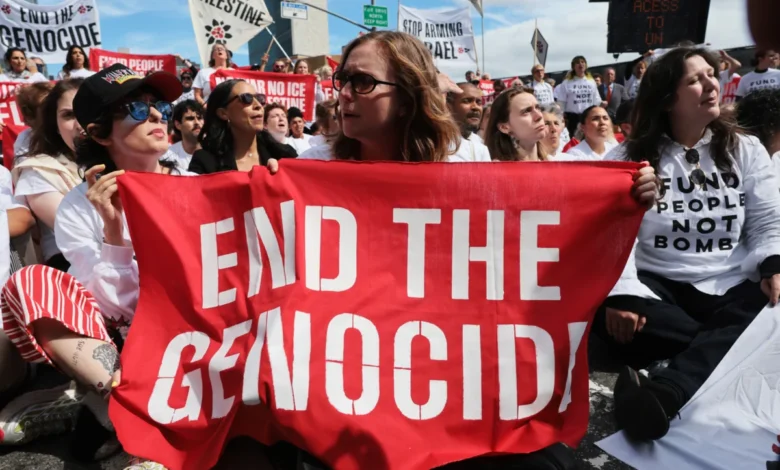
The intersection of First Avenue and 39th Street in New York City transformed into a focal point of global dissent as a high-profile coalition of celebrities, politicians, and civil rights advocates gathered to protest the arrival of Israeli Prime Minister Benjamin Netanyahu. Organized by the advocacy group Jewish Voice for Peace (JVP), the demonstration took place just blocks away from United Nations headquarters as world leaders convened for the annual General Assembly high-level debate.
The protest drew a cross-section of cultural and political figures, including acclaimed actresses Susan Sarandon and Cynthia Nixon, comedian and writer Hannah Einbinder, musicians Julien Baker and Lucy Dacus of boygenius, and actor Elliott Page. They were joined by state legislators, congressional candidates, and local officials such as New York City Councilmember Chi Osse. Many of the prominent participants intentionally sat on the asphalt of the intersection, courting arrest in a coordinated act of civil disobedience against Israel’s military campaign in the Gaza Strip.
The demonstration highlighted deep polarization surrounding the ongoing conflict in the Middle East, capturing the intersection of celebrity activism, progressive politics, and international diplomacy. While the protesters sought to amplify international findings regarding the humanitarian crisis in Gaza, the prime minister used the UN General Assembly podium to launch a blistering counter-offensive against his critics, both domestic and international.
A Coordinated Act of Civil Disobedience
Hours before Benjamin Netanyahu was scheduled to take the podium at the United Nations General Assembly, more than a hundred demonstrators occupied the intersection outside the perimeter security zone. The mood among the crowd was resolute, blending the solemnity of the cause with the familiar rituals of modern political protest. Participants wore matching apparel, chanted slogans, and hoisted banners condemning the military operations in Gaza, which international bodies and human rights organizations have increasingly scrutinized.
Among the crowd was former intelligence analyst and activist Chelsea Manning, who explained her decision to join the blockade despite its limited physical impact on the prime minister’s schedule. Wearing a tailored blue pantsuit, Manning articulated the symbolic weight of the demonstration. She noted that public dissent serves as a vital rejection of policies associated with ethnic cleansing and military occupation, providing a platform for citizens to express solidarity when institutional avenues appear closed.
As New York Police Department (NYPD) officers moved in to enforce municipal codes, the demonstration followed a well-rehearsed protocol. Detectives and patrol officers issued multiple warnings, advising those seated in the roadway that they faced misdemeanor charges for disorderly conduct and obstructing vehicular traffic. Demonstrators who chose not to disperse were systematically detained with flexible zip-ties and escorted toward waiting police transport buses.
Among those detained and led away by authorities were Susan Sarandon and Hannah Einbinder, whose arrests rapidly circulated across social media platforms, amplifying the visibility of the protest. Other participants, including indie-rock musicians Julien Baker and Lucy Dacus, emphasized a long-standing commitment to grassroots activism. Dacus noted that their involvement in political movements predates mainstream media attention, while Baker underscored the accessibility of direct action for individuals at any level of public prominence.
Chronology of the Diplomatic Showdown
The events surrounding the United Nations General Assembly address followed a tense sequence of diplomatic maneuvering and security preparations. The chronology of the day underscored the friction between international critics and the Israeli delegation:

- Morning (Prior to 10:00 AM EST): Protesters, organized by Jewish Voice for Peace, gather at First Avenue and 39th Street, blocking traffic near the United Nations perimeter.
- Mid-Day (Approx. 11:30 AM EST): NYPD begins issuing dispersal warnings as prison buses arrive to process anticipated arrests for civil disobedience. High-profile figures, including Susan Sarandon and Hannah Einbinder, are detained.
- Early Afternoon: Benjamin Netanyahu arrives under heavy security detail, bypassing the primary demonstration areas. Simultaneously, a significant contingent of UN delegates stages a walkout from the General Assembly hall in anticipation of his remarks.
- The Address: The Israeli prime minister takes the lectern, delivering a defiant speech that addresses international criticism, challenges allegations of genocide, and explicitly targets local political figures.
- Post-Address: Netanyahu prepares for an immediate departure from New York City, minimizing his duration in an environment marked by intense public opposition.
Netanyahu Defends Military Actions at the UN Podium
Inside the General Assembly hall, the atmosphere was equally contentious. As Benjamin Netanyahu approached the lectern, a substantial number of diplomats and national delegations stood up and walked out of the chamber, while others registered vocal disapproval. Undeterred by the departures, the prime minister delivered a combative address that defended Israel’s military strategy and fiercely rejected accusations of war crimes or genocide.
Netanyahu directed sharp rebukes not only at international critics but also at municipal leadership in New York City. Singling out local political dynamics, he condemned figures he viewed as sympathetic to hostile rhetoric against Israel.
"To all those who are spreading these lies, whether they sit in this hall or in the office of the antisemitic Mayor of New York, I say shame on you," Netanyahu declared during his address. He maintained that Israel’s military campaign was a necessary defense mechanism designed to ensure national survival following the October 7 attacks, asserting that the state acted to prevent further atrocities rather than commit them.
The speech immediately drew mixed reactions from international observers. While supporters praised the prime minister’s uncompromising stance on national security and counter-terrorism, critics argued that the address ignored mounting international legal scrutiny and the devastating civilian toll in the Gaza Strip.
Broader Context and Humanitarian Concerns
The demonstrations outside the United Nations reflect months of sustained advocacy and policy debates regarding the humanitarian situation in Gaza. International agencies have repeatedly reported severe shortages of food, medical supplies, and clean water, attributing the crisis to ongoing military operations and logistical bottlenecks at border crossings.
Stefanie Fox, executive director of Jewish Voice for Peace, spoke to reporters on the sidelines of the protest about the psychological and moral dissonance experienced by activists. She described the difficulty of maintaining normal routines amid reports of widespread suffering and blocked humanitarian aid trucks. For many participants, taking part in street-level demonstrations was viewed as a necessary moral imperative.
Despite the heavy police presence and sporadic friction with counter-protesters—including individuals voicing support for conservative political figures or displaying hostile messaging—the primary demonstration remained largely peaceful. The juxtaposition of high-profile entertainment figures facing arrest alongside seasoned civil rights activists underscored how the conflict in the Middle East has galvanized a diverse coalition within domestic American politics.
As Benjamin Netanyahu departed New York City immediately following his address, the broader implications of the protests and the diplomatic fallout at the United Nations remained uncertain. Analysts suggest that while such demonstrations may have a limited direct impact on foreign policy decisions, they play a critical role in shaping public discourse, maintaining pressure on elected officials, and signaling sustained domestic division over U.S. foreign policy in the Middle East.